QARs + Tables = Successful Comprehension of Math Word Problems


- Preview |
- Standards |
- Resources & Preparation |
- Instructional Plan |
- Related Resources |
- Comments
Overview
In this lesson, students apply the question-answer relationship (QAR) strategy to word problems that refer to data displayed in a table. By following the QAR framework, students can determine whether mathematical calculations are required to formulate a correct response. Students apply this learning to selected online census information comparing data collected in 1902 and 2002. In addition, they work in collaborative groups to apply and demonstrate the QAR strategy by creating their own word problems identifying the type of QAR for each question and providing an explanation for how the answer is reached.
Featured Resources
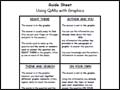 |
Guide Sheet: Using QARs With Graphics: This printout gives students a handy guide to help them analyze question-answer relationships. |
From Theory to Practice
- The QAR framework supports comprehension of a word problem that relates to a graphic or table displaying data.
- By recognizing a variety of question types, students understand that a correct response might require analysis, manipulation, or computation of numerical information rather than identification of a number within the table.
- Answering questions that relate to a graphic or table involves a complex, multistep process that includes understanding the question, determining how a response can be mathematically formulated, analyzing the graphic, and offering a response that rests upon sound mathematical principles.
- Identifying the type of QAR supports mathematical reasoning skills and expands upon successful test-taking strategies.
Common Core Standards
This resource has been aligned to the Common Core State Standards for states in which they have been adopted. If a state does not appear in the drop-down, CCSS alignments are forthcoming.
State Standards
This lesson has been aligned to standards in the following states. If a state does not appear in the drop-down, standard alignments are not currently available for that state.
NCTE/IRA National Standards for the English Language Arts
- 3. Students apply a wide range of strategies to comprehend, interpret, evaluate, and appreciate texts. They draw on their prior experience, their interactions with other readers and writers, their knowledge of word meaning and of other texts, their word identification strategies, and their understanding of textual features (e.g., sound-letter correspondence, sentence structure, context, graphics).
- 6. Students apply knowledge of language structure, language conventions (e.g., spelling and punctuation), media techniques, figurative language, and genre to create, critique, and discuss print and nonprint texts.
- 8. Students use a variety of technological and information resources (e.g., libraries, databases, computer networks, video) to gather and synthesize information and to create and communicate knowledge.
Printouts
- “Using QARs With Charts and Graphs” (The Reading Teacher, 2002)
- U.S. Census Bureau: A Century of Change
- A Century of Change Worksheet (including a Teacher’s Guide)
- Collaborative Group Worksheet: Developing QARs for a Table
- Discussion Questions Sheet
- Guide Sheet: Using QARs With Graphics
Websites
Preparation
| 1. | Familiarize yourself with the QAR strategy by consulting the article "Using QARs With Charts and Graphs," which appeared in The Reading Teacher. |
| 2. | The lesson will progress more smoothly if students are familiar with applying the QAR strategy to texts with a paragraph structure before using the strategy with tables. To assure student familiarity with the QAR strategy, reteach or review it using a short story or newspaper article. Select a text that lends itself to exploring examples of each of the four question types. |
| 3. | Duplicate the Guide Sheet: Using QARs With Graphics and the A Century of Change Worksheet for each student. Although a poster or transparency of the Guide Sheet may prove useful for class discussions, it is not essential. |
| 4. | Determine students' accessibility to computers with Internet access or arrange for the use of a computer presentation system that is connected to the Internet. |
| 5. | Bookmark or provide a live link to the U.S Census Bureau: A Century of Change and the U.S. Census Bureau: Factfinder Kids' Corner. Preview these webpages, along with the related student handouts. |
| 6. | Establish collaborative groups of three students and designate the following roles:
|
Student Objectives
Students will
- Preview tables to stimulate prior knowledge, make predictions, interact with print, and generate questions and answers about the content
- Understand that the format of a table supports comprehension of the relationship between data and the self-monitoring of responses to questions
- Practice analyzing word problems using the QAR strategy to predict a computation strategy and determine a response
- Understand that the type of question may indicate the need for different cognitive and mathematical actions
- Apply think-aloud strategies in small groups to aid in metacognition and to verbalize their thinking process
- Discuss the material with peers, monitor and correct their own work, encourage and support one another, and reinforce social skills in collaborative learning groups
Session 1
| 1. | Explain that students will be answering word problems using information from a table designed by the U.S. Census Bureau. Determine that students understand what a census is, and how, when, and why the census is taken in the United States. If you need to brush up on background information about the census, check out Census in Schools. |
| 2. | Invite students to log on to the U.S. Census Bureau: Factfinder Kids' Corner and answer the questions on the Discussion Questions Sheet. You can have each student answer all the questions or divide them up as you see fit (e.g., half of the class answers the odd-numbered questions, the rest answers the even-numbered questions). Allocate approximately 15 minutes for this portion of the session. |
| 3. | Go online to the U.S Census Bureau: A Century of Change. Discuss how data can be presented in formats other than paragraphs. Tables are among the most familiar graphic format encountered by elementary school students. Ask students the following questions to engage a class discussion:
|
| 4. | Distribute the Guide Sheet: Using QARs With Graphics. Review with students the four types of QARs, pointing out how the Guide Sheet specifically addresses how to respond to questions that relate to graphics and tables. Note: Younger or less adept readers may find it difficult to distinguish between an Author and You question and an On Your Own question. In addition, it is unusual to ask a math question that is entirely unrelated to the corresponding table or that does not have a specific multiple-choice answer. Although quite rare, On Your Own questions are sometimes used to illustrate a question where the related table provides insufficient information to formulate an answer. |
| 5. | Distribute the A Century of Change Worksheet. Ask students to read the questions, identify the type of QAR, and formulate an answer and explanation. Collect the worksheets at the end of the session. |
Session 2
| 1. | Redistribute the completed copies of the A Century of Change Worksheet. Discuss each of the five questions, emphasizing the type of QAR identified and how that type of question influences how the answer is formulated. |
| 2. | Log on to the Internet and access the U.S. Census Bureau: A Century of Change. Place students in collaborative groups of three students per workstation. Designate one student as the Recorder, one as the QAR Checker, and one as the Timekeeper. Each member of the group has a specific task.
|
| 3. | Distribute the Collaborative Group Worksheet: Developing QARs for a Table and ask each group to develop two word problems or questions that relate to the online census table. To encourage question complexity and variety, and to ensure the use of data from the table, ask students to write at least one question that is either a "Think and Search" or an "Author and You." In addition to writing questions, students should write an explanation for why each question represents the QAR indicated and how the correct answer is reached. |
| 4. | Circulate among the groups as students' work and monitor their progress. Assist students as needed to allow each group to complete the task as described. |
Extensions
- Students write a guidebook with information on how to read a table or graph. The Create a Graph website provides excellent information on each type of graph. As part of the guidebook document, students might label the various parts of a table or graph, write a statement as to why each type of graph is useful, and explain how the information is presented in each graph.
- Have students visit the U.S. Census Bureau: Factfinder Kids' Corner and take a quiz about the census. Students might also explore the section that describes the census data collected for the state in which they live.
- Invite students to use the Create a Graph website to develop a bar, line, area, or pie chart for information found in a table. After creating the chart, they should write a brief explanation for why they selected the type of chart that they did and how it is being used to present the information. For further practice with the QAR strategy, they can also write two questions and identify the QAR for each.
- Students write a series of questions that relate to a specific table found in a social studies or math textbook. Alternatively, they can develop posters, bulletin boards, or small books that present a series of questions that relate to several different tables on a single topic.
Student Assessment / Reflections
- At the end of Session 2, collect and review the word problems created by students in their collaborative groups. Provide feedback to those groups that had difficulty writing the questions, identifying the QAR type, or clarifying their explanation for the answer.
- Share the student-created word problems with the class, as you deem appropriate. Suggestions for this assessment include duplicating the questions for whole-class discussion, integrating the questions into math or social studies class as "Problem of the Day" or discussion starters, compiling the questions into a booklet for individual work, or posting a copy of the questions on the bulletin board for students to solve independently.
- Ask students to use their journal to reflect on the QAR process and how this strategy can be used to help them answer questions that relate to tables or graphics.
- Ask students to find a table from the Internet, their textbooks, or a newspaper article and create a series of questions that relate to the table, in addition to identifying the QAR and providing the answer for each question.
I love how thinking about these questions help me to plan out my lessons. The list of questions for each type help me to structure my lesson so that students are able to answer those questions. It seems like many of my elementary teachers knew about this strategy...but it is new to me in high school. I also love to use KWL when I can. So it is nice to add another tool. Excited to share it with the other teachers (high school and middle school)
I love how thinking about these questions help me to plan out my lessons. The list of questions for each type help me to structure my lesson so that students are able to answer those questions. It seems like many of my elementary teachers knew about this strategy...but it is new to me in high school. I also love to use KWL when I can. So it is nice to add another tool. Excited to share it with the other teachers (high school and middle school)
I love how thinking about these questions help me to plan out my lessons. The list of questions for each type help me to structure my lesson so that students are able to answer those questions. It seems like many of my elementary teachers knew about this strategy...but it is new to me in high school. I also love to use KWL when I can. So it is nice to add another tool. Excited to share it with the other teachers (high school and middle school)
Add new comment