The Frog Beyond the Fairy Tale Character: Searching Informational Texts

- Preview |
- Standards |
- Resources & Preparation |
- Instructional Plan |
- Related Resources |
- Comments
Overview
Are frogs found on every continent? Will frogs drown if they don't find land on which to rest? How long do frogs live? Students will find out in this lesson in which they examine their prior knowledge about frogs, make predictions, and verify their predictions through research on the Internet. Students initially record their predictions about frogs on a worksheet with true and false columns. They then use the website The Somewhat Amusing World of Frogs to learn more about frogs and check their predictions. To verify their predictions, students click on the internal page links to reach a subheading. The subheading signals to the reader that this section of informational text contains evidence to support or contradict the statement.
Featured Resources
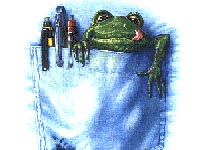 |
The Somewhat Amusing World of Frogs: A website filled with fun facts about frogs from all over the world. Students can use what they learn on this website to get a better understanding of frogs used in fiction. |
From Theory to Practice
- Primary-grade students need increased exposure to nonfiction if they are to appreciate both fiction and nonfiction texts, and informational texts are to become a gateway to increased literacy activities.
- Informational texts present readers with distinctly different text structures and features than those of narrative texts. Primary-grade students must build an understanding of the conventions of informational texts and develop comprehension strategies to assist learning.
- Prediction is based upon prior knowledge about a topic; thus, future learning from informational texts is influenced by the students' knowledge of the world, which can be supplemented by reading nonfiction.
Common Core Standards
This resource has been aligned to the Common Core State Standards for states in which they have been adopted. If a state does not appear in the drop-down, CCSS alignments are forthcoming.
State Standards
This lesson has been aligned to standards in the following states. If a state does not appear in the drop-down, standard alignments are not currently available for that state.
NCTE/IRA National Standards for the English Language Arts
- 1. Students read a wide range of print and nonprint texts to build an understanding of texts, of themselves, and of the cultures of the United States and the world; to acquire new information; to respond to the needs and demands of society and the workplace; and for personal fulfillment. Among these texts are fiction and nonfiction, classic and contemporary works.
- 3. Students apply a wide range of strategies to comprehend, interpret, evaluate, and appreciate texts. They draw on their prior experience, their interactions with other readers and writers, their knowledge of word meaning and of other texts, their word identification strategies, and their understanding of textual features (e.g., sound-letter correspondence, sentence structure, context, graphics).
- 8. Students use a variety of technological and information resources (e.g., libraries, databases, computer networks, video) to gather and synthesize information and to create and communicate knowledge.
Materials and Technology
- One computer with Internet access and projection capability (for instructor)
- Computers with Internet access (for students)
- Large paper or poster to record student responses
- Markers
Printouts
- What Do You Know About Frogs? worksheet
Websites
Preparation
| 1. | Determine student accessibility to workstations with Internet connections or secure the use of a presentation system connected to a computer that accesses the Internet. |
| 2. | Bookmark the website and preview the site using the What Do You Know About Frogs? worksheet. |
| 3. |
Duplicate the worksheet for each student. |
Student Objectives
Students will
- Predict the veracity of a statement based on prior knowledge of scientific facts
- Establish a purpose for reading electronic informational texts to verify predictions and connect new information with prior knowledge
- Use a keyword strategy adapted for hypertext conventions to locate information in electronic texts
- Use the conventions of electronic text and acknowledge its unique text-structure clues
Instruction & Activities
| 1. | Explain to students that they will be conducting research about frogs using information from an Internet site. This information will be added to what they already know about frogs. |
| 2. | Give students one to two minutes to reflect upon their knowledge of frogs. Ask them to think of specific facts that they can state aloud. Then ask students to indicate how much they know about frogs by raising one, two, three, or four fingers: Say: If you know a little bit about frogs–one or two facts–raise one finger. If you know more than a little about frogs–about five facts–raise two fingers. If you know quite a bit about frogs–more than five facts–raise three fingers. If you consider yourself an "expert" on frogs, raise four fingers. This process allows students to recall and evaluate what they already know about frogs, and it provides the teacher with a quick student self-assessment. Suggest to students that before reading about a topic (e.g., frogs), it is often helpful to think about what you already know about that topic. |
| 3. | Distribute a What Do You Know About Frogs? worksheet to each student and read the directions aloud. Make sure that students understand how to mark the statements as true or false. |
| 4. | Read each statement on the worksheet aloud or select a competent reader to read each statement aloud. Many of the statements contain vocabulary words that are designed to review content-area material (e.g., continent, millimeters, pitch, average). After each statement is read and the meaning is clear, instruct students to put an X in either the true or false column based upon what they already know about frogs. Remind students that although their prediction is based upon what they already know about frogs, they will be checking their hypothesis with information from the Internet. Check the students' work as the statements are read to be certain that they are placing only one X by each statement. |
| 5. | Move to the area where students will access the Internet or where the presentation system is located. Display the website The Somewhat Amusing World of Frogs. Point out and demonstrate the two features that students will use during the lesson: the scroll bar at the far right and the small navigation bar located directly below the frog peeking out of the pocket. By clicking on each of the links (i.e., finding, frogs v. toads, size, sight, environment, legs, mouth, food, colour, defence, tadpoles, man, more, late news, email), students can see how the scroll bar moves down the page and new information appears. Allow students to practice clicking on the links to help them become familiar with the process. At this time, you may also mention to your students the alternate spelling of "colour" and "defence"–this site is located in Australia. |
| 6. | Use the term in the Web clue column to select the subheading for the first statement. The Web clue "finding" corresponds to the word "finding" on the navigation bar. Ask students to locate a statement in this section of the webpage that supports or contradicts the statement on the worksheet. Ask the students to point to the information on the screen as they locate it. When most students have found the statement, ask someone to read it aloud. Is the worksheet statement true or false? Ask students if they correctly predicted whether it was true or false. Explore what led some of the students to a correct response. Encourage explanations other than "I just knew that already" to better explicate the knowledge and thinking that went into the prediction. For example, a student might say that the statement mentions all continents. Some continents are snow-covered. Frogs don't like cold weather, so they probably don't live on all of the continents of the world. |
| 7. | To indicate the correct response, direct students to put a circle in the true or false column, circling the X if they predicted correctly or placing a circle in the empty column if they predicted incorrectly. This exercise allows students to keep track of their errors and confirm which of their responses were correct. Emphasize the importance of verifying the information on the worksheet rather than counting the number of correct and incorrect predictions. |
| 8. | After the eight statements have been discussed, students can close the Web browser and an assessment component can begin. |
Extensions
Interested in more frog fun?
- Students develop additional statements for the worksheet, giving the Web clue as well as the correct response.
- Students select one of the eight statements to further research using print and other resources. They can be instructed to write a paragraph that expands upon the statement provided on the worksheet.
- Students color an illustration from the Color Me Frog! website. You may also ask them to write a brief report on that frog.
Student Assessment / Reflections
It is important to recognize that accuracy of the worksheet predictions does not constitute the assessment since predictions are not to be regarded as final responses for evaluation.
- Teacher observation of student proficiency with the browser's scroll bar and navigation bar will offer a view of the students' hands-on facility with the technology. To assist with this learning, the teacher may want to seat a less proficient child near a more accomplished peer or have students work in pairs.
- Ask students what they learned about finding information on the Web. Using large newsprint or poster board, label the sheet "Clues for Reading Informational Texts" and record all responses. Responses might include
- The text was divided into sections with different headings (like a table of contents).
- Dots (bullets) and space separated one idea from the next (paragraphing conventions).
- Matching the word in the Web clue column with the one in the navigation bar helped to locate the correct heading and section of informational text (informational text is divided into sections with headings).
- Matching a phrase in the statement to a phrase in the informational text helped to pinpoint the information (repetition of key content-area terminology).
- Linking what they know about a topic to the new information helped them to understand the new information (accessing prior knowledge to support learning).
- Pictures can provide information as well as text (acknowledging the importance of graphics).
- The text was divided into sections with different headings (like a table of contents).
Posting these responses provides a useful visual reference for students who are reading informational texts independently or in small groups. It lists what they have already discovered about the organization of nonfiction texts. It also suggests some convention hallmarks to use when searching for information in nonfiction texts.
Worksheet Answer Key:
|
Statement |
True |
False |
Web Clue |
|
|
1. |
Frogs are found on every continent in the world. |
|
X |
finding |
| 2. |
Frogs tend to jump; toads tend to walk. |
X |
frogs v. toads |
|
| 3. |
Frogs can range in size from 20 mm to 500 mm, but most are between 20 mm and 80 mm. |
X |
size |
|
| 4. |
Frogs will drown if they don't find land so they can rest. |
X |
environment |
|
|
5. |
Some frogs have adhesive pads on their toes to allow them to cling to plants. |
X |
legs |
|
| 6. |
The larger the frog the higher in pitch the croak is. |
X |
mouth |
|
| 7. |
All frogs are green. |
X |
colour |
|
|
8. |
Frogs live an average of 4 to 15 years. |
X |
defence |
I'd be pleased if i can access to other related websites...
thanks
I'd be pleased if i can access to other related websites...
thanks
I'd be pleased if i can access to other related websites...
thanks
Add new comment