http://www.readwritethink.org/classroom-resources/calendar-activities/dictionary-author-noah-webster-20312.html
Contribute to ReadWriteThink / RSS / FAQs / Site Demonstrations / Contact Us
![]()
![]()
What’s Happening This Week

There is much more to explore in our calendar. Find other important events in literary history, authors' birthdays, and a variety of holidays, each with related lessons and resources.
![]()

Looking for age-appropriate book recommendations, author interviews, and fun activity ideas? Check out our podcasts.
![]()
Home › Classroom Resources › Calendar Activities
October 16
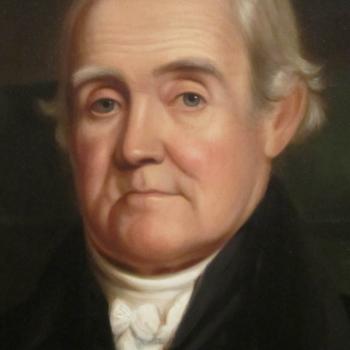
Dictionary author Noah Webster was born in 1758.
![]()
![]()
| Grades | 3 – 12 |
| Calendar Activity Type | Historical Figure & Event |
Noah Webster, called the father of the American dictionary, was born on October 16, 1758, in Connecticut. Believing that American students should not have to use British textbooks, he wrote A Grammatical Institute of English Language, which became the main source for spelling and grammar in the United States. He then began work on the first American dictionary, An American Dictionary of the English Language, which contained nearly 70,000 words by the time it was completed in 1828.
To celebrate Webster's birthday, try this variation of the popular board game Balderdash:
- Divide your class into groups of five or six. You will need one dictionary per group and a stack of blank paper cut into strips of about two inches each.
- One student in the group quickly scans through the pages in the dictionary and identifies a word that he or she believes no one has ever heard before. That student reads the word aloud and spells it. The other students in the group write down a definition for the word, either the real definition or a made-up definition that might fool others into thinking it is the real definition.
- The student with the dictionary writes the real definition on a slip of paper and then collects all the slips from the group. The student then reads each of the definitions created by others in the group, as well as the real definition.
- The students in the group then individually choose which of the definitions they believe is real. Points are awarded as follows: two points if you select the correct definition and one point for each time that someone else selects the definition that you wrote.
- Points are totaled and the next person in the circle selects a word from the dictionary. The game can continue for as long as you like.
- The Noah Webster House & West Hartford Historical Society
This website offers a brief biography of Webster and his views on various political and educational topics.
- Merriam-Webster Online
The online version includes audio pronunciations, thesaurus, Word of the Day, and word games.
- Little Explorers English Picture Dictionary
This online dictionary includes illustrations, and is an excellent resource for K–3 readers.
Grades K – 2 | Lesson Plan | Standard Lesson
Blast Off! Vocabulary Instruction Using a Virtual Moon Trip
3, 2, 1... Blast off! Students learn new vocabulary by taking a virtual field trip to the moon, read-alouds, creating a picture dictionary, and completing a final writing activity.
Grades 6 – 8 | Lesson Plan | Recurring Lesson
Using a Word Journal to Create a Personal Dictionary
Students will be the definition of vocabulary experts as they use the skills they learn in this lesson to track, define, and ultimately master unfamiliar words.
Grades K – 2 | Lesson Plan | Standard Lesson
Our Community: Creating ABC Books as Assessment
Students create alphabet books, which are used as an integrated assessment with science, health, social studies, and any other content area. This lesson plans looks at the theme of community.
Grades 6 – 8 | Lesson Plan | Standard Lesson
Building Vocabulary: Making Multigenre Glossaries Based on Student Inquiry
Students choose unfamiliar words from their reading and create a multigenre, multimodal glossary of terms.
Grades 3 – 5 | Lesson Plan | Standard Lesson
Rooting Out Meaning: Morpheme Match-Ups in the Primary Grades
In this lesson, students use morphemesEnglish words that have been formed by combining common word partsto explore word meanings.
Grades 6 – 8 | Lesson Plan | Standard Lesson
Internalization of Vocabulary Through the Use of a Word Map
Students practice with words and develop both definitional and contextual knowledge through two agents—purposeful sequencing of steps and collaboration with peers.
Grades 3 – 5 | Lesson Plan | Recurring Lesson
My World of Words: Building Vocabulary Lists
Working in small groups, students select vocabulary words and research their meanings. In a culminating activity that uses text and illustration, each student creates a "My World of Words Journal."
Grades 7 – 12 | Lesson Plan | Standard Lesson
Picture This: Student Created Online Vocabulary Flashcards
Let the students be the vocabulary experts! Prior to whole class instruction, students create online flashcards and teach the class the new vocabulary.
![]()

