Audience & Purpose: Evaluating Disney's Changes to the Hercules Myth

- Preview |
- Standards |
- Resources & Preparation |
- Instructional Plan |
- Related Resources |
- Comments
Overview
In this lesson students evaluate the changes Disney made to the myth of "Hercules." By creating a plot diagram of the “real” myth, students hone in on critical differences. They then document these changes in a Venn diagram and discuss the role of audience and purpose in Disney's decisions through the Think-Pair-Share strategy. Finally, students evaluate the changes for themselves in a summary and critique writing activity.
This lesson uses the Disney film Hercules as a model, but can be adapted for use with any film with a companion written mythical version. See the Films Based on Written Myths handout for more suggestions.
Featured Resources
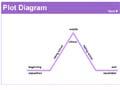 |
Plot Diagram: Students use this interactive tool to document the elements of plot in the myth of Hercules. |
 |
Venn Diagram: Students use this interactive tool to compare the Disney animated film version of the Hercules myth with the real myth. |
From Theory to Practice
Today’s students must become critical consumers of the media that surrounds them. As Fuller (1996) explains, consumers of media “tend to suspend disbelief when experiencing media, doubts arising only when first-hand knowledge contradicts media messages.” He continues that media educators “see a widespread need to teach present and future generations how to employ knowledgeably and critically the many media that inform our cultural environment” (62).
In this lesson, students are exposed to the fact that media producers, including trusted sources such as Disney, will make changes based on purpose and audience; students learn to evaluate the media that surrounds them as opposed to accepting it as fact. As students employ the Think-Pair-Share conversation strategy, they argue and wrestle with the changes to the myth in an authentic learning community. Since there are no “right” or “wrong” answers, students then reflect on their conversations with a summary and critique that is derived from their own new complex understanding of a piece of non-print media.
Further Reading
Common Core Standards
This resource has been aligned to the Common Core State Standards for states in which they have been adopted. If a state does not appear in the drop-down, CCSS alignments are forthcoming.
State Standards
This lesson has been aligned to standards in the following states. If a state does not appear in the drop-down, standard alignments are not currently available for that state.
NCTE/IRA National Standards for the English Language Arts
- 1. Students read a wide range of print and nonprint texts to build an understanding of texts, of themselves, and of the cultures of the United States and the world; to acquire new information; to respond to the needs and demands of society and the workplace; and for personal fulfillment. Among these texts are fiction and nonfiction, classic and contemporary works.
- 4. Students adjust their use of spoken, written, and visual language (e.g., conventions, style, vocabulary) to communicate effectively with a variety of audiences and for different purposes.
- 6. Students apply knowledge of language structure, language conventions (e.g., spelling and punctuation), media techniques, figurative language, and genre to create, critique, and discuss print and nonprint texts.
Materials and Technology
- Using the Think-Pair-Share Technique (Strategy Guide)
Printouts
Websites
This well-known Internet movie site provides a synopsis of Disney’s Hercules for the teacher’s reference. Due to ad content, this site should be used for teacher background only.
This site includes the story of "Hercules" along with classical Greek images to accompany the myth. This site is slightly more geared toward older learners. Use this site to print a copy of the myth if desired.
This site provides an interactive version of the myth of "Hercules." It is more appropriate for younger students because it does leave out some differences noted in the other version.
This site provides a summary of specific differences between the Disney version and the original myth; it also provides some links to more in-depth articles on specific labors. The site concludes with a fun video chronicling the 12 labors.
This site offers some background on the sources and audience of the Greek myths
This site gives in-depth information as to the daily life and social structure of Ancient Greece. This may help provide some background on the audience of “Hercules.”
A teacher’s site from Kilo Middle School, this web page provides some additional information on writing in the third-person in order to achieve a sophisticated tone.
Preparation
- Secure a copy of Disney’s Hercules and a TV or computer with projector if possible. Preview the film in regards to the lesson plan.
- Schedule to use a laptop cart or computer lab if you would like students to complete activities using technology (not required).
- Bookmark your preferred "Hercules" myth or photocopy the myth if not using the computer.
- Bookmark the Plot Diagram and Venn Diagram Interactive Tools or photocopy the diagrams if not using the computer. You could also simply have students draw out a plot diagram or Venn diagram if this is a common skill in your class. Photocopy the Compare & Contrast Guiding Questions if desired, or arrange to project the questions.
- Photocopy the Summary & Critique Tips or arrange to display it on a projector. Do the same with the Summary & Critique Rubric.
- Create your own partial model for the summary and critique. Arrange to display the start of your model by projection. You could also use the sample provided here.
Student Objectives
Students will:
- sequence elements of plot through the creation of a plot diagram.
- compare and contrast two different types of media.
- analyze how audience and purpose drive media decisions.
- evaluate changes across media by writing a summary and critique.
Session One
- Explain to students that they will be learning a bit about Hercules. Get a show of hands for how many students have seen the Disney animated movie Hercules. Then, survey how many students have ever read a written version of the myth. You will then want to show the first 15 – 20 minutes of the film; make sure that you either show or discuss the film up to the point that baby Hercules is turned partly human. If time permits and students need more background, you can have students use a plot diagram to graphically organize the aspects of the film that you didn’t watch as a class. (See the Plot Synopsis of Disney’s Hercules if necessary.) However, most of the critical differences occur within the first 20 minutes.
- Share with students that they will now read a written version of the myth of Hercules. Since there is no “real” myth, use this as a teachable moment to briefly discuss the ways in which a myth is adapted over time. If you would like to use an Internet component, have students access the story online. You could also print a hard copy for students.
- Either as a paired activity or as a class, have students create a plot diagram for the written myth. Consider using the Interactive Plot Diagram Tool to add a technology component. Whether you have students create a plot diagram on paper or on the Interactive Tool, make sure students have a hard copy of their diagram for your next session.
Session Two
- Have students get out their plot diagrams. Students are now ready to compare and contrast the written and animated versions. Give each student a copy of the Compare & Contrast Guiding Questions and discuss what kinds of things they should be comparing between the film version and written version.
- Either in pairs or as a class, have students complete a Venn diagram of similarities and differences. Consider using the Interactive Venn Diagram Tool (if computers are not avaiable, use the Venn Diagram printout). Remind students that they did not view the entire animated version, so they should stick to comparing the premise of the film with the premise of the written myth.
- Once students have completed the Venn Diagram, begin a Think-Pair-Share over reasons why Disney must have decided to change critical portions of the myth. If you would like to vary the Think-Pair-Share strategy, consider partnering students in heterogeneous pairs where one person prefers the film and one prefers the written myth; this will provide a balanced viewpoint. You can also simply pair students in terms of classroom proximity. Students will quickly point out differences such as the antagonist (Hera in myth, Hades in film), Pegasus’s presence, unique changes to the 12 Labors, timing of when Hercules became part mortal, and Hercules’s relationships (widower in myth, in love with Meg in the film).
- Gently guide students towards the key words of audience and purpose if necessary as you monitor the “pair” and “share” portions. Students should begin to realize how Disney’s audience (young children and value-oriented parents) and purpose (to sell tickets and entertain) drove the changes in the film. Take time to brainstorm with students who the audience may have been for the original myth of" Hercules." Point out to students that while myths are designed for entertaining children in our society, in Greek society, myths would have been geared toward entertaining all ages, including adults. You may also want to discuss how “childhood” is more of a modern idea; parents in Greek society would be less concerned with sheltering their kids or focusing on cute, furry sidekicks such as Pegasus.
- Finally, take time to have students analyze the difference in forms of entertainment in modern times and Greek times (movies vs. oral storytelling).
- If students become heated in their opinions over Disney’s changes, encourage them to look forward to voicing their opinions in a written assignment in Session Three.
Session Three
- Either through photocopies or projection on a Whiteboard, give students the Summary & Critique Tips. Discuss with students the differences between the two writing styles. Just as Disney had a purpose in the animated film that differed from the written myth, writers' summaries and critiques are also written for different purposes.
- Model the creation of a summary and critique about something all your students are familiar with such as the school’s lunches or homework policy. You might have a section of each already written, but take time to add to both with the students’ help. They learn through hearing your thought process as a writer. Consider using the samples provided as a starting point.
- Purposely use the third person point of view in the writing samples; this creates a more professional tone (see Third Person Subjective Point of View for more information). Once you have created a model as a class, pass out the Summary & Critique Rubric. As a class, go over the rubric and determine whether the model meets the requirements. Allow time for students to ask questions about the assignment and the rubric.
- Students should now create two paragraphs; one should be a summary of the differences between the original myth and the animated film while the other should be a critique of the changes. Encourage students to speak in the third person and to constantly refer to their rubric. You will also want to encourage students to mention both a positive change and negative change in their critiques to provide a balanced analysis.
- Students should use the remainder of the class time (and time out-of-class, if necessary) to complete their summaries and critiques. Remind students to refer to the rubric often for guidelines and revise their work as necessary.
- Allow time for stents to share their summaries and critiques with a partner or a small group and encourage students to share feedback with each other based on the rubric.
Extensions
- Depending on the writing experience and ability of your students, consider extending the summary and critique paragraphs into a full literary analysis essay.
- Many Greek myths include topics and characters that might not be considered appropriate for today’s children; this is also true of fables by authors such as Hans Christian Anderson. Have students choose another myth or fable to read; they could then create an iMovie or picture book version that addresses the new audience of young children.
- Many students may be particularly interested in the labors of Hercules. They may enjoy comparing the ways Disney represents some of the specific labors as opposed to the written myth. Consider using this as an extra credit assignment where individuals or small groups could investigate differences in specific labors and present to the class.
Student Assessment / Reflections
- Although teachers are welcome to assess both the plot diagram and Venn diagram for evidence of understanding, the main assessment in this lesson is the written summary and critique. Use the Summary & Critique Rubric to aid in evaluation.
Add new comment