Book Buddy Biographies: Intermediate and Primary Students Working Together
- Preview |
- Standards |
- Resources & Preparation |
- Instructional Plan |
- Related Resources |
- Comments
Overview
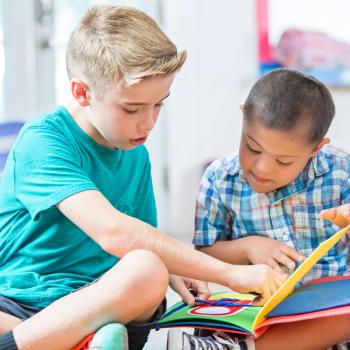
Book Buddies is a program which pairs up a child from a primary class and a child from an intermediate class. In this lesson, students create a personalized biography for their reading buddy as a great way to break the ice when Book Buddies meet for the first time. Students brainstorm questions they can ask to get to know their Book Buddy. They then use the questions to interview their Book Buddies. They write a biography of their new friend and publish it using an online tool. Book Buddies can then share their biographies with each other at their next meeting.
Featured Resources
Stapleless Book: Using this online tool, students can create a book simply by folding.
From Theory to Practice
In "Cooperative Learning: Response to Diversity," the California Department of Education concludes that "[A]fter nearly fifty years of research and scores of studies, there is strong agreement among researchers that cooperative methods can and usually do have positive effects on student achievement. However, achievement effects are not seen for all forms of cooperative learning; the effects depend on implementation of cooperative learning methods that are characterized by at least two essential elements: positive interdependence and individual accountability" (based on Slavin, 1990).
"Book Buddy Biographies" aims to begin the process of nurturing both positive interdependence and individual accountability by encouraging students to learn more about each other and to reinforce that learning through their own writing. Further, working with Book Buddies can enable children to access literature that is appealing, though not easily decodable, the benefits of which Dorothy Watson addresses in her article "Beyond Decodable Texts-Supportive and Workable Literature."
Further Reading
Common Core Standards
This resource has been aligned to the Common Core State Standards for states in which they have been adopted. If a state does not appear in the drop-down, CCSS alignments are forthcoming.
State Standards
This lesson has been aligned to standards in the following states. If a state does not appear in the drop-down, standard alignments are not currently available for that state.
NCTE/IRA National Standards for the English Language Arts
- 4. Students adjust their use of spoken, written, and visual language (e.g., conventions, style, vocabulary) to communicate effectively with a variety of audiences and for different purposes.
- 5. Students employ a wide range of strategies as they write and use different writing process elements appropriately to communicate with different audiences for a variety of purposes.
- 6. Students apply knowledge of language structure, language conventions (e.g., spelling and punctuation), media techniques, figurative language, and genre to create, critique, and discuss print and nonprint texts.
- 12. Students use spoken, written, and visual language to accomplish their own purposes (e.g., for learning, enjoyment, persuasion, and the exchange of information).
Materials and Technology
- General Classroom Materials (paper, pencils, markers, crayons, and clipboards)
- Copy of the Class List, cut up and placed in a container
- Computer Lab, or access to computers
Printouts
Student Objectives
Students will
- participate in a brainstorming session, developing a personalized list of questions.
- engage in an interview session.
- using a planning sheet, write, illustrate and edit a biography for their book buddies.
- present personalized biography to their book buddies.
- strengthen computer/writing skills by communicating with their buddies using e-mail.
Session One
- Generate a list of possible questions (or use the sample provided) to help guide instruction during the brainstorming session.
- Explain the Book Buddy process. Buddies will meet once a week throughout the school year, as well as communicate via e-mail, and the first activity will be completing a project to become acquainted with each other. If needed for the intermediate students, the Scholastic resource Getting the Best out of Book Buddies outlines ways to prepare students to serve as mentors to other readers.
- With the class, brainstorm a list of possible questions that they can ask their Book Buddies to get to know them better.
- Record responses on the board. Keep discussion going by providing examples when needed.
- After brainstorming questions, intermediate students copy at least ten questions to make their interview survey, and the primary students' teacher prepares an interview sheet using questions from the board.
Session Two
- Arrange for the two classes to meet.
- Each teacher can either take a class list and cut the names into strips and place them in a container to choose partners randomly, or they can meet beforehand to choose partners based on reading abilities.
- As buddies are paired up, they find a place in the room and interview each other, recording answers as they talk. They should also exchange school e-mail addresses at this time.
- After completing the interview, the students go back to their respective rooms and begin the biographies.
- If school e-mail is available, have students follow up their first meeting with a "nice to meet you" e-mail. Exchanging e-mail at least once a week throughout the year will reinforce the buddies' writing skills as well as their relationship overall. In effect, students become Tech Buddies and Writing Buddies as well as Book Buddies. Encourage them to write about books and poems they have read, stories they have written, or information about favorite authors in their e-mail communication.
Session Three
- Using the information gathered from the questionnaire, students create personalized biographies for their Book Buddies. Print out the Stapleless Book Planning Sheet to help students plan each page.
- As children work, the teacher should circulate through the room giving instruction and helping to edit as necessary.
- When students are satisfied with their planned books, have them create a final version of their biographies, with text and illustrations, using the Stapleless Book interactive.
- Finish the session by planning a book-sharing time for all the new Book Buddies!
Extensions
Student Assessment / Reflections
Teachers can choose to assess this lesson in a variety ways, including:
- observation and anecdotal notes based on classroom performance.
- a focus on the finished biographies, with attention to questions such as:
- Does the text match the information from the student- or teacher-created questionnaire?
- Did the author proofread his or her writing for capitalization, punctuation, spelling, and grammar?
- Do the illustrations connect with the text?
- Does the text match the information from the student- or teacher-created questionnaire?
- books read aloud without saying the name and have students guess who you are reading about.
Add new comment