Book Report Alternative: Examining Story Elements Using Story Map Comic Strips

- Preview |
- Standards |
- Resources & Preparation |
- Instructional Plan |
- Related Resources |
- Comments
Overview
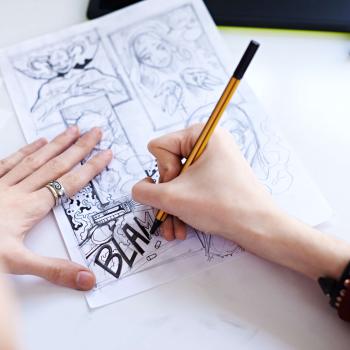
Knowing the elements of a story aids students in their understanding of what is taking place in the book or novel. When students comprehend the story elements of characters, setting, problems, events, and solutions, they become more involved in the story and take a greater interest in details. In this lesson, students use a six-paneled comic strip to create a story map, summarizing a book or story that they've read either read as a class or independently. The story strips that result provide a great way to evaluate student's understanding of important events and elements in a novel. The students enjoy the artistic aspect as well!
This lesson plan uses Maurice Sendak's Where the Wild Things Are as an example to model the process of creating the story map comic strips; however, any book you and your students have explored recently that demonstrates the elements of character, setting, problem, events, and solutions will work.
Featured Resources
- Comic Creator Interactive: This online tool allows students to easily create and print comic strips.
- Comic Strip Planning Sheet: Use this worksheet for students to plan their comic strips before using the online tool.
From Theory to Practice
Story mapping activities are a technique for using graphic representations to explore elements of a reading while working toward increased comprehension. As Margaret Foley explains in her "The (Un)Making of a Reader," story mapping asks readers to focus on the distinctive features of a text (feature analysis), separate the facts or significant information from the other details (signal detection), provide abstract structures that represent the text structure of a reading (schema theory), and explore the process of reading by breaking that process into component parts and making the reader aware of the way that these parts combine (metacognition). Foley warns, however, that teachers must guard against allowing story mapping to become a "self-monitoring system for story reading which inhibits [students'] potential to explore a diverse range of personal responses" (510).
In this activity, students use story mapping as a step toward personal response to the text. The creation of the comic strips is part of a reading process that also includes reflection and personal rethinking of the text elements. In this way, students can explore the benefits of story mapping without losing the opportunity to read and respond to texts personally.
Further Reading
Common Core Standards
This resource has been aligned to the Common Core State Standards for states in which they have been adopted. If a state does not appear in the drop-down, CCSS alignments are forthcoming.
State Standards
This lesson has been aligned to standards in the following states. If a state does not appear in the drop-down, standard alignments are not currently available for that state.
NCTE/IRA National Standards for the English Language Arts
- 1. Students read a wide range of print and nonprint texts to build an understanding of texts, of themselves, and of the cultures of the United States and the world; to acquire new information; to respond to the needs and demands of society and the workplace; and for personal fulfillment. Among these texts are fiction and nonfiction, classic and contemporary works.
- 2. Students read a wide range of literature from many periods in many genres to build an understanding of the many dimensions (e.g., philosophical, ethical, aesthetic) of human experience.
- 3. Students apply a wide range of strategies to comprehend, interpret, evaluate, and appreciate texts. They draw on their prior experience, their interactions with other readers and writers, their knowledge of word meaning and of other texts, their word identification strategies, and their understanding of textual features (e.g., sound-letter correspondence, sentence structure, context, graphics).
- 4. Students adjust their use of spoken, written, and visual language (e.g., conventions, style, vocabulary) to communicate effectively with a variety of audiences and for different purposes.
- 8. Students use a variety of technological and information resources (e.g., libraries, databases, computer networks, video) to gather and synthesize information and to create and communicate knowledge.
- 11. Students participate as knowledgeable, reflective, creative, and critical members of a variety of literacy communities.
- 12. Students use spoken, written, and visual language to accomplish their own purposes (e.g., for learning, enjoyment, persuasion, and the exchange of information).
Materials and Technology
- Picture book, or completed class novel
- Chart paper, overhead projector, or LCD projector
Printouts
Websites
Preparation
- Choose a book to model the comic strip planning and writing process. The example used in this lesson is Where the Wild Things Are by Maurice Sendak; however, any book that your students are familiar with will work for this activity.
- Copy the Story Elements Comic Strip Planning Sheet for students.
- Test the Comic Creator Student Interactive on your computers to familiarize yourself with the tool and ensure that you have the Flash plug-in installed. You can download the plug-in from the technical support page.
- Draw the columns from the Story Elements Comic Strip Planning Sheet on chart paper, an overhead, or the board, so that you can fill in the information as you discuss the story.
Student Objectives
Students will:
- read and analyze a text independently and as a group.
- identify story elements directly from a text.
- create a six-frame story comic strip illustrating five story elements using Comic Creator.
- respond individually to the text through reflection and rethinking of the text.
Session One
- Begin by reading Where the Wild Things Are or another picture book to the students. Alternately, you can use a novel that you have completed as a class. Choose one that illustrates the elements of character, setting, problem, events, and solution.
- Invite students to react to the text by writing a short response in their writers' notebooks. Alternately, students could simply discuss the reading in class. Questions that can elicit conversation include the following:
- What stood out the most for you in the story and why?
- If you were the main character in the story, how would things have been different?
- If this story took place in our classroom, what would change and why? (or our school, our town, so on)
- Have you ever had a problem like the one in the story? What did you do?
- Did the solution in the story seem realistic and appropriate? Would you have changed it if you had written the story?
- What event in the story interested you the most-not which one was most important, but which one did you want to know more about and why?
- What stood out the most for you in the story and why?
- Introduce the idea of story mapping by explaining that story maps help a reader think about the significant features of a text. A story map is a graphic organizer that a reader can use to explore how a story was put together.
- Using chart paper, overhead projector, or LCD projector, write the word "Setting" as your first heading (you'll return to this chart in the next session, so choose a format that you can save). Explain that the setting is the time and place of the story. Ask the students to identify the setting of the book that you've read. In Where the Wild Things Are, for instance, there are two settings, reality and fantasy (bedroom and island). Note their response on the overhead under the Setting heading.
- When the students respond, ask them refer to the book for supporting evidence. Invite students to identify passages, phrases, and illustrations that tells them more about the setting. Write down the supporting evidence that the students give you under the Setting heading.
- Refer to students' reactions to the setting in their writers' notebooks to connect this activity to their reflective writing. Ask what made the setting interesting (or not), and how important the setting was to the story. Give students the opportunity to make personal connections to the reading.
- Repeat the process for the following elements, connecting details and evidence from the story to personal reflections in the students' writers' notebooks:
- Characters
- The forces in a story. Traditionally, these forces have been referred to as the protagonist and the antagonist. The protagonist is the main character in the story. While usually someone the reader empathizes with, the protagonist is not in all cases a likeable person. The antagonist may take many forms, including another person, a force of nature, a situation, fate, society, or the protagonist him- or herself.
Authors use the following methods to create character:
- appearance (what does the character look like)
- speech (what does the character say, and how does he say it)
- the opinions of others
- the character's thoughts
- actions (how the character reacts in certain situations)
In Where the Wild Things Are, the characters are Max, mom, and the Wild Things. - appearance (what does the character look like)
- Problem
- As part of the rising action, the author introduces a problem. Whether a story is comic or tragic, all stories contain some degree of conflict. Conflict is a struggle between two opposing forces. The conflict reaches its peak in the story's climax, the point in the story where the reader's interest is at its highest.
In Where the Wild Things Are, the problem was that Max never really wanted to be where he was at the time. - Events
- A series of related events (what happens in the story).
In Where the Wild Things Are, there were many events. Max gets in trouble, a forest grows, he sails to the Island of Wild Things, Max becomes king, Max grows lonely, Max sails home, and Max arrives to find his dinner waiting for him. - Solution
- As the action subsides, the story eventually arrives at a resolution, or denouement. Traditionally, the problem(s) is solved by the end of the story.
In Where the Wild Things Are, Max came home to where he belonged.
- Set these notes aside so that you can return to them in the next class session.
- Ask students to respond and reflect on the texts that they've read in their writer's notebooks. The discussion questions in #2 above can be starting points for these entries; however, encourage students to think and reflect independently as well.
Session Two
- When you are confident that the students are comfortable with the five story elements, provide students the opportunity to use the Comic Creator Student Interactive to map the story elements for a book they have read.
- Distribute the Story Elements Comic Strip Planning Sheet.
- Demonstrate the planning sheet using the version that you've prepared on the board or an overhead. Make connections between the information students identified in the previous session, the planning sheet, and the options in the Comic Creator as you fill in the sheet for the story that you've read. You may wish to share with students the sample comic strip from Where the Wild Things Are.
- To make comic strips as well as to demonstrate the process, have your students follow these basic steps, referring to their planning sheet as they work in the Comic Creator:
- For the comic title, name the story that will be depicted.
- For the comic subtitle, name the elements you'll focus on, or allow students to write an original subtitle based on their reflection and response to the text.
- Include your name or the names of the members of your group as the authors of this comic strip.
- Choose the six-frame comic strip.
- The first frame of the comic can be used as a title frame. Students can create an original book cover or write a summary of the story.
- In each of the remaining five frames of the comic strip, students should create a caption for the frame with the appropriate story element (Setting, Character, and so forth) as well as the supporting details from the story. They can add backgrounds, characters, and dialogue that relate to the information represented in the frame.
- Print at least three copies of the finished comic strip.
- For the comic title, name the story that will be depicted.
- While students work, encourage them to interact with one another, to share and receive feedback on their comic strips.
- After the comic strips are printed out, students can decorate them with markers or other classroom supplies.
- As students finish, ask them to turn in two copies of the comic strip (one for you to respond to and one for display in the classroom or a school bulletin board-the third copy is for the students to keep and share with others).
Extensions
- If there is time, this is a great activity for the students to share with the class, or with a younger class as Reading Buddies.
Student Assessment / Reflections
- Planning sheet and comic strips should be collected as evidence of student's understanding of story elements. Also note student participation in guided discussions, student response and reflection to the texts, as well as whether students answer questions and providing information about story elements.
- Teacher observation during discusson to determine whether students can think critically about story elements. In paraticular, you can focus on these key questions.
-
- Does it seem like the child understood the story?
- Does is seem like the student understood the five elements?
- Does it seem like the child understood the story?
- Teacher interviews with students as they work or in response to finished comics can also pinpoint comprehension and areas which need more work. The following questions can work well to guide these conversations.
-
- What is the setting of your story?
- Who are the characters of your story?
- What is the problem/solution in your story?
- What are the events of your story?
- What are you adding in the sixth frame?
- What is the setting of your story?
Add new comment