Bridging Literature and Mathematics by Visualizing Mathematical Concepts


- Preview |
- Standards |
- Resources & Preparation |
- Instructional Plan |
- Related Resources |
- Comments
Overview
Math-related, informational books, like Steve Jenkins' Actual Size and David M. Schwartz' If You Hopped Like a Frog, provide the focus for this lesson, which connects reading, writing, math, and science. By exploring the life-size images in Actual Size and the comparisons to familiar objects in both books, students visualize measurements and mathematical proportions, which, in turn, teaches ratio. Students first begin with a read aloud and discussion of Actual Size and then use their hands to make size comparisons with the illustrations in the book. Next they listen to and discuss If You Hopped Like a Frog. They then talk about the similarities and differences between the two books and complete a Venn diagram. Finally, students apply these strategies to their own research and writing, bridging literature and mathematics as they research and write about an animal from one of the texts and then share their work with the class.
Featured Resources
Interactive Venn Diagram: Students use this online tool to compare and contrast the elements of two stories read in class.
Multigenre Mapper: Students use this online tool to publish their writing, including a drawing and three written texts.
From Theory to Practice
Stephanie Harvey suggests that teachers "surround kids with compelling nonfiction of every type and form" (13) and provide children with time to "research topics of interest and to practice reading and writing strategies" (14). The visual, language, and mathematical features of the math-related book pair that provides the focus of this lesson serve as powerful examples for children to examine critically and to inspire their own nonfiction writing. At the same time, these books incorporate real world applications of linear, area, and other forms of measurement, as well as the concept of ratio (NCTM, 2000, Connections Standard, Whitin & Whitin, 2004). These books can also inspire an inquiry stance toward scientific learning that is advocated by the National Science Teachers Association (NRC, 1996).
Further Reading
Common Core Standards
This resource has been aligned to the Common Core State Standards for states in which they have been adopted. If a state does not appear in the drop-down, CCSS alignments are forthcoming.
State Standards
This lesson has been aligned to standards in the following states. If a state does not appear in the drop-down, standard alignments are not currently available for that state.
NCTE/IRA National Standards for the English Language Arts
- 1. Students read a wide range of print and nonprint texts to build an understanding of texts, of themselves, and of the cultures of the United States and the world; to acquire new information; to respond to the needs and demands of society and the workplace; and for personal fulfillment. Among these texts are fiction and nonfiction, classic and contemporary works.
- 5. Students employ a wide range of strategies as they write and use different writing process elements appropriately to communicate with different audiences for a variety of purposes.
- 6. Students apply knowledge of language structure, language conventions (e.g., spelling and punctuation), media techniques, figurative language, and genre to create, critique, and discuss print and nonprint texts.
- 7. Students conduct research on issues and interests by generating ideas and questions, and by posing problems. They gather, evaluate, and synthesize data from a variety of sources (e.g., print and nonprint texts, artifacts, people) to communicate their discoveries in ways that suit their purpose and audience.
- 11. Students participate as knowledgeable, reflective, creative, and critical members of a variety of literacy communities.
- 12. Students use spoken, written, and visual language to accomplish their own purposes (e.g., for learning, enjoyment, persuasion, and the exchange of information).
Materials and Technology
- Actual Size by Steve Jenkins
- If You Hopped Like a Frog by David M. Schwartz
Printouts
Websites
Preparation
- Read carefully Actual Size and If You Hopped Like a Frog, including the endnotes of each text.
- Review the Mathematical Notes about Actual Size and If You Hopped Like a Frog, which act as a good reference for teachers.
- Collect measuring tools: rulers, yardsticks, meter sticks, scale, tape measures, trundle wheel, etc.
- Test the Venn Diagram, Mulitgenre Mapper, Stapleless Book, and ReadWriteThink Printing Press on your computers to familiarize yourself with the tools and ensure that you have the Flash plug-in installed. You can download the plug-in from the technical support page.
- Select and bookmark several animal Websites from the Websites section for students to use in their research.
Student Objectives
Students will:
- read and discuss two pieces of children's literature.
- analyze two authors' styles and the techniques used to convey mathematical information.
- write and illustrate a comparative example to explain mathematical details about an animal's size or abilities.
Session One
- Read aloud and discuss Actual Size, a book that not only introduces students to a variety of animals, but also presents those animals, or their body parts, at their actual size.
- Invite students to comment, by asking open-ended questions such as the following:
- Who would like to say something about this page?
- What do you find interesting? Surprising?
- What does _____ remind you of?
- Who would like to say something about this page?
- It is likely that students will use their hands to make some personal comparisons with the illustrations (e.g., “I can’t even stretch my hand across that squid’s eyeball!”).
- Although the book can be read and discussed in one sitting, you may prefer to read a few of the examples each day over a longer period.
- After you read about each creature, you may want to read aloud the corresponding endnote description for the animal.
- Ask students to discuss the following: “What does the author, Steven Jenkins, do to hook the reader’s interest?”
- List several ideas on chart paper. Save this chart for Session Three.
Session Two
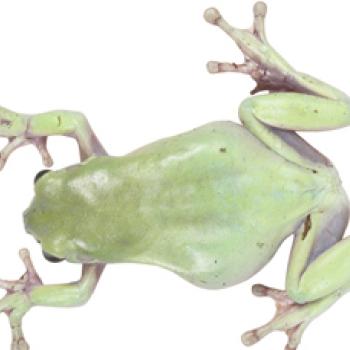
- Read aloud If You Hopped like a Frog, a children’s book that compares human feats like jumping with those same actions in animals. For example, if you hopped like a frog in a baseball game, you could get to first base in one hop!
- Invite students to comment, by asking open-ended questions such as the following:
- What animal feat do you find the most interesting? Why?
- Why can these animals do these things?
- What does these animal feats tell us about the animals’ adaptations to their environment?
- What animal feat do you find the most interesting? Why?
- Again, while reading, invite the students’ observations.
- Ask students to discuss the following: “What do the author and illustrator do to hook the reader’s interest?”
- Note students’ ideas on a second chart to use in Session Three.
- If there is time, ask the students to complete the math presented in the animal information. For example, if a snake can eat something twice as wide as its head, how big would their prey be?
Session Three
- Display both of the books, Actual Size and If You Hopped Like a Frog.
- Review the charts of the students’ comments regarding both books.
- Ask students what similarities and differences they see between the books.
- Working as a class or in small groups or pairs, create a Venn Diagram to represent their analysis. This can be done online or in a print version.
- Use students’ ideas to discuss how both books try to help the readers understand the different measurements of animals. Be sure to highlight the use of actual size pictures, and verbal comparisons with familiar objects to show various ratios. For example:
- Verbal comparison to a familiar object:
- A giant squid’s eyeballs are “the size of basketballs.” This comparison shows a one-to-one ratio.
- "If you could hop like a frog you could jump from home plate to first base in one mighty leap.” This sentence compares body length to the distance of leap, which is a one-to-20 ratio.
- A giant squid’s eyeballs are “the size of basketballs.” This comparison shows a one-to-one ratio.
- Verbal comparison to a familiar object:
Session Four
- Review the Venn Diagram from Session Three, while telling students that they will use the information from the books about the animals in their own inquiries.
- Explain that students will research an animal and its related attributes and then publish their information. Students will research, write and illustrate their information.
- Discuss options for their projects with the students.
- Discuss expectations for this assignment, as well as the specifics for what the children will be doing:
- Choose an animal from one of the texts.
- Conduct further research, using print and online sources as necessary.
- Find a measurement tool that will help solve the problem.
- Work on measuring accurately.
- Compare the statistic and an everyday object, using words and numbers to explain ideas and findings.
- Illustrate the comparison to help the reader understand it.
- Write an explanation on the procedure and solution.
- Choose an animal from one of the texts.
- Answer any questions that the students may have before allowing them time to work. Direct students to the Websites National Geographic Animal Facts, Animal Weigh In, and KidsClick! Animals, where they can find information on a variety of animals.
Session Five
- Allow time for the students to work on their projects.
- If desired, students can use the Multigenre Mapper, which provides an area for illustrations as well as three text boxes, to publish their work:
- One text box can be used for the quote from the book.
- One text box can be used to document the research conducted by the student.
- One text box can be used to summarize the mathematical and scientific findings.
- One text box can be used for the quote from the book.
- Other publishing options include the Stapleless Book or the ReadWriteThink Printing Press.
- At the end of the work session, provide time for children to share their comparisons with the whole class.
- Students can revise and edit their work for another audience during writing workshop.
Extensions
- Explore area measurement using the gorilla’s hand in Actual Size. Trace the hand and distribute copies. Have students first record an estimate of how much larger the gorilla’s hand is than their own hands. Record their strategies for this calculation. Next ask students to use squared centimeter paper to calculate exact measurements and record their findings. Provide time for class discussion.
- Research statistics for any animal, using print and online resources. Create a short book, using the Stapleless Book for a younger child (pen pal, reading buddy), that uses familiar comparisons to illustrate some of the mathematical statistics about animals. Be sure to use comparisons that reflect the experiences of young children. (Students might also explain how the animals’ adaptations help it survive.)
- Have students collect examples of analogies and comparisons in published scientific writing (newspapers, trade books, and so on). Discuss the effectiveness of various examples and develop suggestions for students to use while composing expository texts. See the ReadWriteThink lesson Imagine That! Playing with Genre through Newspapers and Short Stories for ideas on introducing expository writing. The students can use the ReadWriteThink Printing Press to publish their own scientific writing.
- Tap the ReadWriteThink lesson Webcams in the Classroom: Animal Inquiry and Observation to extend your exploration of animal feats by observing animal habits and habitats using one of the many webcams broadcasting from zoos and aquariums around the United States and the world.
Student Assessment / Reflections
- Use anecdotal notetaking or kidwatching to track students’ cognitive skills as they explain their thinking in sorting, comparing and contrasting, and forming the Venn diagram.
- As students record their work on the Venn Diagram, check for accuracy in the unions and sets that students have recorded. Encourage students to label their diagrams and to explain their work using think-aloud techniques. Be sure that students make their thinking visible through “rough-draft” talk as they explore the connections between mathematics and language.
- Assess the students’ projects using the Assessment Guidelines.
Add new comment