Catching the Bug for Reading Through Interactive Read-Alouds

- Preview |
- Standards |
- Resources & Preparation |
- Instructional Plan |
- Related Resources |
- Comments
Overview
This lesson uses an interactive read-aloud of Miss Bindergarten Stays Home From Kindergarten by Joseph Slate to help kindergarten and first-grade students learn reading strategies and how to prevent the spread of germs in their classroom. Students discuss and build knowledge about how germs are spread, how to cope with having a substitute teacher, and how to construct a caring classroom community, all while learning about story structure, new vocabulary, and a variety of reading strategies.
From Theory to Practice
- During interactive read-alouds, teachers pose questions throughout the reading that enhance meaning construction and also show how one makes sense of texts.
- Dialogue during read-aloud events supports students as they construct meaning based on the story and draw upon their personal experiences to build story relevance.
- These meaning-centered interactions engage students with literacy information and demonstrate strategies that they can adopt for use when reading independently.
- Select high-quality literature that extends children's knowledge of literature, language, and the world.
- Allow students to discuss the text as it is being read to scaffold their construction of meaning.
Common Core Standards
This resource has been aligned to the Common Core State Standards for states in which they have been adopted. If a state does not appear in the drop-down, CCSS alignments are forthcoming.
State Standards
This lesson has been aligned to standards in the following states. If a state does not appear in the drop-down, standard alignments are not currently available for that state.
NCTE/IRA National Standards for the English Language Arts
- 3. Students apply a wide range of strategies to comprehend, interpret, evaluate, and appreciate texts. They draw on their prior experience, their interactions with other readers and writers, their knowledge of word meaning and of other texts, their word identification strategies, and their understanding of textual features (e.g., sound-letter correspondence, sentence structure, context, graphics).
- 11. Students participate as knowledgeable, reflective, creative, and critical members of a variety of literacy communities.
Materials and Technology
- Miss Bindergarten Stays Home From Kindergarten by Joseph Slate (Dutton Books, 2000)
- Computers with Internet access
- Sink, towels, soap, and water for hand washing
Printouts
Websites
Preparation
According to Barrentine, you can use the following steps to plan and prepare for an interactive read-aloud lesson:
| 1. | Read the book several times to yourself. Because of the idiosyncrasies that arise when interacting and discussing texts with groups of students, it is important for you to know the text well. |
| 2. | Think about the reading goals you have for your students and identify the process and strategy information at work in the story. Choose vocabulary words to be discussed, such as flu, temperature, substitute, and get-well card. Decide if you want to point out the rhyming nature of the story or the alphabetical student names since this information can help students when decoding the text. |
| 3. | Identify where student's predictions about the developing story should be sought and shared. Plan what aspects of the story you would like to focus on and note where those aspects are located in the text. Be prepared also to use student responses to guide the interaction. |
| 4. | Anticipate where you may need to build students' background knowledge. Depending on the needs and abilities of your students, anticipate areas where students may need more background information to be able to fully understand the lesson you are teaching. |
| 5. | Think through how you will phrase your questions and anticipate student responses. "Canned" questions do not enhance comprehension or interaction if students are beyond the strategies the questions are eliciting. |
| 6. | After you have prepared the read-aloud event, be prepared to relinquish your plans and tailor your questions to the needs and responses of your group. Remember to find and use "teachable moments." |
| 7. | After reading, devise opportunities for students to explore stories in personal and exciting ways. In this lesson, students will write a personalized invitation inviting another class and their family members to a literacy event. Think of other ways the text can be used to generate interest and excitement for literacy learning. |
Student Objectives
Students will
- Use their prior knowledge to comprehend events in a story
- Preview a story and periodically predict what will happen in the text based upon knowledge gained while reading and through discussion
- Learn new vocabulary
- Make personal connections to a text
- Retell the main events of a story
- Relate how germs are spread and what the consequences are
- Use the Internet to access information about hand washing and to create a "stay well" card
Session 1: Interactive Read-Aloud
Before reading
Introduce the story, Miss Bindergarten Stays Home From Kindergarten, and ask students to give reasons why a teacher might have to stay home from school. Ask students if they have ever been sick and what things they had to do to get better. Discuss vocabulary that will help in understanding the text, such as flu and temperature.
Talk about what schools and students do when a teacher cannot come to school. Have students explain what a substitute is and how they can help when a substitute comes to their class.
Ask if there is anything people can do to help someone who is sick (e.g., make them a get-well card, take them soup). Tell students that you will be talking about a way to help keep people from getting sick.
During reading
Ask questions to guide the discussion and highlight strategies that good readers use. The following questions can be asked as you read the corresponding page numbers, but remember that the reading should be interactive so take cues from your students and tailor your questions according to their needs and responses.
- Page 1: Who is Miss Bindergarten calling? (–the substitute or the principal) Why? (–because she is too sick to come to school)
- Page 8 and 9: What do you notice about the beginning letters of the kids' names so far? (–they are in alphabetical order) You would only mention this aspect if you are focusing on the alphabetical nature of names in the story.
- Page 9: What is happening to Franny? (–she is getting sick)
- Page 10 and 11: Why are both Franny and Miss Bindergarten staying home from school? (–they do not feel well enough to go and they need to keep their germs to themselves)
- Page 15-17: What kind of cards are the kids making for Miss Bindergarten? (–get-well cards)
- Page 17: What is happening to Lenny? (–he is getting sick too)
- Page 22-23: What is happening to Raffie? Do you notice something that keeps repeating in the story, like a pattern? (–people keep getting sick) Explain that good readers watch for patterns to help them predict what might happen next and to understand and remember the story.
- Page 24-25: What can you tell from the pictures about how the characters in the story are feeling? (–they are starting to feel better)
- Page 29: If you are focusing on the alphabetical nature of the kids' names you can ask the following. Where are we in the alphabet now with Ursula, Vicky, and Wanda? (–getting close to the end of the alphabet, so we are probably getting close to the end of the story)
- Page 38: What happened to Mr. Tusky? (–he caught the sickness Miss Bindergarten and the kids in her class had)
After reading
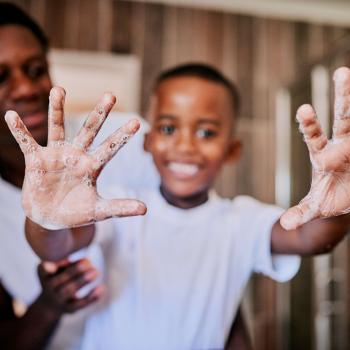
Tell students that you don't want to be sick and have to miss school. Explain that there is a terrific way they can help keep everyone in the class healthy—by washing their hands! Discuss what germs are and how they make people sick, and end the session by telling students that the best way to get rid of germs is to wash them down the drain!
Session 2: Hand Washing Lesson
Access the Handwashing Teaching Module for lessons and activites that focus on the importance of hand washing and the general principles of germ transmission. Lesson 3 in the module provides techniques for proper hand washing. An evaluation sheet is provided to assess how well students follow the hand washing steps.
Check the Great Ideas for Handwashing Educators for additional education methods related to hand washing. Students may also enjoy the Henry the Hand theme song.
Session 3: Making Cards
This session is intended to help students explore the read-aloud in personal and exciting ways and to assess their knowledge of good hand washing techniques. Ask each student to make a "stay well" card for a friend or relative. Enlist an upper-grade class to help students make their cards.
Have students access the My Card Maker website and choose the cover for their cards. For the message section, students should dictate or write the basic steps for correct hand washing. Students can then print the cards and give them to their friends and relatives. Make sure that students remember to also tell the recipients about the story they read in class and explain good hand washing techniques to them. It's helpful to attach an evaluation sheet with each card to ask the recipient for feedback on whether the student was able to tell about the story and explain why hand washing is important and how to wash. The evaluation sheet can be adapted for the purposes of your lesson.
Extensions
- Design a poster about good hand washing techniques to be posted in the school bathrooms and above classroom sinks. When distributing copies of the poster to other classrooms, students can retell the main parts of the story Miss Bindergarten Stays Home From Kindergarten and explain why it is important for students to wash their hands in school and at home. The class or teacher can fill out an evaluation sheet.
- Help students compose a class book explaining the routines they follow in class each day. If students are advanced enough to write on their own, divide them into groups to write different chapters such as "Our opening routine" or "How we go to lunch," etc. For less experienced students, allow students to dictate the text for their book while you write for them. Students can then illustrate the pages. The final product serves as a good resource for substitute teachers and helps establish the classroom community.
Student Assessment / Reflections
- Since this is an interactive experience, you can constantly assess students' understanding during class discussions. For example, do students base their predictions on the text or are their predictions random? Do they pick up on the pattern presented in the story? Do they understand and use the new vocabulary? Kid-watching is the best assessment method during an interactive read-aloud.
- Use the evaluation sheet to evaluate each student's ability to retell the main events of the story and to relate the importance and proper techniques of hand washing.
- Read other patterned or predictable texts with students and observe whether they can find the patterns and make accurate predictions. Provide these types of texts for independent reading and discuss with students what patterns they noticed or how well they were able to predict what would happen.
- Have students make a chart highlighting the strategies that good readers use, such as look for patterns, make predictions, check predictions, and so on.
- Anecdotal records documenting student responses in both whole class and individual settings can also help assess students' understanding of the concepts presented during the lesson.
Add new comment