Digging Deeper: Developing Comprehension Using Thank You, Mr. Falker

- Preview |
- Standards |
- Resources & Preparation |
- Instructional Plan |
- Related Resources |
- Comments
Overview
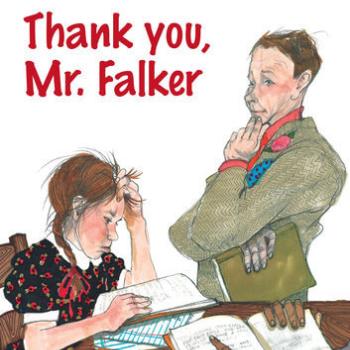
Good readers demonstrate comprehension of text using a wide variety of strategies. Making personal connections to stories is one way to develop deeper understanding of both character and theme. This teacher read-aloud of Thank You, Mr. Falker and follow-up whole-group instruction provide a basis for improved higher-level reading comprehension. The teacher works with the whole class to model making predictions and personal connections, envisioning character change, and understanding the themes of the book. Response journals can also be used to further student connections to the characters and themes in the book.
From Theory to Practice
- Comprehension is a complex process, and no single instructional method is effective for all texts in all learning situations.
- The act of making personal connections aids comprehension through schema activation or connecting what readers already know about a given topic with new information presented in the text.
- Without response in some form (e.g., oral, written, creative), comprehension is rarely deepened.
- Direct instruction in reading strategies is a prerequisite for awareness of the comprehension process.
Common Core Standards
This resource has been aligned to the Common Core State Standards for states in which they have been adopted. If a state does not appear in the drop-down, CCSS alignments are forthcoming.
State Standards
This lesson has been aligned to standards in the following states. If a state does not appear in the drop-down, standard alignments are not currently available for that state.
NCTE/IRA National Standards for the English Language Arts
- 1. Students read a wide range of print and nonprint texts to build an understanding of texts, of themselves, and of the cultures of the United States and the world; to acquire new information; to respond to the needs and demands of society and the workplace; and for personal fulfillment. Among these texts are fiction and nonfiction, classic and contemporary works.
- 2. Students read a wide range of literature from many periods in many genres to build an understanding of the many dimensions (e.g., philosophical, ethical, aesthetic) of human experience.
- 3. Students apply a wide range of strategies to comprehend, interpret, evaluate, and appreciate texts. They draw on their prior experience, their interactions with other readers and writers, their knowledge of word meaning and of other texts, their word identification strategies, and their understanding of textual features (e.g., sound-letter correspondence, sentence structure, context, graphics).
- 6. Students apply knowledge of language structure, language conventions (e.g., spelling and punctuation), media techniques, figurative language, and genre to create, critique, and discuss print and nonprint texts.
- 11. Students participate as knowledgeable, reflective, creative, and critical members of a variety of literacy communities.
Materials and Technology
- Thank You, Mr. Falker by Patricia Polacco
- Chart paper and colored markers
- Student response journals (optional)
- Sticky notes
Printouts
Websites
Preparation
| 1. | Read the book Thank You, Mr. Falker by Patricia Polacco. This story is the semiautobiographical account of a young girl's struggle to learn to read. For more background about the author and the book, you may wish to refer to the author's description of the book on PatriciaPolacco.com. Before the lesson, you should practice reading the book aloud with fluency and expression. You will also want to decide whether you are going to show the illustrations to students as you read. It is sometimes better not to do this, especially if you are going to ask students to make predictions. |
| 2. | You will be using a combination of comprehension strategies and interactive writing activities in this lesson. To obtain more information about comprehension strategies, visit Comprehension Instruction: What Makes Sense Now, What Might Make Sense Soon or Reading Comprehension Strategies. For information about interactive writing, visit About Interactive Writing. |
| 3. | For Session 1, think about three or four appropriate spots in the text where you can stop reading and reinforce connections between your students and Trisha, the main character, using specific questions. Places you might stop and questions you might ask include the following: Note: The pages in Thank You, Mr. Falker are not numbered. For the purposes of this lesson, the first few words from each page are used to indicate which page of the book is referred to.
|
| 4. | Session 2 helps students understand how events in Thank You, Mr. Falker contribute to a character change in Trisha. Copy the Character Change Continuum onto chart paper or the board. |
| 5. | For Session 2, determine where you are going to stop reading and question students to gather information for the Character Change Continuum. Suggested stopping places and questions include:
|
| 6. | Make enough copies of the Observational Assessment Checklist to take notes on each student during each session of the lesson. |
Student Objectives
Students will
- Develop specific strategies for reading comprehension following a teacher model of thinking aloud and asking questions
- Demonstrate comprehension by discussing their reactions to a story, identifying with characters in a story, and relating events in a story to their own lives
- Learn about character development and themes using charts created by the class
- Develop oral language skills as they participate in discussions about a story
Session 1: Making predictions and forming connections
| 1. | Gather students together. Do not show them the cover of the book yet. The purpose of this before-reading discussion is to activate prior knowledge and experience about the nature of learning a new task and the kinds of roadblocks, including other people, that we all face. Be sensitive to students' emotions, carefully guiding the discussion. Ask the following questions:
|
| 2. | Show students the cover of the book. Ask the following questions:
|
| 3. | As you read the story aloud, ask students to think about the following questions:
|
| 4. | Read the story aloud. Stop at the pages you have marked and ask students the suggested questions. You may wish to model thinking aloud. For example, after reading the sentence "...But knowledge is like the bee that made that sweet honey, you have to chase it through the pages of a book!" you might say, "I really like that sentence. I think Trisha's family is telling her that reading is important, because you can find in a book just about anything you want to know." |
| 5. | Help students improve their understanding by having a discussion about their reactions to the story. Record their responses on chart paper; you will need this information for Session 3. Some of the questions you may wish to ask include:
|
| 6. | Tell students that they have been making personal connections with characters in the book. Tell them that good readers do this to help them understand the text better. |
| 7. | You may choose to have students illustrate and write their reaction to the story in a response journal. Or, you may have them write about their favorite or least favorite part of the story. This can be completed in class or as homework. |
Session 2: Envisioning character change
| 1. | Gather students. Have the Character Change Continuum chart available. Begin to read Thank You, Mr. Falker aloud again. Stop at your predetermined points to elicit student responses. |
| 2. | At each page where you stop, ask students to help you record where and why they think Trisha is on the Character Change Continuum chart. |
| 3. | When you are finished, read the completed Character Change Continuum with students. Ask them to think of one or two words that describe Trisha at various stages throughout the story. Examples include:
|
| 4. | Tell students that they have been studying character development. Tell them that good readers do this to help them understand the text better. |
| 5. | Display the chart in your classroom and have students use it independently as they read additional books. Examples of appropriate books include A Bad Case of Stripes by David Shannon (Blue Sky Press, 1998), Wings of Change by Franklin Hill (Illumination Arts Publishing Co., 2000), Chrysanthemum by Kevin Henkes (HarperTrophy, 1996), and The Dot by Peter H. Reynolds (Candlewick Press, 2003). You might also give students sticky notes and their own copies of the chart to record their responses as they listen to a story or read it on their own. |
Session 3: Making thematic connections
| 1. | Refer students to the chart on which you recorded their responses to the discussion questions during Session 1 (see Session 1, Step 5). |
| 2. | Display a blank Life Lesson Chart on the board or a blank piece of chart paper. You may wish to view the filled in Life Lesson Chart example to help you structure the chart you develop with your students. |
| 3. | Tell students that often stories have several themes or main ideas (you might want to give students an example of a theme from another book you have read as a class), and that readers make thematic connections as they read. Help students identify the main themes of Thank You, Mr. Falker, which are "believe in yourself" and "important people in our lives shape how we feel about ourselves" using the following strategy:
|
| 4. | Now challenge students to make thematic connections by identifying the supporting evidence from the text for this theme. Record their responses on the Life Lesson Chart. Help students extend the thematic connections to their own lives by responding to the following questions:
|
| 5. | Read and review the chart together. This helps students review and consolidate the information, encouraging them to reflect as they read. |
| 6. | You may want to have students use their response journals as a place to comment on the "So What?" section of the Life Lesson Chart. |
| 7. | Tell students that during this part of the lesson, they were making thematic connections. Tell them that good readers do this to help them understand the text better. |
Extensions
- Encourage students to find other books to which the Character Change Continuum or the Life Lesson Chart can be applied. Begin a class list of the books they have chosen. If students choose appropriate books, this helps you assess how well students can apply their knowledge of the comprehension strategies.
- Have students work with a partner to write "thank you" pages for a class book. Each student writes one page about an important person in his or her life, beginning with the phrase "Thank you, __________ (name of person)." You could combine these with photographs or portraits of the students as well as student drawings of the person they have selected.
- Have students make a chart entitled "Things You Can Say To Make People Feel Good About Themselves" to post in the classroom. Have students add to it as they think of suggestions.
- Ask students how the story would change if Trisha's family did not move. Would Trisha learn to read? What would the other characters then have to do to make her feel good about herself? Would anything happen to the bully? Give them time to talk about this in small groups and write a brief story outline.
- Have students do a Readers Theatre presentation of Thank You, Mr. Falker. Readers Theatre is a strategy in which students take a text and interpret it in dramatic form. It develops deeper comprehension, as students summarize a piece of text, write their own script, and perform their interpretation of the story. To obtain more information on Readers Theatre, you may wish to visit the following websites:
- Reader's Theatre Basics
- Internet Resources for Conducting Readers Theatre
- Reader's Theatre Basics
Student Assessment / Reflections
- Use the Observational Assessment Checklist to take notes during all three sessions. Observe which students seem to be grasping the comprehension strategies and which students need further assistance, perhaps through reading conferences during independent reading.
- Informally assess student comprehension of the text, ability to identify character changes and traits, and their understanding of thematic elements by observing them during class discussion and looking at the responses that are recorded on the Character Change Continuum and the Life Lesson Chart.
- If you have students keep response journals, collect these and use them as a way to assess student comprehension.