Discovering a Passion for Poetry With Langston Hughes
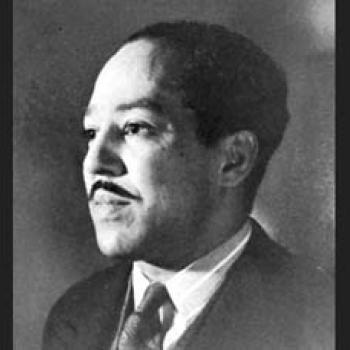

- Preview |
- Standards |
- Resources & Preparation |
- Instructional Plan |
- Related Resources |
- Comments
Overview
Poetry is written to convey the essence of a greater meaning, and it can bundle a great deal of passion in a small package. In this lesson, students begin by discussing the impact of social context on one's goals and choices. Students analyze examples of contemporary youth poetry and the poetry of Langston Hughes to determine how a writer's environment influences his or her writing. Students then work in groups to conduct research on how events in the world shaped Hughes's work. In a group presentation to the class, students cite specific examples that link their interpretation of the poem to the sociohistorical context in which it was written. The lesson culminates with each student creating an original poem that communicates a personal view on a current world issue.
Featured Resources
Library Graffiti interactive tool: Students can use this interactive tool to combine visual interpretations or representations of a text with their written interpretations.
Common Core Standards
This resource has been aligned to the Common Core State Standards for states in which they have been adopted. If a state does not appear in the drop-down, CCSS alignments are forthcoming.
State Standards
This lesson has been aligned to standards in the following states. If a state does not appear in the drop-down, standard alignments are not currently available for that state.
NCTE/IRA National Standards for the English Language Arts
- 1. Students read a wide range of print and nonprint texts to build an understanding of texts, of themselves, and of the cultures of the United States and the world; to acquire new information; to respond to the needs and demands of society and the workplace; and for personal fulfillment. Among these texts are fiction and nonfiction, classic and contemporary works.
- 2. Students read a wide range of literature from many periods in many genres to build an understanding of the many dimensions (e.g., philosophical, ethical, aesthetic) of human experience.
- 3. Students apply a wide range of strategies to comprehend, interpret, evaluate, and appreciate texts. They draw on their prior experience, their interactions with other readers and writers, their knowledge of word meaning and of other texts, their word identification strategies, and their understanding of textual features (e.g., sound-letter correspondence, sentence structure, context, graphics).
- 8. Students use a variety of technological and information resources (e.g., libraries, databases, computer networks, video) to gather and synthesize information and to create and communicate knowledge.
- 11. Students participate as knowledgeable, reflective, creative, and critical members of a variety of literacy communities.
Materials and Technology
- The Dream Keeper and Other Poems (Knopf, 1994)
- "Dreams"
- "Let America Be America Again"
- "Theme for English B"
- "I, Too, Sing America"
- Computers with Internet access and the Shockwave plug-in downloaded
Websites
Preparation
| 1. | Read "Dreams" by Langston Hughes in The Dream Keeper and Other Poems. Read both the "Introduction" and "A Personal Note" for background information on the author and the poem. "Dreams" can also be found online. |
| 2. | Preview the Literary Graffiti interactive tool. Make certain all computers have the Shockwave plug-in downloaded. If not, follow instructions for downloading at the Shockwave Player Download Center |
Note: For this lesson, it would be helpful for students to already be familiar with various types and elements of poetry.
Student Objectives
Students will
- Identify connections between an author's work and the sociohistorical context in which it was written
- Analyze a poem by Langston Hughes in its historical context
- Summarize in writing the connection between one poem's meaning and the sociohistorical context in which it was written
- Create an online visual representation of one poem's meaning supported by examples from research
- Orally present the poem and its relevant historical connections
- Compose an original poem that reflects a personal view on a current social issue
Session 1
| 1. | Initiate a class discussion about how social context has a dramatic impact on one's goals and choices. (You might use the example of the many Americans who enlisted in the armed forces after September 11.) Ground this notion in students' lives by asking students to respond in writing to the following questions:
|
| 2. | Ask students to brainstorm examples of how the times in which a writer lives can impact his or her writing. As a class, visit the following websites to look for examples of how the youth of today are writing about their life experiences:
|
| 3. | Read and display the poem "Dreams" by Langston Hughes. Ask students to volunteer their initial reactions and interpretations of this poem. |
| 4. | Read aloud the "Introduction" and "A Personal Note" from the anthology The Dream Keeper and Other Poems and then reread the "Dreams" poem. These brief biographical pieces illustrate how Hughes' passion for encouraging the black youth of America influenced his writing of "Dreams." Again solicit responses from students. |
| 5. | Ask students to respond to the following question: How did what you learned about Hughes' life affect your interpretation of the poem? |
Session 2
| 1. | Inform students that they will be embarking on an adventure to show how historical events have influenced other works by Hughes. Tell them that they will be learning about his life and considering how sociohistorical context (social issues in history) affected his writing. To culminate this study, inform students that they will be composing their own free-verse poem on a personally relevant social topic. |
| 2. | Invite students to participate in the structuring of a project rubric to assess their work. Use the RubiStar website as a guide to create a class rubric that best captures the lesson objectives. Begin by sharing the lesson objectives with the students. Invite them to consider what criteria would need to be present in their finished products to best demonstrate their having met these objectives. For each objective, have students assist in defining what constitutes a rating of 4, 3, 2, and 1. |
| 3. | Divide the class into three groups and assign each group one Langston Hughes poem.
|
| 4. | Tell students to begin by reading the poem and interpreting its meaning. Explain that their initial interpretation of the poem may change as they learn more about Langston Hughes' life and times. |
| 5. | The purpose of students' research is to encourage them to explore a variety of rich and varied websites to learn about Hughes' life. Having these websites bookmarked on the computers will make them easier for students to access:
|
Session 3
| 1. | If needed, provide students with additional time during the third session to complete their research. |
| 2. | Introduce the Literary Graffiti interactive tool to the class. Ask each group to use this tool to summarize Hughes' background information as it relates to the selected poem and to create a visual representation of the poem's meaning. |
| 3. | Invite each group to give a brief presentation on their interpretation of the poem's meaning and the sociohistorical context in which it was written. |
Session 4
After the presentations are complete, invite each student to write a free-verse poem that speaks to a personally relevant world issue.
| 1. | Begin by having students revisit their responses to the questions from Session 1. |
| 2. | Ask students to volunteer possible poetry topics, and then have students form groups based on common topics of interest. |
| 3. | Encourage students to work together to assemble a list of words and phrases for use in their poems. |
| 4. | Once they are ready to begin, have students write individual poems that are a reflection of themselves and their life experiences. |
| 5. | As a class, decide how you want to share individual poems. Possible suggestions include conducting an oral reading, or creating a book, a literary journal, or class website. Educational Web Design provides some information on creating a website. |
Extensions
- Videotape students performing dramatic readings of their own poetry. Format the tape into a montage of poetry for social awareness.
- Invite another class to be a live audience for a class poetry reading.
- Invite students to create an alternate artistic interpretation of their poem. This might take the form of a painting, sculpture, or piece of music.
- Ask students to select another poet and analyze how sociohistorical influences impacted his or her writing.
Student Assessment / Reflections
Use your class-created rubric to evaluate students' performance against the lesson objectives.
As an additional assessment, invite students to respond to the following questions:
- How effectively did your group capture the connection between the poem's meaning and its sociohistorical context?
- How effective were you in using the Literary Graffiti interactive tool to represent what you learned and wanted to share about your poem?
- How effective were you in connecting aspects of the poet's life history with the messages in his writing?
- Did your poem effectively convey a personal view on a current social issue?
As you read students' responses, assess how they met the lesson goals. Consider the following questions:
- Were their personal reflections accurate?
- Do you agree with how they described their work?
- How effective were the students in connecting aspects of the poet's life history with the messages in his writing?
- How effective were students' Literary Graffiti presentations in summarizing background information on Hughes and creating a visual representation of the poem's meaning?
You may wish to meet individually with students to discuss their reflections and assessments further.