An Exploration of The Crucible through Seventeenth-Century Portraits
- Preview |
- Standards |
- Resources & Preparation |
- Instructional Plan |
- Related Resources |
- Comments
Overview
Act 1 is always the most difficult for the students to understand, as 13 out of the 21 characters are introduced within this section alone. After reading act 1 of The Crucible, students create Trading Cards to describe and analyze an assigned character. Then, they explore portraits of Puritans online to assist them in creating a portrait of the character and present a rationale to explain their work of art. A “Portrait Gallery” is set up around the classroom, so the students are able to refer to portraits during later acts and better understand the characters' motives and relationships.
Featured Resources
|
|
 |
|
|
From Theory to Practice
As The Crucible is a play, it is easy to incorporate the dramatic aspect of the arts by including lessons on the social purpose of a play and more practical elements, such as blocking and performing. However, incorporating the visual arts into a unit on The Crucible is challenging, as the Puritans themselves forbade, as Miller writes, "anything resembling a theater or ‘vain enjoyment.'" This lesson allows the teacher to incorporate a creative activity, in that students create drawings, paintings, or collages of the characters.
Still, Osburg highlights a serious problem that can occur during such imaginative assignments, and one that teachers must keep in mind when instructing this lesson: students could easily "miss the point of the work or confound the author's intent" (56). It is the teacher's job, as Osburg argues, to "hold them responsible for actual knowledge of the text and the time period." Indeed, students must demonstrate creativity and imagination; however, if they do not display close-readings of the text and original paintings, the project will be for naught.
Further Reading
Common Core Standards
This resource has been aligned to the Common Core State Standards for states in which they have been adopted. If a state does not appear in the drop-down, CCSS alignments are forthcoming.
State Standards
This lesson has been aligned to standards in the following states. If a state does not appear in the drop-down, standard alignments are not currently available for that state.
NCTE/IRA National Standards for the English Language Arts
- 1. Students read a wide range of print and nonprint texts to build an understanding of texts, of themselves, and of the cultures of the United States and the world; to acquire new information; to respond to the needs and demands of society and the workplace; and for personal fulfillment. Among these texts are fiction and nonfiction, classic and contemporary works.
- 2. Students read a wide range of literature from many periods in many genres to build an understanding of the many dimensions (e.g., philosophical, ethical, aesthetic) of human experience.
- 3. Students apply a wide range of strategies to comprehend, interpret, evaluate, and appreciate texts. They draw on their prior experience, their interactions with other readers and writers, their knowledge of word meaning and of other texts, their word identification strategies, and their understanding of textual features (e.g., sound-letter correspondence, sentence structure, context, graphics).
- 4. Students adjust their use of spoken, written, and visual language (e.g., conventions, style, vocabulary) to communicate effectively with a variety of audiences and for different purposes.
- 5. Students employ a wide range of strategies as they write and use different writing process elements appropriately to communicate with different audiences for a variety of purposes.
- 7. Students conduct research on issues and interests by generating ideas and questions, and by posing problems. They gather, evaluate, and synthesize data from a variety of sources (e.g., print and nonprint texts, artifacts, people) to communicate their discoveries in ways that suit their purpose and audience.
- 8. Students use a variety of technological and information resources (e.g., libraries, databases, computer networks, video) to gather and synthesize information and to create and communicate knowledge.
- 9. Students develop an understanding of and respect for diversity in language use, patterns, and dialects across cultures, ethnic groups, geographic regions, and social roles.
- 11. Students participate as knowledgeable, reflective, creative, and critical members of a variety of literacy communities.
- 12. Students use spoken, written, and visual language to accomplish their own purposes (e.g., for learning, enjoyment, persuasion, and the exchange of information).
Materials and Technology
- The Crucible by Arthur Miller
- The Crucible Trading Cards
- “Early American Paintings” at the Worcester Art Museum
- Portraits of the Chosen Leaders and the Clergy at The Winthrop Society
- Materials for art project: butcher paper or poster board, paint or markers, glue, scissors and magazines for collage, etc. and to hang portraits in the classroom
- Internet access
Printouts
Websites
Professor Reuben provides background information about Puritan literature along with study questions.
Pages 226-229 in the chapter on “Poetry” offers a historical view of the Puritan’s aversion to art.
The Worcester Art Museum provides free-online access to four portraits of Puritans painted by an unidentified artist.
While the Winthrop Society is primarily dedicated to preserving family history for descendants of the Puritans, their page that includes multiple portraits of political and religious leaders proves to be an invaluable resource for this lesson.
Preparation
- Students should have finished reading act 1 of The Crucible. You might choose to assign the character before they start reading, so that students could trace and take notes on the characterization as they read. Students may use the Crucible Characterization handout to assist them with notetaking.
- Preview background material related to early American art and portraiture at such websites as those listed below. After reviewing these, select background information to share with the students during Session Two.
- Arrange access to computers with Internet access for all sessions. Prepare bookmarks of the online gallery, “Early American Paintings” at the Worcester Art Museum and portraits of the Chosen Leaders and the Clergy at The Winthrop Society. Also, familiarize yourself with and prepare a bookmark of the Character Trading Cards.
- Gather an LCD projector and materials for art project: butcher paper or poster board, paint or markers, glue, scissors and magazines for collage, etc., and to hang portraits in the classroom.
- Photocopy Character Portrait Assignment and Rubric.
Student Objectives
Students will:
- compare their knowledge about the Puritans to Miller’s characterization in their journals.
- describe a character’s insights, developments and actions and critique that character’s behaviors using the Character Trading Card.
- learn about the historical and cultural context of The Crucible as it relates to art and portraiture.
- analyze several portraits of Puritans from seventeenth-century America in their journals.
-
create an original portrait of their character using the information gathered in their Trading Card assignment and their review of seventeenth-century portraits.
-
write a description and rationale of their portrait.
-
present their portrait to the class in during a Gallery Walk.
Session One
- Begin by having the students respond to the following questions in writing.
- When you hear the word “pilgrim,” what images and associations come to your mind?
- What stereotypes of the original Pilgrims (or Puritans) have Miller’s play upheld, so far?
- What has surprised you about Miller’s characterization of the Pilgrims, or Puritans?
- Show students the Character Trading Cards interactive and, as a class, have the students complete a practice trading card for Tituba, so as to check for understanding, before moving on to the next step.
- Divide students into 8 groups, one for each of the following characters who appear in Act One:
- Betty
- Reverend Parris
- Abigail
- Mr. Putnam
- John Proctor
- Giles Corey
- Rebecca Nurse
- Reverend Hale
Session Three
- Provide students with an overview of the historical context of Early American literature and art (or lack thereof) using PAL: Perspectives in American Literature - A Research and Reference Guide Chapter 1: Early American Literature to 1700 - A Brief Introduction and The Cambridge History of American Literature: 1590-1820 By Sacvan Bercovitch, Cambridge University Press, 1994.
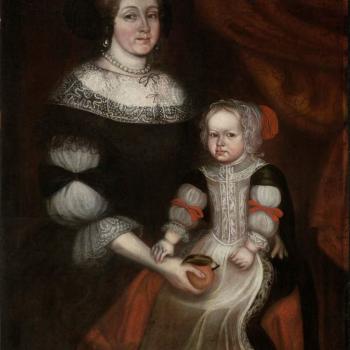
- Have students open the link to the image of Elizabeth Clarke Freake (Mrs. John Freake) and Baby Mary at the Worcester Art Museum’s on-line gallery and/or bring it up on the LCD projector. You can click on the image to zoom in. Ask students to describe the painting, using the following questions to catalyze their responses and ask students to share their responses to the portrait:
- Describe the painting. What are the mother and child doing? Describe their clothes. Describe the room.
- Describe the faces of the mother and child. How would you describe their emotions?
- What feeling do you get when you look at this painting?
- What new information does this portrait give you about life for seventeenth-century Puritans?
- Describe the painting. What are the mother and child doing? Describe their clothes. Describe the room.
- Have the students return to their groups and go online to visit the portraits of Puritans at the following online galleries.
- Unidentified Artist’s Portraits, Seventeenth Century, 1671-1674, John Freake and Elizabeth Clarke Freake (Mrs. John Freake) and Baby Mary at the Worcester Art Museum’s online gallery
- Multiple portraits of the Chosen Leaders and the Clergy at The Winthrop Society
- Have them look through all of the portraits, and then choose the one that they think most closely resembles their assigned character from the Trading Card assignment. Once they have selected a portrait, students respond to the following questions on the Puritan Portrait Response handout:
- Describe the setting of the painting. What colors are used?
- Describe the expressions on the subject’s face.
- Describe what the subject is wearing.
- Describe how the subject is sitting or standing.
- What feeling do you get when you look at this painting? How do the
colors affect your response? - What new information does this portrait give you about life for
seventeenth-century Puritans?
- Before they leave, have students from each group present which portrait they
chose to respond to in Step 4 and their response to one of the last two questions. If you will not have access to the computers, have students print out their chosen portrait. Also, students will hold on to their responses to use during the next session.
Session Four
- Students try to create their own definition of the word “portrait” (without looking at a dictionary) in their journals. Record answers on the board or chart paper; as a class, create a whole-class working definition for “portrait.”
- Go over the Character Portrait Assignment and Rubric. Students will use the time in class to create a portrait of their assigned character and write a rationale to explain their choices.
Session Five
- When students have completed their portraits, hang them up around the classroom and place a number on each one.
- Hand out the Character Trading Cards from the first day, one for each student. Have students complete a Gallery Walk, with their intended goal being to try to correctly match the Trading Card to the matching character(matching the card to the number.)
- After the Gallery Walk is complete, review each portrait, asking the students if they have determined the character, based on the clues presented in the portrait. After the students have identified the characters correctly, have the student present the rationale of their portrait to the class.
- Use the rubric, as well as verbal rationales, to evaluate the students’ understanding of characterization and portraiture for the Character Portrait Assignment.
Session Two
- Using the information provided in Act One, student groups (that were assigned in Session One) will use this session to create a Character Trading Card for their assigned character. When they finish, have students print their Trading Card. Remind students that their work will not save.
- Before they leave, have the students share one way that this particular character’s actions or motives contradicted their former understanding of the Puritans.
- Collect the Trading Cards, and if you have access to a photocopy machine, make a copy of each card for each student, to be handed out during Session Three.
Extensions
- Have students visit the Portrait Wing of a local museum and then write an essay to compare-contrast Puritan portraiture with modern portraiture.
- Have students create a self-portrait. Students might even re-imagine themselves as a Puritan, highlighting the qualities with which they identify.
- After reading act 3, have students study and create portraits of some of the original members of the McCarthy Hearings (such as Senator Joseph McCarthy, Joseph Welch, Sam Ornitz, Paul Jarrico, Marsha Hunt) at such websites as excerpts from the PBS documentary "The Legacy of the Hollywood Blacklist" and the McCarthy-Welch Exchange "Have You No Sense of Decency" delivered June 9, 1954 during the Army-McCarthy Hearings in Washington, D.C.
- Students can use the trading cards as a review for a final exam for The Crucible.
Student Assessment / Reflections
- Evaluate the students’ understanding of characterization and portraiture using their completed journal entries, Trading Cards, Puritan Portrait Response handout, Character Portrait Assignment(including written rationale and presentation) using the Rubric.
Add new comment