Exploring Audience and Purpose with a Single Issue

- Preview |
- Standards |
- Resources & Preparation |
- Instructional Plan |
- Related Resources |
- Comments
Overview
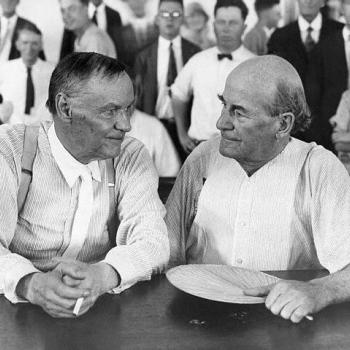
Students explore the rhetorical concept of audience and purpose by focusing on an issue that divided Americans in 1925, the debate of evolution versus creationism raised by the Scopes Monkey Trial. Students first become familiar with the case by reviewing a newspaper article and other resources with details about the trial. They then identify the purpose and audience of a newspaper article about the trial, and explain how the purpose and audience for the article shaped the text. Then, students brainstorm a list of positions someone writing about the trial might take and the audience they might address as they consider how audience and purpose might shape other communication on the issue using an online Audience Analysis Inventory tool.
From Theory to Practice
The NCTE Beliefs about the Teaching of Writing offer principles that should guide effective teaching practice in English language arts and across the content areas. These guidelines include the recognition that "Writing grows out of many different purposes." These purposes, the Beliefs explain, "grow out of and create various relationships between the writer and the potential reader, and relationships reflected in degrees of formality in language, as well as assumptions about what knowledge and experience is already shared, and what needs to be explained." In short, the purpose of every piece of writing is closely tied to the readers, the audience for that piece of writing.
Because of the significant role of purpose and audience, teaching must directly address these rhetorical aspects. As the Beliefs explain, "In order to make sure students are learning how writing differs when the purpose and the audience differ, it is important that teachers create opportunities for students to be in different kinds of writing situations, where the relationships and agendas are varied." This lesson plan offers students the chance to explore the range of audiences and purposes that a single issue can yield as well as to explore the ways that audience and purpose shape messages.
Further Reading
Common Core Standards
This resource has been aligned to the Common Core State Standards for states in which they have been adopted. If a state does not appear in the drop-down, CCSS alignments are forthcoming.
State Standards
This lesson has been aligned to standards in the following states. If a state does not appear in the drop-down, standard alignments are not currently available for that state.
NCTE/IRA National Standards for the English Language Arts
- 3. Students apply a wide range of strategies to comprehend, interpret, evaluate, and appreciate texts. They draw on their prior experience, their interactions with other readers and writers, their knowledge of word meaning and of other texts, their word identification strategies, and their understanding of textual features (e.g., sound-letter correspondence, sentence structure, context, graphics).
- 4. Students adjust their use of spoken, written, and visual language (e.g., conventions, style, vocabulary) to communicate effectively with a variety of audiences and for different purposes.
- 5. Students employ a wide range of strategies as they write and use different writing process elements appropriately to communicate with different audiences for a variety of purposes.
- 12. Students use spoken, written, and visual language to accomplish their own purposes (e.g., for learning, enjoyment, persuasion, and the exchange of information).
Printouts
Websites
Preparation
- Review resources on the Scopes Monkey Trial and choose materials appropriate for your classroom.
- Make copies or an overhead transparency of the Purpose and Audience Analysis sheet.
- Test the Audience Analysis Inventory on your computers to familiarize yourself with the tool and ensure that you have the Flash plug-in installed. You can download the plug-in from the technical support page.
Student Objectives
Students will
- develop an awareness of the needs of different audiences.
- identify ways that language is adjusted to communicate effectively with different audiences.
Session One
- Pass out copies of the 1925 New York Times story “Scopes Guilty, Fined $100, Scores Law; Benediction Ends Trial, Appeal Starts; Darrow Answers Nine Bryan Questions” or another newspaper article or resource with details on the trial.
- Ask students to share what they know about the Scopes Monkey Trial. If their knowledge on the trial is limited, use the resources from the ReadWriteThink calendar entry to provide basic information on the issue and events surrounding the “Trial of the Century.” The newsreel on the Scopes Trial from the PBS Evolution site is a nice overview of the issues as well.
- Ask students to read the article for homework and to pay particular attention to the kind of information and arguments included in the piece.
- If desired, share or allow students to explore additional resources on the Scopes Trial, using the Websites listed in the Resources section. The available resources include political cartoons, popular songs from the era, historical documents, and photographs.
Session Two
- Introduce or review the Purpose and Audience Analysis sheet.
- Ask students to identify the purpose and audience of the New York Times article that they read for homework. Note their responses on the board or on chart paper.
- Next, ask students to identify how the purpose and audience for the article shaped the text itself. You might ask questions such as the following:
- What was the purpose of the article? How could you tell?
- What arguments and evidence were included in the article, and how did they help achieve the author’s purpose?
- What are the characteristics of the audience? Think about the audience’s age, gender, location, education, and so forth.
- How could you tell who the audience for the article was?
- What did the audience seem most interested in?
- How did the purpose and audience shape the kinds of details that were included?
- Why was the order of the information appropriate for the audience?
- What was the purpose of the article? How could you tell?
- If students explored additional resources on the Scopes Trial during the previous session, ask them to identify the audience and purpose of some of the additional texts if desired. The audience and purpose of the political cartoons and sheet music should be especially obvious, so they can provide easy success for students who are less experienced with audience analysis.
- Ask students to brainstorm a list of positions that someone writing about the trial might take and the related audiences that person might address. Again, note the information on the board or on chart paper.
- If students have difficulty getting started, ask them about possible positions first (e.g., who would someone who supported Scopes’ teaching communicate with?) After they decide on positions, ask them to think about audiences they might communicate that position to and the purposes for that communication. Encourage students to define very specific audiences and positions.
- Arrange the class into as many groups as you have audiences on the board (or narrow your list to 3 or 4 audiences if you prefer). Assign a position and audience to each group.
- Have each group work through the purpose questions on the Purpose and Audience Analysis sheet for the particular group they are considering.
- After students have had several minutes to answer the purpose questions, ask each group to share the information they identified with the rest of the class.
- Display and demonstrate the Audience Analysis Inventory for the class. Be sure that you demonstrate how to complete each of the following tasks in the interactive:
- Create additional subsections for their answers.
- Indent and outdent subsections.
- Reorder information using the Up and Down arrows.
- Use the Zoom buttons to navigate in the outline.
- Save an HTML file from the Print window.
- Print their finished work.
- Create additional subsections for their answers.
- Working in their groups, ask students to work through the questions in the Audience Analysis Inventory for their particular audience.
- Circulate among groups as they work, and remind students to print their finished inventory for you to read later.
- Once students have completed the Audience Analysis Inventory, ask each group to brainstorm ways that they would convince the particular audience of the specific position on the trial.
- After students have had ten to fifteen minutes to work, ask them to summarize their points on chart paper or on a section of the board. Ask each group to choose a representative to present their ideas to the rest of the class.
- When groups are ready, gather the class and ask each group to share their ideas with the rest of the class. Ask class members to listen for similarities and differences among the strategies that the groups would use to present their information to the specific audience.
- Once the presentations have been completed, ask students to identify how audience and purpose shaped the similarities and differences among the presentations.
- As students discuss the presentations, listen for general guidelines that students will be able to use in their own writing to specific audiences (e.g., the kinds of details that are included depend upon the position that the writer is arguing, the ways that information is shared depend upon the needs of the audience). Note these observations on the board.
- To summarize the ways that audience and purpose effect a message, ask students to review the list of general guidelines that you recorded. Have students make additions and revisions as necessary.
- Collect groups’ notes and Audience Analysis Inventory printouts so that you can review their work.
Extensions
- This lesson gives students the opportunity to practice audience analysis before they go on to compose texts. You might complete any composition project after this activity, asking students to analyze purpose and audience as part of their writing process. To extend the exploration of audience on the same topic, ask individual groups to create the texts that they have discussed in their small groups.
- Students can apply their knowledge of the ways that audience and purpose shape a message with the ReadWriteThink lesson plan Communicating on Local Issues: Exploring Audience in Persuasive Letter Writing. Introduce this lesson by connecting the ways that the Scopes Trial divided community members to the ways that local issues currently divide members of their own community.
- Continue the focus on the Scopes Trial by completing a lesson on the play Inherit the Wind, which was based on the historical events from the trial.
Student Assessment / Reflections
- As groups work, listen for comments that show a clear understanding of the ways that audience and purpose influence a message. Urge students to think critically about the questions included in the Audience Analysis Inventory and to refer to the information from their printouts as they sketch out possible ways to communicate with that audience.
- Check the printouts from the Audience Analysis Inventory for completion and effort. Look in particular for indications that students identified specific and detailed information about their audiences.
- After completing the analysis activities, ask students to write a a short, reflective journal entry that explains how they would address their audience and how they would meet the needs of their audience if they completed the related text. Ask them to discuss specifically what they learned about audience awareness from the assignment.
Add new comment