Fact or Fiction: Learning About Worms Using Diary of a Worm

- Preview |
- Standards |
- Resources & Preparation |
- Instructional Plan |
- Related Resources |
- Comments
Overview
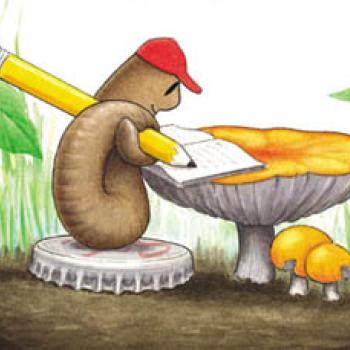
Do worms live underground? Are they good diggers? Can they really read and write? As students read Doreen Cronin's Diary of a Worm in this lesson, they learn to separate the facts from the fictional details. Students begin the lesson by brainstorming what they know about worms. They then begin examining the book in layers. Four read-aloud sessions engage students by focusing attention on different features of the text in each session. In a whole-group setting, students explore the illustrations, fictional details, nonfiction details, and captions and speech bubbles. In this way, students are given concrete strategies that they can use to help differentiate narrative and informational elements in other books they read.
Featured Resources
Concept Map graphic organizer: Students can use this graphic organizer to list facts they learn about worms as they read the story.
From Theory to Practice
- In their book, Kletzien and Dreher describe several techniques for introducing and teaching comprehension strategies specific to informational texts. These same strategies are useful for fully appreciating and understanding fictional texts that incorporate informational elements. These comprehension strategies include accessing prior knowledge, predicting, questioning, making connections, visualizing, inferencing, using text structure to identify major ideas, paraphrasing, clarifying, summarizing, and creating pictures and graphs (56).
- We know that strategies can be effectively taught when they are introduced one at a time, with the teacher explaining directly what the strategy is, how to use it, and when it is appropriate.
- Students need to have scaffolded lessons in which the teacher gradually releases the responsibility for using the strategy to the student. It is vitally important, however, to have this practice within the context of real reading for meaning so that students will learn the importance of using these strategies for comprehension. Explicit explanation and practice (of comprehension strategies) in connected reading are the best ways for children to become strategic readers.
Common Core Standards
This resource has been aligned to the Common Core State Standards for states in which they have been adopted. If a state does not appear in the drop-down, CCSS alignments are forthcoming.
State Standards
This lesson has been aligned to standards in the following states. If a state does not appear in the drop-down, standard alignments are not currently available for that state.
NCTE/IRA National Standards for the English Language Arts
- 1. Students read a wide range of print and nonprint texts to build an understanding of texts, of themselves, and of the cultures of the United States and the world; to acquire new information; to respond to the needs and demands of society and the workplace; and for personal fulfillment. Among these texts are fiction and nonfiction, classic and contemporary works.
- 3. Students apply a wide range of strategies to comprehend, interpret, evaluate, and appreciate texts. They draw on their prior experience, their interactions with other readers and writers, their knowledge of word meaning and of other texts, their word identification strategies, and their understanding of textual features (e.g., sound-letter correspondence, sentence structure, context, graphics).
- 6. Students apply knowledge of language structure, language conventions (e.g., spelling and punctuation), media techniques, figurative language, and genre to create, critique, and discuss print and nonprint texts.
- 12. Students use spoken, written, and visual language to accomplish their own purposes (e.g., for learning, enjoyment, persuasion, and the exchange of information).
Materials and Technology
- Diary of a Worm by Doreen Cronin (HarperCollins, 2003)
- Chart paper and chart stand OR overhead projector and blank overheads
- Student response journals
- Sticky notes of various sizes
- Computer with Internet access and projection capabilities (see Step 9 in Session 1)
Printouts
- Concept Map graphic organizer
- Story Map graphic organizer
Websites
Preparation
| 1. | Obtain and familiarize yourself with the book Diary of a Worm by Doreen Cronin. |
| 2. | Have chart paper or an overhead ready. |
| 3. | Prepare the necessary blank graphic organizers for Sessions 2 and 3, either on chart paper or an overhead transparency. This lesson contains samples of the Story Map and Concept Map graphic organizers; please note that these handouts are not meant to be photocopied for student use. They are for your reference only. For other graphic organizer samples, visit Education Place: Graphic Organizers or WriteDesign Online: Graphic Organizers. |
Student Objectives
Students will
- Use effective strategies for reading and understanding a text
- Distinguish between the factual and fictional elements of a text
- Examine vocabulary through careful examination of a text
- Categorize factual information about a topic using graphic organizers as an aid in comprehension
- Apply higher-level thinking skills through oral discussion and the use of graphic organizers
Session 1: Illustrations
In the first session, the focus will be on the illustrations in Diary of a Worm by Doreen Cronin. You will not read the book; rather, you will conduct a "picture walk," in which you display the pictures and elicit predictions and responses to the illustrations from the students. Some teachers prefer to cover the text in a book when doing a picture walk. If you wish, you can cover the text with Sticky notes.
| 1. | Gather the students around you to prepare for the first read-aloud. |
| 2. | Do not show the book right away. Ask students, "Tell me anything that comes to mind when you hear the word worms." |
| 3. | Record all responses on chart paper, and ask the student who gave the response, "What made you think of that idea?" This list will serve as a starting point in assessing their background knowledge about worms. |
| 4. | Show the cover of Diary of a Worm. Ask students for predictions of what the book will be about. |
| 5. | Let students know that you are going to "read" this book by looking only at the illustrations. Tell them that you will read the words in the next session, but for now it is important to see what information the pictures reveal about worms. Explain that Diary of a Worm is a different kind of book that contains both a fictional story about worms and facts about worms. |
| 6. | Begin the picture walk, pausing at each page to show the illustrations. Ask students, "What do you think this picture is telling us about worms? What makes you say that? Do you think this is something we should add to our list of facts?" |
| 7. | If students tend to want to add fictional rather than factual information to the list, you may wish to further probe them with questions such as, "Do you think that situation could really happen? Why or why not?" Remind them that the list is what they know about worms. (For example, on the April 4 diary entry, there is a picture of a garden with a cutaway showing worms underground. The fact portion of the picture is that worms live underground in homes they dig and tunnel out. The fictional part of the picture shows the worms reading and sleeping. It is important that the students are able to differentiate between fact and fiction in the pictures.) |
| 8. | After you have finished the picture walk, review the list of facts about worms. Talk about what students predicted correctly; summarize what they know about worms. |
| 9. | If you find students have very little background knowledge about worms after doing the picture walk and creating the list, you may wish to visit The Adventures of Herman as a class to build this necessary knowledge before moving on to Session 2. |
Session 2: Narrative text
| 1. | Review the list from Session 1. Remind students that all of the information came from their prior knowledge of worms and by looking at the pictures in a book. |
| 2. | Remind students that Diary of a Worm is a different kind of book that includes both facts and a story combined together. Let them know that in the previous session you began looking at the facts and this time you will look at the story. |
| 3. | Review the cover to reinforce concepts of print. (Where is the title? What else do we find on the book cover?) |
| 4. | Skip the inside cover for now. You will focus on that page during Session 4. |
| 5. | Turn to the title page. Again, take the opportunity to reinforce some concepts of print. (Point to the title. What do we call this page? Where do we begin reading?) |
| 6. | An important feature of this book is that it is written in the form of a diary. You don't want to focus too much on the diary format at this time, as there are so many other features that you want students to examine. However, you should point out that the book is written in the form of a diary, which means the writer puts a date on the page and writes down what happened on that day. |
| 7. | Begin reading, pausing only two or three times at specific points in the book to assess comprehension by asking questions or doing a think-aloud. Some suggested pause points include:
|
| 8. | The target concept of this book is that the earth needs worms and worms need the earth-they are codependent. After you have finished reading the book, ask students what they think was meant by "the earth never forgets we're here?" This discussion will assist you in assessing their understanding of the story. |
| 9. | Invite students' responses to the book. What was your favorite part? What made you laugh? What parts could really happen and what parts couldn't happen? |
| 10. | Summarize the story by filling in the Story Map graphic organizer with students, using an enlarged copy on chart paper or the overhead. |
| 11. | Let students know that you will read Diary of a Worm again, next time looking at yet another part of the book. |
Session 3: Informational text
Note: Since you will focus on the speech bubbles during Session 4, you may wish to cover them with Sticky notes for this session.
| 1. | Review your list of facts from Session 1. Remind students that the purpose in making the list was to help them better understand the new book, as it includes both factual and fictional elements. |
| 2. | Let students know that, in this session, you will be reading Diary of a Worm again, but this time they will gather information in a different way. |
| 3. | Show students the Concept Map graphic organizer that you have prepared. The word worms should be written in the box labeled "Main Concept." |
| 4. | Let students know that as you read the story, you want them to listen for information that can be placed on this graphic organizer. Tell them to listen specifically for:
|
| 5. | If you have covered the speech bubbles with Sticky notes, tell the students why. "You probably noticed that the other day when we did our picture walk, I covered the words with Sticky notes, and today I have covered a different part of the page with Sticky notes. That's because there is a lot of information in this book, and so we have to read it a little differently than we normally do when there is just a story. We need to look at it piece by piece, and look at it over and over again to get all of the information we can out of it. This is a good strategy to remember when you read other books like this." |
| 6. | Read through the book, stopping every few pages to review and add to the graphic organizer. You may need to jumpstart the process by providing an example for Attributes. For example, on the March 29 diary entry the text reads, "Today I tried to teach Spider how to dig." Ask the students, "What does this tell us about worms?" The fact that worms like to dig can be added to the organizer under Attributes because it tells something about what worms are like. |
| 7. | Encourage students to raise their hands when they hear something else that should be added to the organizer. If they give you a response that is not found in the text, ask them, "What did I read that makes you say that?" Let them know that although they are probably correct, only information from the text will be added to the organizer right now. [You might also invite them to add their new facts to the list they made during Session 1.] |
| 8. | After you have finished reading, review the concept map. Look for boxes that are blank, and ask students if there was anything in the text that could help fill in the blanks. For example, the Category and Cousins sections of the organizer will likely not be filled in because that information is not in the text. In the Cousins section, you may wish to include "earthworms" because that can be identified from the book. |
| 9. | Explain to students that it is okay that the entire organizer is not filled in. This tells us that one book does not usually give us all the information we need. |
| 10. | Ask students to write in their response journals what they know about worms so far. Emergent writers may draw a picture and conference with you about it. |
Session 4: Additional details
| 1. | Review the features of combined text, as previously examined in Diary of a Worm. Let students know that in this final reading of the book, you will look at the speech bubbles and the worm "photographs" to see what information they can give you about either the story or the facts. |
| 2. | Turn to the inside cover. Examine the "photographs" and captions with students. Begin a shared writing piece with the title "Worms." |
| 3. | Explain to students that they will create a shared writing piece about what they have learned from the story Diary of a Worm. The writing will include factual information about worms. Although the photos and captions in the story contain both factual and fictional information, the shared writing should be factual. |
| 4. | Print students' sentences on the board or overhead as they think of them. For example, after reviewing the inside front cover, students might suggest a sentence such as, "Worms like to dig, and they can build tunnels." |
| 5. | You can also make this an interactive writing session by allowing the students to come up and "share the pen." They can print any words they know or can refer to the word in the speech bubble that made them think of their sentence, and let you print the remainder of the sentence. |
| 6. | Some of the speech bubbles will not lend themselves to sentences. Help students discern which ones are important to the shared writing experience and which ones are not. Use questioning techniques to encourage a rich discussion around the pictures with speech bubbles, as this will also build vocabulary, deepen knowledge, and build oral fluency. For example, a wonderful discussion can evolve from examining the picture of the worm family on vacation on Compost Island. |
| 7. | When finished, read your shared writing together. As time permits, you may wish to use this piece of shared writing to highlight concepts such as punctuation, formation of letters in printing, and the use of descriptive words. Realistically, there will not be time for a minilesson on writing conventions during this session; keep the shared writing to use at a later date. |
| 8. | Place Diary of a Worm in the classroom library for students to revisit during independent reading. |
Extensions
- Examine the diary genre by creating a timeline of the book with students.
- Invite students to visit Worm World to find out more about worms and to finish the Concept Map from Session 3.
- Bring a worm farm into your classroom and watch it evolve!
Student Assessment / Reflections
Ongoing assessment, mainly through observation and examination of student responses, is crucial throughout the four sessions. Use the information gathered to help you in your planning for each subsequent session. Is more background knowledge needed? Are students grasping the idea that the book combines fact and fiction? Can they distinguish between the two? Are they engaged? Some specific suggestions follow:
- Examine the journals completed after Session 2 to determine students' level of understanding and their ability to distinguish fact from fiction in Diary of a Worm. This may require probing questions on your part—"What makes you say that? Where in the story did you see (hear) that? Could that situation really happen?"
- Analyze students' oral responses during the shared writing activity (Session 4) to assess their ability to formulate sentences and discern factual from fictional elements in the story.
- Ask individual students to read their favorite page from the book and tell you why it is their favorite. This oral reading will assist you in assessing fluency and comprehension.
Once again that you so much for sharing your work!
Once again that you so much for sharing your work!
Once again that you so much for sharing your work!
Add new comment