The Feature Story—Fifteen Minutes (and 500 Words) of Fame!

- Preview |
- Standards |
- Resources & Preparation |
- Instructional Plan |
- Related Resources |
- Comments
Overview
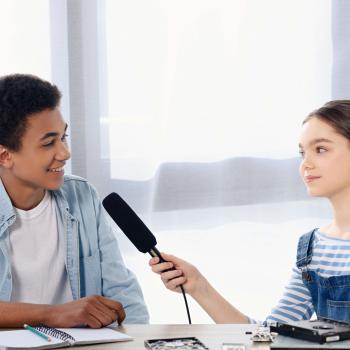
At the heart of all feature stories is human interest. This lesson asks students to write a profile of a classmate, with a particular focus on a talent, interest, or passion of that classmate. As an introduction to the feature article, students compare the characteristics of a hard news story to those of a feature story. They then practice writing about the same event in the two different styles. Next, they list and freewrite about their own talents and interests. These topics then become the focus of a feature story as students randomly select topics noted by classmates and write interview questions based on them. Finally, students interview a classmate, write a feature story, and share it with the class. This lesson enables students to practice interviewing techniques, develop voice, learn to write for an audience, and perhaps most importantly, celebrate their individual strengths.
Featured Resources
Qualities of a Feature Story: This handout lists the main characteristics of a feature story.
Printing Press: Students can use this online tool to publish their writing as a newspaper, flyer, brochure, or booklet.
From Theory to Practice
This lesson plan taps two pedagogical beliefs-students work best in collaborative and supportive environments, and moving beyond the typical essay formats can help students grow as writers. In Go Public! Encouraging Student Writers to Publish, Susanne Rubenstein explains that the writing teacher: "must create a classroom environment that allows her students to see themselves and each other as writers, not students. In this classroom-turned-writing-community, the writers support and encourage each other, and, through their efforts, not only as fellow writers but also as readers and as editors, they work to strengthen both the quality of each other's work and the confidence of the writer. . . within this classroom-turned-writing-community, writers are engaged in work that has meaning outside of the classroom." (15)
This notion of collaborative growth in the writing classroom fits naturally with writing feature stories, which move beyond the typical personal essay format and give students the chance to share significant personal information with one another. Rubenstein explains, "Certainly there is nothing wrong with teaching students to write personal essays . . . . But as a form it is perhaps overused in middle and high school classrooms, and when students begin to see it as ‘the way one writes in school,' they adopt a writing voice that is academic and artificial and calculated to please the teacher alone" (43). To avoid this situation, Rubenstein invites students to "experiment with different genres to find their strong suit" (43). Feature stories provide just the right solution: "Through the writing and reading of each [feature] story, students come to learn a lot about each other in a very short time, and we are well on our way to becoming a community of writers" (44).
Further Reading
Common Core Standards
This resource has been aligned to the Common Core State Standards for states in which they have been adopted. If a state does not appear in the drop-down, CCSS alignments are forthcoming.
State Standards
This lesson has been aligned to standards in the following states. If a state does not appear in the drop-down, standard alignments are not currently available for that state.
NCTE/IRA National Standards for the English Language Arts
- 1. Students read a wide range of print and nonprint texts to build an understanding of texts, of themselves, and of the cultures of the United States and the world; to acquire new information; to respond to the needs and demands of society and the workplace; and for personal fulfillment. Among these texts are fiction and nonfiction, classic and contemporary works.
- 3. Students apply a wide range of strategies to comprehend, interpret, evaluate, and appreciate texts. They draw on their prior experience, their interactions with other readers and writers, their knowledge of word meaning and of other texts, their word identification strategies, and their understanding of textual features (e.g., sound-letter correspondence, sentence structure, context, graphics).
- 4. Students adjust their use of spoken, written, and visual language (e.g., conventions, style, vocabulary) to communicate effectively with a variety of audiences and for different purposes.
- 5. Students employ a wide range of strategies as they write and use different writing process elements appropriately to communicate with different audiences for a variety of purposes.
- 6. Students apply knowledge of language structure, language conventions (e.g., spelling and punctuation), media techniques, figurative language, and genre to create, critique, and discuss print and nonprint texts.
- 7. Students conduct research on issues and interests by generating ideas and questions, and by posing problems. They gather, evaluate, and synthesize data from a variety of sources (e.g., print and nonprint texts, artifacts, people) to communicate their discoveries in ways that suit their purpose and audience.
- 8. Students use a variety of technological and information resources (e.g., libraries, databases, computer networks, video) to gather and synthesize information and to create and communicate knowledge.
- 9. Students develop an understanding of and respect for diversity in language use, patterns, and dialects across cultures, ethnic groups, geographic regions, and social roles.
- 11. Students participate as knowledgeable, reflective, creative, and critical members of a variety of literacy communities.
- 12. Students use spoken, written, and visual language to accomplish their own purposes (e.g., for learning, enjoyment, persuasion, and the exchange of information).
Materials and Technology
Sample newspapers and magazines (see Websites for possible online sources)
Printouts
Websites
Preparation
- Collect issues of newspapers and magazine that students can use in class. Include both national and local publications.
- Collect sample feature stories that offer personality profiles. Look for recently published pieces in newspapers and magazines, especially pieces about people with whom students are familiar. A good source is Parade—The Sunday Newspaper Magazine. Also some local papers in their annual back to school issues publish feature stories about area teenagers. These are especially effective and engaging for students.
- Prepare copies of the handouts for the lesson:
- Qualities of a Feature Story
- Reviewer Response Sheet, if needed for response group work.
- Sample Leads for Feature Stories
- Student Reflection Sheet
- Qualities of a Feature Story
- The Society of Professional Journalists offers a succinct description of feature reporting that can be used for teacher reference.
- Test the Printing Press on your computers to familiarize yourself with the tool and ensure that you have the Flash plug-in installed. You can download the plug-in from the technical support page.
Student Objectives
Students will
- read published feature stories and determine the characteristics of this genre.
- discover an appreciation for their own unique talents and those of their classmates.
- develop interviewing techniques and carry out an interview.
- consider the importance of audience.
- apply their knowledge by writing their own feature stories.
- employ all the steps of the writing process to create a polished piece.
- take the first steps toward writing for publication.
Session One
- Distribute copies of various newspapers and news magazines to small groups of students (3--4 students per group). Your goal during this session is to generate interest in the idea of a feature story and to guide students to understand the characteristics of the piece.
- Tell students to peruse the papers/magazines and find a hard news story. Ask each group to list the characteristics of the piece they find.
- Once groups have gathered the information, have each group report their findings. As the groups share the information, compile a class list of qualities of a news story on the board or on chart paper.
- Challenge students to peruse the same paper or magazine looking now for something that is almost a news story, but not quite. Ask them to look for a piece that gives more than the basic facts and that does more to tell a story. (If students are unfamiliar with journalistic writing, the teacher may need to offer help to individual groups.)
- Ask students to list the characteristics of this piece, and put their responses on the board. Use these two lists to help students understand the particular qualities of a feature story and its purpose. (Refer to Qualities of a Feature Story.)
- Give each group a topic and ask them to write first the beginning of a news story on that topic and then a feature story on the topic. Allow about eight minutes for each piece, just enough time for students to get a feel for the challenge of each and a sense of the "ingredients" of each. Possible topics include the following:
- a recent school event such as a homecoming parade
- a spring dance
- the hiring of a new teacher/administrator/coach
- the induction of students into a group such as the National Honor Society
- the selection of students for a team
- a story about a student who has won some honor or achieved some special distinction.
- a recent school event such as a homecoming parade
- Ask each group to read both pieces aloud, and use the content in conjunction with the lists already on the board to illustrate and emphasize the qualities of each journalistic style. Introduce students to the concept of "hard news" vs. "soft news."
Session Two
- To help students find a focus for their feature stories, and, in doing so, to generate a positive sense of self in each student as he/she acknowledges his/her strengths and abilities, begin class with a brainstorming activity in which students make two lists: one listing their talents, and the other listing their passions/interests. Allow about four minutes for each list.
- Encourage students to think beyond the obvious. Tell them, for example, that it is just as appropriate to note the ability to wiggle one's ears as it is to note one's skill at tennis!
- Go quickly around the room, asking students to share one item from each list. Continue to encourage them to name an unusual talent or passion. Allow class comments and discussion, as this will generate enthusiasm for the project.
- Ask students a series of prewriting questions from the Prewriting Questions: What Makes you Interesting? to generate more material that highlights the uniqueness of each student.
- Instruct students to choose any one item from the talent list (it may be the one shared or another one entirely) and to freewrite about that talent for six minutes.
- Repeat this process with an item from the interest list.
- Finally, repeat with something from the responses to the What Makes You Interesting? prewriting questions.
- Ask for one student volunteer to share the topic of one of his or her freewrites. Put the topic on the board, and ask other students what they would like to know about the topic. Fill the board with their questions.
- Ask the student to read her or his freewrite, and direct the class to note how many of their questions were answered.
- Explain to the class that in six minutes, one would not expect a writer to be able to tell everything about his/her passion; but that this exercise demonstrates that there is much to tell and that an audience is interested.
- Use the questions on the board to generate discussion of what makes a good interview question. Guide students to see that the best questions lead to more questions. Promote a discussion of interview techniques in terms of note taking, courtesy, respecting privacy, etc.
- To read as a homework assignment, give students 2 or 3 sample feature stories that present human profiles, as gathered in the preparation of this lesson.
Session Three
- To begin the interview process and determine a feature story focus, give students each a slip of paper when they enter the classroom, and ask them to put two of their most significant interests, abilities, or unique experiences/qualities on that slip. Put the papers in a box.
- Allow each student to randomly draw a slip of paper. At this point, students should not acknowledge to whom the paper belongs. It's best if students do not know whom they will be interviewing at the early stages of planning the interview.
- Give students 10 or 15 minutes to list as many good questions as they can for these two topics. Then ask each student to pair up with another student, share the assigned topics and the lists of questions, and try to add to each other's lists.
- Begin the actual interview process. Establish interview pairs. This can be done either by a random draw, or the teacher can assign pairs in order to ensure that students are interviewing someone whom they do not know well.
- Allow ten minutes per student for each introductory interview. Encourage students to use this introductory time to explore a focus for the interview. (They do not have to use both interests/talents provided on the slip of paper, but having two choices can give students more options. Sometimes, moreover, a story can blend the two.)
- Tell interviewers to also seek out basic factual information.
- Remind students of the importance of strong quotes in a feature story. Encourage them to take detailed notes (or use tape or audio recorders, if preferred). Tell students that they will be given additional time during the next class session to take the interview further and to recheck important information.
- At the end of class, suggest that students who are unfamiliar with the subject(s) their interviewee is interested in should do further research on the topic at home. Remind students that professional writers often have to "do their homework" in terms of researching topics they are going to write about.
- Instruct all students to refine interview questions for homework and to determine what else they will need to know to write a complete story.
- Tell interviewers and interviewees to be thinking about a photograph that can accompany the story. This should be a photo of the interviewee involved in the activity the story describes or of something connected to the story (i.e., a photo of the artwork of a student who paints, the project of an Eagle Scout, the items a collector collects).
Session Four
- Choose one of the feature stories students read for homework at the end of Session Two, and use that to encourage class discussion on the design of the feature story.
- Using examples from that story, point out the the following characteristics:
- importance of a clear focus for the story.
- a strong, attention-getting opening (the lead).
- an equally memorable ending (often a quote).
- the use of correctly quoted material throughout.
- the inclusion of significant background information.
- verified factual data (including the subject's name spelled correctly!).
- the importance of a unique writing voice that captures the writer's own style.
- importance of a clear focus for the story.
- Have students determine the intended audience for this particular feature story.
- Point out the ways that the focus, language, background information, and other aspects change depending on the audience.
- Guide students to recognize the importance of these two questions:
- Who is my audience? and
- What response do I want from this audience?
- Who is my audience? and
- Allow students to conduct the second phase of their interviews. Tell students to ask all remaining questions, verify important information (e.g., names, dates, spellings), and be sure they have a clear focus for the story.
- Ask students to discuss with their partners the choice of photograph. They might choose a picture that already exists, or, if it needs to be taken in class, the teacher should allow time and opportunity for that. (Note: If students don't have access to cameras, the teacher can provide a time for picture taking using his/her own or the school's digital or 35mm camera.)
- Instruct students to work on the first draft of the feature at home. Give students whatever amount of time is appropriate for the group to complete a first draft to share in response groups.
Session Five
- Have each pair of students join with another pair to share their stories and give and receive feedback. (Note: it is helpful to have both interviewer and interviewee in the same response group in case there is incorrect material in the story that needs to be corrected and revised.)
- If students are inexperienced with response, use the Reviewer Response Sheet to guide their work.
- Tell students to help each other create memorable and meaningful titles.
- When all students have received response on their stories, direct them to use this material to continue revising and rewriting their feature stories until they reach a final draft stage. If desired, students can compile the feature stories in a reader-friendly format using the Printing Press. The teacher can determine with student input how much additional time is need for completion.
Extensions
- This project works especially well at the start of the school year (or at the start of a second semester class) to help build a sense of community in the classroom OR as an end-of-the-year activity to "wrap up" a course and to celebrate the strengths of each member of the class. In addition, it could be a good activity if new students move to the school or transfer into the class.
- To encourage student publication, the feature stories can be:
- hung with accompanying photographs on the classroom wall or on a school-wide bulletin board
- collected in a class publication
- submitted to the high school or local newspaper.
- hung with accompanying photographs on the classroom wall or on a school-wide bulletin board
- Students may want to think about the "Feature Story of the Future," and write the story that could be written about them thirty years in the future.
- If a number of students are struggling with a particular aspect of the story (i.e., creating a good title, developing an interesting lead, organizing material logically), the teacher can conduct mini-workshops to help the group. For example, a mini-lesson on leads might include the Sample Leads for Feature Stories handout that promotes discussion of why certain leads work better than others and how weak leads can be improved.
- If students need more practice in mechanics of including quotations in their writing, the ReadWriteThink lessons Character Clash: A Mini-Lesson on Paragraphing and Dialogue and Inside or Outside? A Mini-Lesson on Quotation Marks and More can provide useful supplements to this activity.
- Have students use the Profile Publisher either as a template for gathering information on each other or as a way to publish the information that they find during their interviews.
Student Assessment / Reflections
- Grade each feature story as a complete writing assignment. When students are writing and revising their stories, they should be guided by the specific characteristics outlined in the handout of Qualities of a Feature Story and in the Reviewer Response Sheet.
- Students can assess their own work and learning by completing a reflection sheet that is handed in with the story. As with all reflection sheets, this should include 4–5 questions that make the reader think deeply about the piece and the process that led to its creation. Suggested questions include:
- What do you think is the strongest line in the story? Why?
- What do you think will most please the person the story is written about? Why?
- What part of the story are you still dissatisfied with? Why?
- What did you struggle with most in creating this story?
- Where could you include some more specific detail?
- What was the best piece of advice you got from your response group?
- Talk about yourself as a “journalist.” Is this a kind of writing you like or dislike? Why? What did you think about the interview process?
- What do you think is the strongest line in the story? Why?
Add new comment