Guided Comprehension: Previewing Using an Anticipation Guide


- Preview |
- Standards |
- Resources & Preparation |
- Instructional Plan |
- Related Resources |
- Comments
Overview
In this recurring lesson, students use an anticipation guide to preview and make predictions about texts. The lesson begins with teacher-directed whole-group instruction in which students are introduced to the concept of previewing and guided in completing a prepared anticipation guide for Teammates by Peter Golenbock. Students are then given an opportunity to complete a portion of the anticipation guide independently. In the days that follow, students work in both teacher-guided and student-facilitated groups to extend their use of the previewing strategy with other texts. Finally, students discuss as a class how using anticipation guides helped them better understand the reading.
Featured Resources
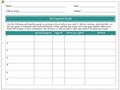 |
Blank Anticipation Guide: Use this printout to help students make and confirm predictions about the stories they read. |
From Theory to Practice
- Guided Comprehension is a context in which students learn comprehension strategies in a variety of settings using multiple levels and types of text. It is a three-stage process focused on direct instruction, application, and reflection.
- The Guided Comprehension Model progresses from explicit teaching to independent practice and transfer.
- Previewing is a comprehension strategy that involves activating prior knowledge, predicting, and setting a purpose for reading.
- Current studies demonstrate that when students experience explicit instruction of comprehension strategies, it improves their comprehension of new texts and topics (Hiebert et al., 1998).
Common Core Standards
This resource has been aligned to the Common Core State Standards for states in which they have been adopted. If a state does not appear in the drop-down, CCSS alignments are forthcoming.
State Standards
This lesson has been aligned to standards in the following states. If a state does not appear in the drop-down, standard alignments are not currently available for that state.
NCTE/IRA National Standards for the English Language Arts
- 1. Students read a wide range of print and nonprint texts to build an understanding of texts, of themselves, and of the cultures of the United States and the world; to acquire new information; to respond to the needs and demands of society and the workplace; and for personal fulfillment. Among these texts are fiction and nonfiction, classic and contemporary works.
- 2. Students read a wide range of literature from many periods in many genres to build an understanding of the many dimensions (e.g., philosophical, ethical, aesthetic) of human experience.
- 3. Students apply a wide range of strategies to comprehend, interpret, evaluate, and appreciate texts. They draw on their prior experience, their interactions with other readers and writers, their knowledge of word meaning and of other texts, their word identification strategies, and their understanding of textual features (e.g., sound-letter correspondence, sentence structure, context, graphics).
- 7. Students conduct research on issues and interests by generating ideas and questions, and by posing problems. They gather, evaluate, and synthesize data from a variety of sources (e.g., print and nonprint texts, artifacts, people) to communicate their discoveries in ways that suit their purpose and audience.
- 8. Students use a variety of technological and information resources (e.g., libraries, databases, computer networks, video) to gather and synthesize information and to create and communicate knowledge.
- 11. Students participate as knowledgeable, reflective, creative, and critical members of a variety of literacy communities.
Materials and Technology
- Several copies of Teammates by Peter Golenbock (Voyager Books, 1992)
- Three instructional-level texts (see Suggested Booklist for Jackie Robinson)
- Summary Sheet: Student-Facilitated Comprehension Routines
Printouts
Websites
Preparation
| 1. | Review the Teacher resources listed before using anticipation guides and the previewing strategy with your students. For more information on the previewing strategy and the Guided Comprehension Model, see Guided Comprehension in Grades 3–8 by Maureen McLaughlin and Mary Beth Allen. |
| 2. | Read Teammates and review the Anticipation Guide for Teammates to become familiar with the story. Photocopy a class set of the anticipation guide and prepare a transparency as well. |
| 3. | Photocopy a class set of the blank Anticipation Guide. |
| 4. | Gather three instructional-level texts that match the needs of three levels of reading in your class (see Suggested Booklist for Jackie Robinson). Create an anticipation guide for each text that you select using the blank Anticipation Guide sheet in preparation for the teacher-guided, small-group instruction (see Stage 2). |
NOTE: This lesson is intended as an introduction to the previewing strategy and the use of anticipation guides. With continued practice, students should be able to apply the previewing strategy independently to other texts.
Student Objectives
Students will
- Learn and have opportunities to apply the previewing strategy
- Work cooperatively and independently to make and then confirm predictions about a text using an anticipation guide
- Reflect on the previewing strategy and how it helps to extend their understanding of a text
Day 1
Stage 1—Teacher-directed whole-group instruction (40 minutes)
| 1. | Explain the strategy. Explain to students what previewing means (i.e., setting a purpose for reading). Show students the Anticipation Guide for Teammates and explain how it is used. Show students the cover of Teammates and ask them what they notice (e.g., men in baseball caps, one black man and one white man). Ask students what they know about having teammates. |
| 2. | Demonstrate the strategy. Read statement 1 in the first column of the Anticipation Guide for Teammates aloud and fill in the second column marked "Agree/Disagree." Then, read the first two pages of Teammates and demonstrate how to complete the last three columns of the anticipation guide for statement 1. Be sure to think aloud while modeling so that students can hear and understand your thought process. |
| 3. | Guide students to apply the strategy. As a whole class, have students mark whether they agree or disagree with statements 2–4 on the anticipation guide (column two only). Encourage student discussion. |
| 4. | Practice individually or in small groups. Have students work with the person next to them to decide whether they agree or disagree with statements 5–7 on the anticipation guide (column two only). Then read Teammates aloud and complete the last three columns for statements 2–4 together as a class. Students can pair off with the same partner to complete the last three columns for statements 5–7. |
| 5. | Reflect. Lead a short discussion with students about how the anticipation guide helped them to better understand the text. |
Stage 2—Teacher-guided small groups and student-facilitated independent practice (40 minutes)
Before beginning Stage 2, students must be divided into three instructional-level groups. Students with similar instructional needs should be grouped together. This does not necessarily mean that students in each group are on the same reading level. Instead, they may have similar needs for comprehension instruction (e.g., students who have trouble making inferences or students who need extra practice making connections between texts).
Students are working in three different areas during this stage:
- Teacher-guided small-group instruction
- Student-facilitated comprehension centers
- Student-facilitated comprehension routines
Classroom management is at the discretion of each individual teacher. You may want to assign students to small groups and set up a rotation schedule, or you may want to allow groups of students to choose their own activities. Regardless, each group of students needs to visit the three areas at least once in the three-day period.
| 1. | Teacher-guided small-group instruction. Choose one group to begin with you as follows:
|
| 2. | Student-facilitated comprehension centers. Students may be assigned to centers or choose activities on their own.
|
| 3. | Student-facilitated comprehension routines. Working in small groups, students engage in three different literacy strategies. Students should already be familiar with each of the strategies and have practiced them over time. For more information, review the Summary Sheet or refer to the text Guided Comprehension in Grades 3–8 by Maureen McLaughlin and Mary Beth Allen. |
Days 2 and 3
For Days 2 and 3, pick up where you left off the previous day. The suggested time for each session is 60 minutes, however, since the group on the first day only had 20 minutes in small groups, you may want to meet with them for another 20 minutes and then switch groups for the last 40 minutes. The rotation should continue until all three groups have visited all three areas. On Day 3, students will spend 40 minutes in small groups, leaving 20 minutes for whole-group reflection and discussion (see Stage 3).
Stage 3—Whole-group reflection (20 minutes)
| 1. | Talk to students about the previewing strategy. Ask them to tell why and how previewing helps them better understand texts. |
| 2. | Talk to students about the anticipation guides and how they helped to preview stories. |
| 3. | Give students time to share the activities they completed during the student-facilitated comprehension centers. |
Extensions
- Adapt this lesson and use it with students to preview another content-area text. With continued practice, students should be able to apply the previewing strategy independently.
- Access and use other lessons based on the Guided Comprehension Model to teach additional comprehension strategies:
- Guided Comprehension: Evaluating Using the Meeting of the Minds Technique
- Guided Comprehension: Knowing How Words Work Using Semantic Feature Analysis
- Guided Comprehension: Making Connections Using a Double-Entry Journal
- Guided Comprehension: Monitoring Using the INSERT Technique
- Guided Comprehension: Self-Questioning Using Question-Answer Relationships
- Guided Comprehension: Summarizing Using the QuIP Strategy
- Guided Comprehension: Visualizing Using the Sketch-to-Stretch Strategy
- Guided Comprehension: Evaluating Using the Meeting of the Minds Technique
- To extend the activities in this lesson, students may want to do further research on the life of Jackie Robinson using primary sources. The Digital Classroom website provides a list of primary sources for Jackie Robinson on the page, Teaching with Documents: Jackie Robinson, Civil Rights Advocate. Students can explore how primary sources differ from other types of information.
- Other interesting websites related to Jackie Robinson and the Negro Baseball Leagues include:
Student Assessment / Reflections
- Students should complete the Self-Reflection sheet to help monitor their own learning and self-regulate their progress. These evaluations will also give you insight into how well students are staying on task, as well as how well they are retaining and applying the previewing strategy.
- You can also assess students using their completed anticipation guides or any of the materials they worked on during the student-facilitated comprehension centers. Anticipation guides should be evaluated for correct format as well as content.
Add new comment