Listen, Look, and Learn: An Information-Gathering Process

- Preview |
- Standards |
- Resources & Preparation |
- Instructional Plan |
- Related Resources |
- Comments
Overview
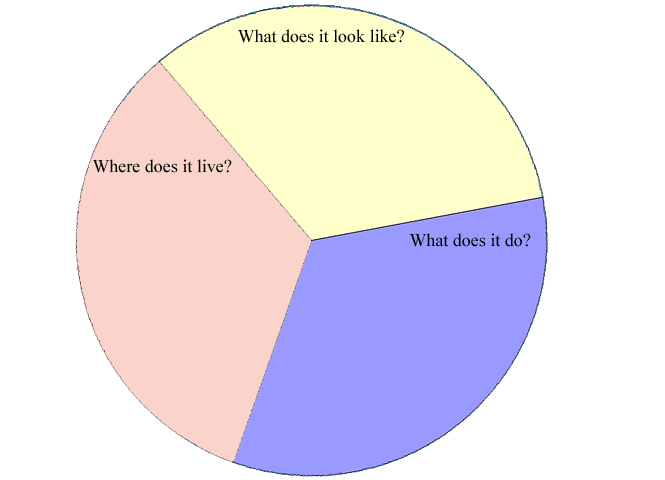
Learning to extract information from varied sources is essential to the learning process. This lesson models an information-gathering process for primary learners as they listen to and look at resources, seeking information pertinent to the questions on an information wheel. Students begin by reading and discussing Helen Lester's story Score One for the Sloths. Next, students are introduced to an information wheel—a circle divided into 3 large pieces, each labeled with a different question about the sloth. Questions include: where does it live? what does it look like? and what does it do ? Then various resources are shared with students as they decide where on the wheel each fact or statement about the sloth should be recorded. Guiding the listening, looking, and learning process helps students gain confidence and develop strategies for gathering information independently.
From Theory to Practice
In her book Planning for Inquiry: It's Not an Oxymoron!, Diane Parker poses a series of questions that make inquiry-based learning seem essential for elementary grade students: "Do we want them simply to memorize facts and procedures in order to pass a test? Or do we want them to want to know, to seek to know, and ultimately, to understand themselves and their world more deeply as a result of their knowing?" (5). Part of inquiry in the language arts classroom is learning to research, which must be explicitly taught. In her article "Rethinking Research," Eileen A. Simmons notes: "We can't expect students to produce outstanding research papers unless we teach them strategies for gathering information, analyzing, synthesizing, and evaluating that information through critical thinking." (115) This lesson helps primary students develop strategies for extracting and evaluating information.
Further Reading
Common Core Standards
This resource has been aligned to the Common Core State Standards for states in which they have been adopted. If a state does not appear in the drop-down, CCSS alignments are forthcoming.
State Standards
This lesson has been aligned to standards in the following states. If a state does not appear in the drop-down, standard alignments are not currently available for that state.
NCTE/IRA National Standards for the English Language Arts
- 1. Students read a wide range of print and nonprint texts to build an understanding of texts, of themselves, and of the cultures of the United States and the world; to acquire new information; to respond to the needs and demands of society and the workplace; and for personal fulfillment. Among these texts are fiction and nonfiction, classic and contemporary works.
- 7. Students conduct research on issues and interests by generating ideas and questions, and by posing problems. They gather, evaluate, and synthesize data from a variety of sources (e.g., print and nonprint texts, artifacts, people) to communicate their discoveries in ways that suit their purpose and audience.
Materials and Technology
- Score One For The Sloths by Helen Lester (Houghton Mifflin, 2001)
- Animal Specialists by Nathan Aaseng (Lerner Publications, 1987)
- "Sloth" in World Book Student Discovery Encyclopedia, Vol. 10, p. 121 (World Book, Inc., 2000)
Printouts
Websites
Pease note that there are advertisements on this site.
Preparation
- Gather resources listed in the Resources section.
- The diagram of a sloth can either be projected directly from a computer or printed out and made into a transparency for overhead projection.
- Create an information wheel by drawing a large circle on poster board, following the model Information Wheel provided:
- Divide the circle into 3 large pie pieces. The three sections should be labeled, each with a different question:
- Where does it live?
- What does it look like?
- What does it do?
- Where does it live?
- "Topic: Sloth" should be printed in large letters above the wheel.
- Divide the circle into 3 large pie pieces. The three sections should be labeled, each with a different question:

Student Objectives
Students will
- comprehend the nature and the intent of the questions on the information wheel.
- listen to and look for information that helps to answer each of the questions.
- determine what fact fragments or notes will be recorded under each question on the information wheel.
- discuss how the information is similar and different in each of the resources.
- begin to develop the inital skills of selecting and sorting information leading to increasingly independent application of information-gathering skills.
Instruction & Activities
- Read and discuss Score One for the Sloths.
- Discuss how can we learn about the real sloth.
- Introduce the Information Wheel concept if students are unfamiliar with it, encouraging the students to see themselves as information detectives at work.
- Read or show each of the information sources listed in the Resources, asking students to raise their hands when they have seen or heard something that should be recorded on the Information Wheel. Each time a hand is raised, stop the reading or showing, and allow the student to share the information and to indicate what and where the note will be recorded on the Information Wheel.
- When the first item is shared, model the way to turn the sentence (or paragraph) into a fact fragment or note—cutting the information into a fact phrase (See example below). Emphasize how taking notes in this way will help them to create reports in their own words later, thus reducing the chance of plagiarism.
Excerpt from Enchanted Learning Website:
"The sloth is a slow-moving mammal that lives in trees. Sloths spend most of their lives hanging upside-down from tree branches."
Related Fact Phrases:- slow-moving
- mammal
- lives in trees
- hangs upside-down
- slow-moving
- Students continue to identify fact fragments to add to the Information Wheel, indicating the question which the information should be recorded under.
- Complete the lesson by discussing how the process worked, noting that the next step would be to work together to write a class report on the sloth.
Extensions
The topic could be varied using a bird, fish, reptile, insect, another mammal, amphibian, a plant, a natural event, an invention, or a machine. You'll need to modify the Information Wheel slightly for some of these options, as shown below.
Interest in the topic might evolve from a story, a curriculum unit of study, or a class or personal experience. Subsequent Listen, Look and Learn experiences might be in small groups facilitated by an adult, culminating in a group written mini-report.
- Questions for Natural Event
- Where does it happen?
- What does it look like?
- How does it work?
- Questions for Machine or Invention
- What does it look like?
- What does it do?
- How does it work?
Student Assessment / Reflections
- Observation of student interest during the lesson.
- Observation of contributions of students throughout the notetaking phase.
- Anecdotal notes about student participation and understanding shared with the classroom teacher if the lesson is taught outside of the classroom.
Add new comment