Literary Scrapbooks Online: An Electronic Reader-Response Project


- Preview |
- Standards |
- Resources & Preparation |
- Instructional Plan |
- Related Resources |
- Comments
Overview
This lesson leads students to reflect on and respond to literature by creating an online scrapbook. Students view a sample electronic scrapbook and use the project rubric to evaluate it, becoming familiar with the project requirements in the process. They use an online tool to evaluate resources on a topic related to a piece of literature and post their evaluations for class reference. Students then use online resources to capture “scraps” of information about their assigned topic and create a scrapbook using PowerPoint or another presentation software, making sure to cite all their sources. They share their online scrapbook with the class, defending their choice of scrapbook entries: why is the entry important to the understanding of the topic?
This lesson focuses on The Adventures of Huckleberry Finn by Mark Twain, but any piece of literature could be used for the basis of an online scrapbook.
Featured Resources
Directions for Creating an Electronic Scrapbook: This resource provides printable directions for the literary scrapbook project.
Website Evaluation Form: Students can use this online tool to evaluate Websites for audience, purpose, authorship, and relevance.
From Theory to Practice
As teachers, we know that incorporating technology into our classrooms is an exciting way to get students engaged, and critically thinking about the curriculum. In his article in English Journal, Alan Perry cites research to support this idea: "Theorists such as Gardner, Smagorinsky, and Wilson and Castner claim that the creation of technology projects helps students to learn through multiple intelligences. Freeman says that multimedia presentations also provide an opportunity for students to work together collaboratively and hone public speaking skills as they make their presentations before an audience." In this lesson on electronic scrapbooks, students will be working on all of these skills while investigating issues that interest them in relationship to their reading. By responding their readings in this way, students take advantage of the best of reader-response theory in a context designed to let students' multiple intelligences shine through.
Further Reading
Common Core Standards
This resource has been aligned to the Common Core State Standards for states in which they have been adopted. If a state does not appear in the drop-down, CCSS alignments are forthcoming.
State Standards
This lesson has been aligned to standards in the following states. If a state does not appear in the drop-down, standard alignments are not currently available for that state.
NCTE/IRA National Standards for the English Language Arts
- 1. Students read a wide range of print and nonprint texts to build an understanding of texts, of themselves, and of the cultures of the United States and the world; to acquire new information; to respond to the needs and demands of society and the workplace; and for personal fulfillment. Among these texts are fiction and nonfiction, classic and contemporary works.
- 3. Students apply a wide range of strategies to comprehend, interpret, evaluate, and appreciate texts. They draw on their prior experience, their interactions with other readers and writers, their knowledge of word meaning and of other texts, their word identification strategies, and their understanding of textual features (e.g., sound-letter correspondence, sentence structure, context, graphics).
- 4. Students adjust their use of spoken, written, and visual language (e.g., conventions, style, vocabulary) to communicate effectively with a variety of audiences and for different purposes.
- 5. Students employ a wide range of strategies as they write and use different writing process elements appropriately to communicate with different audiences for a variety of purposes.
- 7. Students conduct research on issues and interests by generating ideas and questions, and by posing problems. They gather, evaluate, and synthesize data from a variety of sources (e.g., print and nonprint texts, artifacts, people) to communicate their discoveries in ways that suit their purpose and audience.
- 8. Students use a variety of technological and information resources (e.g., libraries, databases, computer networks, video) to gather and synthesize information and to create and communicate knowledge.
- 12. Students use spoken, written, and visual language to accomplish their own purposes (e.g., for learning, enjoyment, persuasion, and the exchange of information).
Materials and Technology
- PowerPoint software, or a similar piece of presentation software
- Internet access
- LCD projector, or large monitor
- Sample Electronic Scrapbook: Mark Twain, An American Icon
Printouts
Websites
Preparation
- Students should have finished reading Huckleberry Finn, or the selected piece of literature.
- Choose the software that students will use to publish their scrapbooks. This lesson assumes that students are using PowerPoint; however, you can adapt the lesson to use other presentation software or Web publishing software.
- Students should have a working knowledge of PowerPoint and its capabilities. Consult the PowerPoint Design Tips handout if needed.
- If your students need extra practice or a more structured introduction to finding and evaluating Websites, complete the Inquiry on the Internet: Evaluating Web Pages for a Class Collection lesson before beginning this project.
- If desired, arrange for additional sites for students to explore. Try to limit the time that students spend freely "surfing the Web" to ensure the best use of class time.
- Test the Interactive Website Evaluation Form on your computers to familiarize yourself with the tools and ensure that you have the Flash plug-in installed. You can download the plug-in from the technical support page.
Student Objectives
Students will
- critically read a piece of literature.
- select a topic or theme from the piece of literature and construct their own definition or meaning of it, informed by research on the Internet.
- select from online sources what they feel is important to the understanding of concepts presented in the novel.
- create an electronic scrapbook using PowerPoint to present their relevant information about a given topic.
- develop oral presentation skills through practice and oral delivery of the online scrapbook to class members.
- document Web sources accurately.
- assess their own working using a checklist.
Session One: What is an electronic scrapbook?
- Generate discussion by beginning the session with questions:
- What is a scrapbook?
- What types of things do you find in a scrapbook?
- Have you ever kept a scrapbook?
- What is a scrapbook?
- If desired, you may want to share your own personal scrapbooks with the class.
- After introducing the idea of a scrapbook, explain that for this activity students will create electronic scrapbooks about a piece of literature that they have read, in this particular lesson plan, Huckleberry Finn.
- Use the sample scrapbook Mark Twain, An American Icon to show what an online scrapbook may look like when finished. The online version of the Lewis Carroll Scrapbook Collection and the scrapbooks at Heritage Scrapbooks: Scrapbooking through Time can be used as additional examples, as needed.
- Explain the role of Internet research in the project and that much, if not most, of the information in the scrapbooks will come from the Internet. If desired, allow students to search for other Websites to supplement those provided.
- Pass out the list of topics or themes for the project.
- If desired, pair students to work on the project together rather than having students work independently.
- Pass out the rubric that will be used to assess their electronic scrapbooks. Discuss the components and expectations for the project.
- Make connections between the requirements outlined in the rubric and the sample.
- Emphasize that student scrapbooks do not have to look like the sample.
- Encourage students to use their creativity when they think of the term "scrapbook."
- Make connections between the requirements outlined in the rubric and the sample.
- If desired, invite the students to assess the scrapbook example using the rubric, so they have first hand knowledge of the expectations. This can be done as a whole class activity or in groups, and shared with the rest of the class.
Session Two: Evaluating Web Resources
- Share the Website Evaluation Form, which provides a basic list of questions students can use to determine whether a site is appropriate for the project.
- Explain that you'll evaluate several sites as a class in order to demonstrate how the process works, using the Website Evaluation Form Student Interactive.
- Take the opportunity to demonstrate the technical process of using the student interactive, providing pointers on how the tool works. Be sure to work all the way through to printing the responses by using the Finish button at the top of the interactive after answering all of the questions.
- Answer any questions that students have about the process.
- Once you're certain that students understand the basics of Internet searches, point students to the Website Evaluation Form Student Interactive or distribute copies of the Website Evaluation Form (PDF) for students to use as they evaluate the sites that they find. If you use the interactive, explain that students can use the tool as many times as needed to evaluate all the resources that they find.
- Assign each student a Web site to research, or several sites to small groups to explore.
- Ask students to work through the Twain sites on the Themes and Topics list, keeping track of which ones are most useful and what kind of resources they provide for the project. Explain that students will share their findings with the rest of the class.
- Circulate among students as they work, providing feedback and support. If some students complete the task earlier than others, you might allow them to search the Internet for more sites pertaining to the topic, as time allows.
- After students have completed their evaluation, ask each student to share details about the sites. If possible, students might post their reviews in the classroom or share their reviews electronically. The reviews should be a resource for students as they continue their work on this project, by helping them determine which sites are most useful for their scrapbooks. You might compare the evaluations to book reviews, which provide potential readers with information to help them decide whether to read a book themselves.
Session Three: How to Create Scrapbooks
- Pass out the Directions for Creating Electronic Scrapbooks.
- Model the steps in the process using an LCD projector for students, in as much detail as students need based on their experience.
- Using the instructions from steps 2 and 3 of the Directions handout, demonstrate how to find a picture, save it to a folder, or copy and paste it right into PowerPoint. If students need additional examples, demonstrate how to copy a poem or a piece of clip art. You may want to also demonstrate capturing an audio segment.
- Explain the importance of keeping track of the source for resources for the citations for the work as well as to be mindful of copyright. If students are using the project for classroom use only, fair use policy allows for educational use without copyright violation. If the presentation is put online, then copyright becomes an issue. Either way, students should still be taught to cite sources with any Internet project. The ReadWriteThink lesson The Landmarks Citation Machine can help with this.
- Demonstrate how to find information about copyright on Web sites, how to contact the creator to ask permission for usage of pictures from a site, and so forth. If desired, share resources from the A Teacher's Guide to Fair Use and Copyright.
- Show students how to set up a Bibliography, or Works Cited, slide in PowerPoint, or they may want to create a temporary Bibliography page in Word to cite sources from the Web.
For example, find a picture to use then copy and paste the picture into PowerPoint. Next copy the URL and paste it to the Bibliography page. Add an annotation under the URL with details on what was selected from the page to use in the scrapbook. If desired, you can immediately go to The Citation Machine and create the proper citation, copy, then paste it into the Bibliography slide. Be sure to require an annotation under the proper citation so that students will relate what was taken from a particular site. Example: Picture of the horse on slide 2, or information on Mark Twain's life on slide 3.
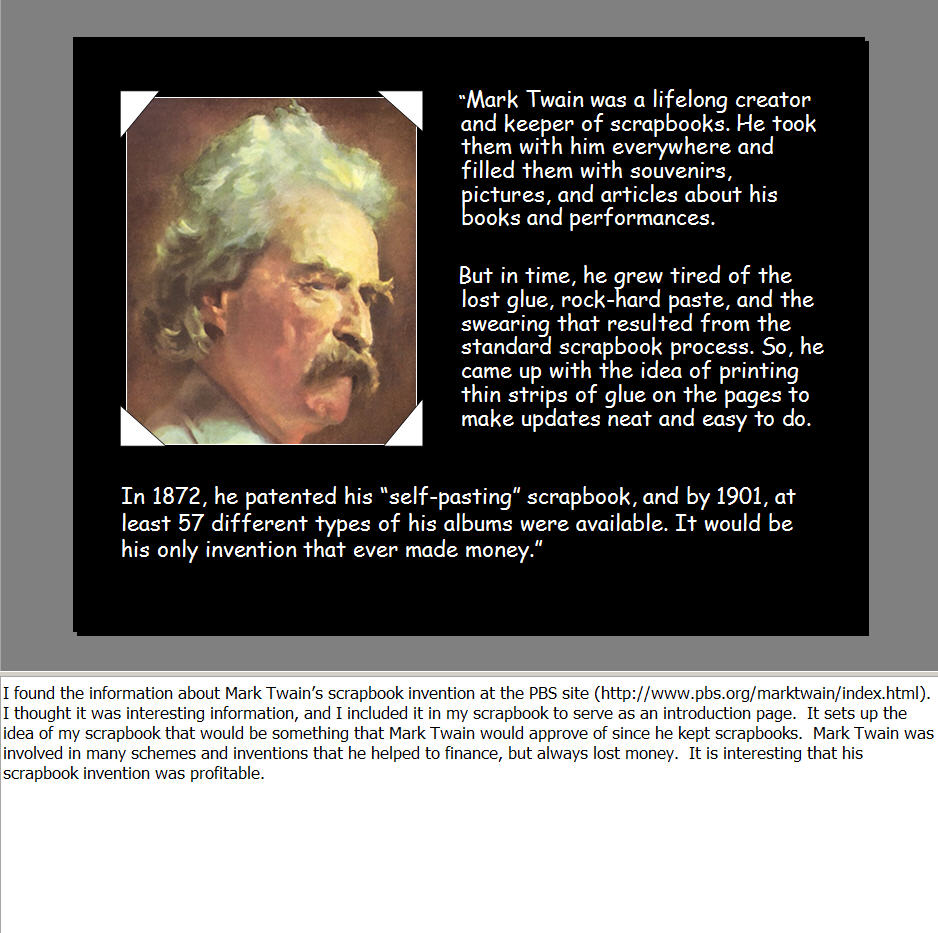
As you work, also paste the URL and citation information in the Notes section for each slide, akin to tracking the details in footnotes in a printed paper. You can keep your working notes in this area. You'll return to these notes and polish them for your final version of the scrapbook. - Share the screenshot of a slide from the sample scrapbook and point out the notes, the "scraps" of information, and other details. Emphasize that the image is from a finished scrapbook. Working drafts of the scrapbook will likely include more fragments and notes that the author will polish later.
- Ask students to move to computers and practice the process of copying and pasting on their own or in pairs. They can also work on rearranging PowerPoint slides and refining slides when they have finished with collecting "scraps."
- Once students have had enough time to practice the basic steps of copying and pasting, move on to step 4 on the handout. Demonstrate with an example Web site how to find two to three sentences of information.
- Discuss the difference between copying full passages and searching for the important nuggets of information. Because students tend to copy and paste full paragraphs of text, be sure to talk about narrowing in on the most important passages and paraphrasing or summarizing other information.
- Discuss when it is appropriate to create a second slide for the same site with two to three more sentences.
- Have students return to the practicing at the computer. Remind students to search for information that they find interesting or feel is important. The information might answer a question that they have or provide more details that makes something they read in the novel more significant.
- After talking about the components of an electronic scrapbook, discuss with the students PowerPoint design tips, using the PowerPoint Design Tips handout.
- In preparation for the next session, invite the students begin to think about their topic and to plan ideas on how to present their gathered information.
For example: If students choose to research superstitions used in Huckleberry Finn, they may want to think about the following:
- Can I find comments about the acceptance of superstitions during the time?
- Do I want to include some superstitions and illustrate them?
- Do I want to copy and paste information from the text of the novel into this presentation to show Huck's superstitions?
- Can I find comments about the acceptance of superstitions during the time?

Session Four: Research Strategy
- Begin this session by asking students to gather their ideas in their journals on two questions: What are the preliminary ideas for your scrapbook? and Visually, what do you want your presentation to look like?
- Once students have had a few minutes to gather their thoughts, ask them to review the information and sketch out a plan for their scrapbooks. Ask them to focus on how to present their gathered information.
For example:
If students choose to research Mark Twain's life, they may want to think about the following questions as they organize their research plans:
- What can I do to make my scrapbook avoid sounding like an encyclopedia article?
- Do I want to include some pictures of Mark Twain?
- What one or two lines of information can I find about Mark Twain that I think are really amazing?
- Do I want to mention other novels Twain wrote?
- What can I do to make my scrapbook avoid sounding like an encyclopedia article?
- Once students have their research strategies planned, ask them to begin finding information on the Internet and assembling their scrapbooks.
- Emphasize the fact that first drafts of the scrapbooks can include lots of information. Explain that there will be time in the process to narrow the focus and select the best or favorite resources for their projects.
- Remind students of the importance of tracking their sources for copyright and documentation.
Sessions Five to Eight: Researching and Preparing the Scrapbook
- Allow several class sessions for students to work on their scrapbooks: researching Internet sites, finding "scraps," and copying and pasting them into their scrapbooks.
- At the end of Session Five, have students turn in the Self-Check on Progress Form to assess their progress.
- Once students have collected a good range of material in their scrapbooks, ask them to review their scrapbooks, using the PowerPoint Design Tips handout.
Session Nine: Refining and Practicing
- Discuss presentation with students, emphasizing that each slide entry is set up to give information that the presenter will talk about in more-depth. The slides should not be read to the audience.
- Point students to the rubric, and remind them to make sure they have included all of the necessary components.
- Allow time for students to continue to refine and practice their presentations, both online and oral.
- Ask students to print out their presentation in the notes format, with three slides per page, so that they can practice the presentation at home.
Sessions Ten and Eleven: Presenting the Electronic Scrapbook
- As students deliver their presentations to the class, prompt them to discuss why the chosen "scrap" of information is necessary to the understanding of the topic or theme. For example, if a student finds a recorded voice of Hal Holbrook delivering a Mark Twain reading, this information may be deemed important because Mark Twain did travel the world as a lecturer.
- As the students are presenting, the teacher should be assessing their work using the rubric.
Extensions
- Students usually get intrigued by the issue of banning books. As an extension activity students might research other banned books, using a list from the American Library Association. With parental permission, students could read one of these books to try to discover why they think the book was banned and offer an opinion as to whether they found the book offensive or not.
- Help students learn more about copyright when using multimedia resources with the ReadWriteThink lesson Students as Creators: Exploring Multimedia.
Student Assessment / Reflections
- Focus on observation and anecdotal note taking as students work on the project to provide ongoing assessment of their progress.
- Ask students to keep a Self-check on Progress so you know the status of their work during the research sessions.
- Use the rubric to assess the electronic scrapbook and the oral presentation.
Add new comment