Native Americans Today

- Preview |
- Standards |
- Resources & Preparation |
- Instructional Plan |
- Related Resources |
- Comments
Overview
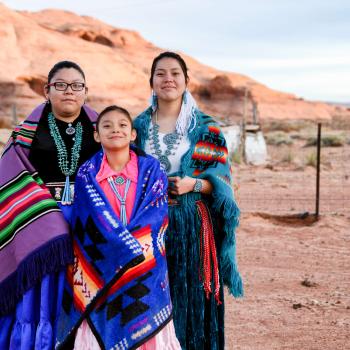
Many people think that Native Americans are a vanished people—that they do not exist in the present day. In this lesson plan, teachers use photo essays and other texts to introduce students to Native children and their families, thereby countering the idea that Native people no longer exist. Students first brainstorm all they know about Native Americans, while the teacher creates lists of their comments on the board. Students then read books and explore Websites from provided lists highlighting contemporary Native Americans. Finally, they use a Venn diagram to compare and contrast their ideas about Native Americans at the beginning of the lesson with what they now know.
Featured Resources
Present-Day Native American Book List: This book list includes books that portray contemporary Native Americans from a variety of tribes.
Teaching Native American Literature and Cultures: Additional Teacher Resources: These teacher resources provide information about teaching about Native Americans without perpetuating stereotypes.
From Theory to Practice
In their book Stories Matter: The Complexity of Cultural Authenticity in Children's Literature, Kathy Short and Dana Fox state that "literature serves a crucial role in multicultural education, social justice, and reform." In Using Multiethnic Literature in the K-8 Classroom, Rudine Sims Bishop identifies five functions of multicultural literature: to provide knowledge or information; expand how students view the world by offering varying perspectives; promote or develop an appreciation for diversity; give rise to critical inquiry; and illuminate human experience.
This lesson utilizes the powerful role of literature described by Short and Fox to help students address stereotypes and misconceptions about Native Americans in contemporary society by providing them with knowledge and information about present-day Native Americans. With this knowledge and information, children are introduced to different perspectives on family and community, and they have an informed knowledge base from which to critique stereotypical representations of Native people in their textbooks, literature, television programs, videos, and movies.
Further Reading
Common Core Standards
This resource has been aligned to the Common Core State Standards for states in which they have been adopted. If a state does not appear in the drop-down, CCSS alignments are forthcoming.
State Standards
This lesson has been aligned to standards in the following states. If a state does not appear in the drop-down, standard alignments are not currently available for that state.
NCTE/IRA National Standards for the English Language Arts
- 1. Students read a wide range of print and nonprint texts to build an understanding of texts, of themselves, and of the cultures of the United States and the world; to acquire new information; to respond to the needs and demands of society and the workplace; and for personal fulfillment. Among these texts are fiction and nonfiction, classic and contemporary works.
- 2. Students read a wide range of literature from many periods in many genres to build an understanding of the many dimensions (e.g., philosophical, ethical, aesthetic) of human experience.
- 3. Students apply a wide range of strategies to comprehend, interpret, evaluate, and appreciate texts. They draw on their prior experience, their interactions with other readers and writers, their knowledge of word meaning and of other texts, their word identification strategies, and their understanding of textual features (e.g., sound-letter correspondence, sentence structure, context, graphics).
- 5. Students employ a wide range of strategies as they write and use different writing process elements appropriately to communicate with different audiences for a variety of purposes.
- 6. Students apply knowledge of language structure, language conventions (e.g., spelling and punctuation), media techniques, figurative language, and genre to create, critique, and discuss print and nonprint texts.
- 7. Students conduct research on issues and interests by generating ideas and questions, and by posing problems. They gather, evaluate, and synthesize data from a variety of sources (e.g., print and nonprint texts, artifacts, people) to communicate their discoveries in ways that suit their purpose and audience.
Materials and Technology
- Books from the Present-Day Native American Book List that show present-day Native Americans
- Teaching Native American Literature and Cultures: Additional Teacher Resources
- Computers with Internet access
Printouts
Websites
Preparation
- Select a collection of texts from the book list that show present-day Native Americans.
- To familiarize yourself with Native American culture, spend time at the Lisa Mitten's Website of Native American Sites. The site is quite extensive and filled with carefully selected links to sites with accurate and useful information about Native Americans. Web resources that are especially useful for the goals of this lesson include "I" Is Not for Indian: The Portrayal of Native Americans in Books for Young People, and The American Indian and Alaska Native Population: 2000.
- Select and bookmark the Websites you want students to explore in Session Two.
- Obtain and peruse books from the Teaching Native American Literature and Cultures: Additional Teacher Resources handout to further prepare for student instruction.
- Prepare copies of the Reflection Questions if you wish for students to produce written responses.
Student Objectives
Students will
- participate in critical discussions about their knowledge of Native Americans, understanding that Native people are part of contemporary America.
- work cooperatively in small groups.
- access and gather information about Native Americans from Websites.
- share information with others through discussion.
Session One
- Begin by writing "Native American," "American Indian," and "Indian" on the board. Introduce each term, and briefly describe its usage.
- Engage students in a brainstorming session during which they share all they know about Native Americans. Create lists of their comments on the board.
- Divide the students into small groups and give each group one or two of the books from the book list. Ask them to notice how the ideas generated in the brainstorming list are similar to or different from what they see in the books.
Session Two
- In a computer lab or classroom, have students spend part of the session exploring the images and information at the Websites you selected.
- Solicit general comments from the groups regarding their observations and discussions. Move to soliciting specific examples of how their prior knowledge was affirmed or challenged by the material they found in the books.
- Have students use the interactive Venn diagram tool to map out their findings.
Extensions
- Students can visit Websites developed by people of the tribes featured in the books on the book list to learn more about the tribe.
- Students can read works of fiction that portray American Indian children in the present day. It is especially helpful for them to read books written by Native writers. This reinforces the objective of the lesson: to illustrate to students that Native Americans are present in modern day American society. An extensive list can be found on this collection of resources compiled and updated by the lesson author.
- Invite students to write to publishers, asking for fictionalized works about Native American children in modern day settings. Consider using elements of the ReadWriteThink lesson Dear Librarian: Writing a Persuasive Letter as part of this process.
- Ask students to write an essay comparing the portrayal of a particular aspect of Native American culture in two different books or a book and a Website. Use the Comparison and Contrast Guide to introduce the aspects of comparison and contrast to students. Have students sketch out the details of their comparisons using the Compare and Contrast Map. Alternately, you can use the Teaching the Compare and Contrast Essay through Modeling lesson plan to model the writing process for students.
Student Assessment / Reflections
- Observe student interactions as they communicate with each other as they go through the activities.
- Engage students in conversations about what they have learned through this lesson, using the Reflection Questions as a guide or written activity.