Press Conference for Bud, Not Buddy

- Preview |
- Standards |
- Resources & Preparation |
- Instructional Plan |
- Related Resources |
- Comments
Overview
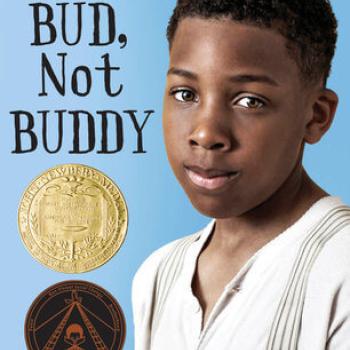
This lesson can be used after the reading of Bud, Not Buddy by Christopher Paul Curtis. The lesson encourages students to use higher level thinking skills and asks them to examine different character perspectives. Students demonstrate comprehension of the story by actively involving themselves in group and whole-class discussions. Information about the author contributes to their understanding of historical fiction. By further analyzing the characters in preparation for a class "press conference," students can better understand the characters' impact in the story. The development and responses to critical-thinking questions lead to deeper understanding of the story.
Featured Resources
Story Mapping: Students will use this interactive tool to analyze the characters, setting, conflict, and resolution in the story.
From Theory to Practice
- Talking, writing, and drawing help readers reflect about what they've read and share their insights with others. These kinds of responses can take many forms, but, without response, comprehension of a text is rarely deepened.
- Whole-group direct instruction in comprehension strategies is most effective when coupled with guided practice in small groups.
- Taking multiple perspectives is a comprehension strategy that involves having students consider two or more points of view to examine perception.
- Dialogic discourse is not teacher led; it is the interaction of many different voices.
- Studies show that good discussion amongst a group has a strong correlation with student achievement in both literature study and writing.
Common Core Standards
This resource has been aligned to the Common Core State Standards for states in which they have been adopted. If a state does not appear in the drop-down, CCSS alignments are forthcoming.
State Standards
This lesson has been aligned to standards in the following states. If a state does not appear in the drop-down, standard alignments are not currently available for that state.
NCTE/IRA National Standards for the English Language Arts
- 4. Students adjust their use of spoken, written, and visual language (e.g., conventions, style, vocabulary) to communicate effectively with a variety of audiences and for different purposes.
- 6. Students apply knowledge of language structure, language conventions (e.g., spelling and punctuation), media techniques, figurative language, and genre to create, critique, and discuss print and nonprint texts.
- 11. Students participate as knowledgeable, reflective, creative, and critical members of a variety of literacy communities.
- 12. Students use spoken, written, and visual language to accomplish their own purposes (e.g., for learning, enjoyment, persuasion, and the exchange of information).
Materials and Technology
- Bud, Not Buddy by Christopher Paul Curtis (Yearling Books, 2002)
- Articles about Christopher Paul Curtis
- Chart paper or overhead and markers
- Writing paper for each student
Websites
Preparation
This lesson takes place after students have read Bud, Not Buddy.
Student Objectives
Students will
- Make a story map to analyze the setting, characters, conflict, and resolution in the story
- Formulate questions about characters' attributes or actions in the story
- Skim and pull out important facts about the author from the online articles provided
- Organize the information they identify from the online articles in a systematic, logical way
- Communicate findings orally in a clear manner
- Use effective listening strategies, summarize major ideas, and draw logical inferences from presentations
- Vary language choice and use effective presentation techniques
- Take on the perspectives of the characters they are trying to portray
- Use learned discussion expectations, such as one person talking at a time, responding directly to peers, and relating personal ideas to the group discussion
Session 1
| 1. | Begin the lesson with a brief class discussion of the book Bud, Not Buddy, by Christopher Paul Curtis. This discussion should include details about the characters, setting, and important events that helped to shape the story. Students should start to make connections to the book, either personal connections or connections to other books they have read. Part of the discussion should also revolve around historical fiction and how the story is part of that genre. |
| 2. | After the discussion, have students work in small groups to analyze the characters, setting, conflict, and resolution in the story by creating a Story Map. Students can refer back to the class discussion for help while working on their maps. Students will need to print their maps and save them for use later in the lesson. It is also important that you review the completed maps to make sure that the details align with the story and the class discussion. |
| 3. | Lead another class discussion about the book that is mostly student-directed, and focuses on the characters in the story. Set up the classroom so that students can easily see one other. One suggestion is to arrange students in a circle. Make sure that you start by reviewing the rules or expectations for the discussion. For example, remind students that only one person may speak at a time. Your primary role is to act as a facilitator to keep students on track during the discussion and clear up any misconceptions that may arise. |
| 4. | You can begin the discussion in one of two ways. Either ask students if they have any questions about the characters, or pose an initial thought-provoking question, such as "Do you feel the story was more interesting because Bud was an orphan?" Keep students on track during the discussion, and encourage them to ask critical-thinking questions about the characters and also use high-level thinking skills to respond to questions asked by their peers. |
| 5. | Begin to guide students toward a character analysis by asking questions, such as:
|
| 6. | Use "what if" questions to guide students in thinking about the characters in more depth. For example, "What if the Amos' weren't part of the story? How would the story be different?" |
| 7. | Review what has been discussed so far about the characters and the story. Students can refer to their story maps and the class discussions to summarize the main points. This review should only take a few minutes, unless students are having difficulty answering or asking questions. At this point, students should have a good grasp of the characters and their personalities and how they affect the events in the story. |
| 8. | Prompt students to think about questions they would ask a character if he or she were standing right in front of them. Students can choose any character in the story to ask a question. Examples of questions include:
|
| 9. | As students are posing questions for the different characters, record them on the board or overhead. These questions can be used as examples when students are preparing for the press conference. |
Session 2
| 1. | Briefly review the previous session's discussion about the book and characters. Have students look at their story maps and ask if there are any questions about the story events or characters. |
| 2. | Discuss the genre of historical fiction (i.e., a story that is fiction but based on true events) and what that means for Bud, Not Buddy. Why is this novel an example of historical fiction? |
| 3. | Talk about Christopher Paul Curtis, the author of the book, and have several different articles or biographies about him for the students to read in groups. The following websites provide information about Curtis for students to use:
|
| 4. | In continuing the class discussion, have students determine questions to ask the author if they saw him on the street. Record questions on the board or overhead so they can be used as examples when students are preparing for the press conference. Questions for the author should relate specifically to the story Bud, Not Buddy. |
Session 3
| 1. | Ask students to identify three major characters that are instrumental to the story. |
| 2. | Have students work in small groups to chart out each of the three character's attitudes, emotions, and impact in the story. Students can decide how to organize their character charts. They may choose to create a graph to compare the characters, or can simply divide the paper into three sections to list information about each character. |
| 3. | Explain the activity to take place during the next session—the class will be holding a press conference for Bud, Not Buddy. Role-play
Objectives
|
| 4. | Gather students into two groups. One group includes the reporters and the other group includes the characters and author. Have each group prepare for the press conference as follows.
|
Session 4
| 1. | Introduce the panel of characters to the reporters to begin the press conference. |
| 2. | Ask the reporters to begin one at a time asking their questions for the characters and recording the responses as they are given. |
| 3. | The press conference continues until all of the reporters have had an opportunity to ask and receive answers to their questions. |
| 4. | At the conclusion of the press conference, gather the class together to talk about the experience. This discussion should focus on how students felt during and after the conference. How did this experience make them feel? Did they really try to become the characters they were role-playing? |
Extensions
- Students may decide to present the press conference again for other classes to try to encourage them to read the book Bud, Not Buddy.
- Students can use what they have learned to write a book review for the school newspaper or website.
Student Assessment / Reflections
- Session 1, 2 and 3: Observe students during the discussions to determine their comprehension of the story events and the story characters. You can also assess the Story Map completed during Session 1, the author study completed during Session 2, and the character chart completed during Session 3.
- Session 4: Take anecdotal notes during the press conference. Note things such as tone of voice and quality of oral communication. Did students ask and answer questions in a clear and concise manner? Did they show evidence of active listening skills, as well as knowledge of the characters in the story?
- Student Reflection: Have students reflect in written form, on the past four sessions and evaluate what they learned and if they gained anything by participating in the activity.
- Teacher Reflection: Reflect on the lesson and consider areas that worked well with your students and areas that need improvement.
Thank you!
Thank you!
Thank you!
Add new comment