A Race With Grace: Sports Poetry in Motion


- Preview |
- Standards |
- Resources & Preparation |
- Instructional Plan |
- Related Resources |
- Comments
Overview
Can athletes' moves be described as beautiful? How are grace, beauty, and aesthetics expressed through movement? These and many other questions will provide the framework for students' exploration of poetry in motion of athletes who participate in a variety of sports. Examining examples from their own experiences and from popular media, students learn about the aesthetic elements of athletics. After viewing images of various athletes, students create a class word wall with adjectives that describe movement. Students then write in reflective journals, view and interpret media, conduct Internet research, take digital photographs, and create original poems. As a culminating activity, the teacher presents students' poetry to the class in a multimedia presentation.
Featured Resources
Doodle Splash: Students can use this interactive site to create illustrations to accompany the poems that they write.
From Theory to Practice
- Computers are tools for meaning making that should be integrated into the literacy curriculum, not added to it.
- It is important to teach students the strategies they will need to know to work with the Internet, and it is equally important to teach students how to work together effectively to share knowledge as they construct meaning.
Common Core Standards
This resource has been aligned to the Common Core State Standards for states in which they have been adopted. If a state does not appear in the drop-down, CCSS alignments are forthcoming.
State Standards
This lesson has been aligned to standards in the following states. If a state does not appear in the drop-down, standard alignments are not currently available for that state.
NCTE/IRA National Standards for the English Language Arts
- 3. Students apply a wide range of strategies to comprehend, interpret, evaluate, and appreciate texts. They draw on their prior experience, their interactions with other readers and writers, their knowledge of word meaning and of other texts, their word identification strategies, and their understanding of textual features (e.g., sound-letter correspondence, sentence structure, context, graphics).
- 4. Students adjust their use of spoken, written, and visual language (e.g., conventions, style, vocabulary) to communicate effectively with a variety of audiences and for different purposes.
- 5. Students employ a wide range of strategies as they write and use different writing process elements appropriately to communicate with different audiences for a variety of purposes.
- 7. Students conduct research on issues and interests by generating ideas and questions, and by posing problems. They gather, evaluate, and synthesize data from a variety of sources (e.g., print and nonprint texts, artifacts, people) to communicate their discoveries in ways that suit their purpose and audience.
- 11. Students participate as knowledgeable, reflective, creative, and critical members of a variety of literacy communities.
- 12. Students use spoken, written, and visual language to accomplish their own purposes (e.g., for learning, enjoyment, persuasion, and the exchange of information).
Materials and Technology
- Computers with Internet access
- One classroom computer with a projection screen
- Digital or disposable cameras
Printouts
Websites
Preparation
- Think about how you would like to use poetry as a resource to support your individual instructional goals. Questions to ask yourself include:
- Do I see poetry as a way to help further students' self-expression?
- Do I see poetry as a way to facilitate students' writing?
- Do I value the aesthetic elements of poetry?
- Do I see poetry as a way to enhance students' oral expression?
- Do I see poetry as a tool to help support my literacy goals?
- Do I see poetry as a way to help further students' self-expression?
- If you do not have classroom computers with Internet access available, you will need to reserve at least two and possibly three sessions in your school's computer lab (see Sessions 2, 3, and 4). In addition, if possible, arrange to use a computer with Internet access and a projector (see Session 1).
- Visit and familiarize yourself with the websites listed in the Internet Resources section. (Note that to view the movies on the NCAA website, you will need to makes sure computers have QuickTime, which can be downloaded for free at http://www.apple.com/quicktime/download/win.html). Bookmark these sites on the computers you will be using.
You will be using the websites to evoke students' responses to movement and may want to jot down your own responses so you have some ideas of your own to share. - When you assess students' work, it is important to focus on how well they were able to convey meaning. You can print the Sports Poetry Rubric to share with your students during Session 4. This is intended as a model, and may be modified to reflect your classroom goals. Rubrics are most helpful when they are created with your students and when students are aware of the goals, purpose, and expectations for their work.
- Prepare materials and space for a class word wall. You may choose to use chart paper or a blackboard.
- Students will be creating a collection of images and words having to do with movement (see Sessions 2 and 3). To help them, gather sports magazines and books about sports with lots of images; you might also want to save the sports section from your local newspaper for a couple of weeks. You may also choose to gather a few dictionaries and thesauri for students to use.
Student Objectives
Students will
- Explore the idea of how to describe movement by looking at images and short films of athletes and discussing them, by generating a class list of words related to movement, and by responding to writing prompts
- Practice research and critical thinking by viewing, interpreting, and responding to different media
- Demonstrate comprehension by summarizing information from varied sources
- Synthesize what they have learned by assembling a body of words and images creating an original poem
- Practice oral presentation skills by sharing their poem with the class
Session 1: Exploring Movement
| 1. | Share the following websites with your students. If possible, you may wish to use a projector.
|
| 2. | Tell students they are going to create a class word wall that describes movement. Explain that this is a collection of words that they can use for inspiration and ideas. (The wall should include words but not definitions.) As you construct the wall with students' suggestions, use questions to help them elaborate their choices and further explore the images they are looking at. For example, if a student suggests the word fast you might ask for further elaboration by saying, "Describe what part of his or her body is moving fast." |
| 3. | Ask your class to think about what they have just seen on the websites you shared. What other words can they come up with that might work for the wall? Continue adding words until you feel that there is a wide range of movement described. You can also include your own suggestions. Note: Continue to add to the word wall throughout the lesson activities; it will provide a resource for students to use as they write their poems. |
| 4. | Ask each student to respond to the following prompts in a writing journal:
|
| 5. | Ask for volunteers to share their responses to the journal prompts. The goal of the discussion is to elicit an understanding of how grace, beauty, and aesthetics are expressed through movement. |
Sessions 2 and 3: Creating a Sports/Movement Center
| 1. | Tell students they that are going to create a classroom Sports/Movement Center that contains examples of bodies in motion. Divide the class into groups of three or four students each. Tell each group that it is responsible for collecting the following:
|
| 2. | Bring students outside or to a gymnasium, and provide them with disposable or digital cameras to take photographs of each other as they move. Encourage them to try all different types of movement — playing with balls, climbing on playground equipment, or just running and jumping. Students can also bring in photographs from home or take the cameras home with them. The pictures will need to be developed or printed off before Step 4. |
| 3. | Students should also use the websites you have bookmarked and the materials you have gathered to assemble their words and images (see Preparation, Steps 3 and 6). While the groups are working, answer questions and provide support as needed. Note: If you do not have enough cameras or computers for the entire class, you may choose to have half the class completing Step 2 while the rest of the class does Step 3 |
| 4. | Each group should present its collection of images and words for the Sports/Movement Center to the entire class. Add the new words that have been generated to describe movement to the classroom word wall. You can work with students to determine how they might best present their findings, but some possible ideas for presentations include the following:
|
| 5. | Encourage students to discuss their classmates' presentations, as they might find inspiration for the poems they are going to create in Session 4 Place the materials they presented in a center so that other students can use them. You may also wish to invite others in the school to view the class work. |
Session 4: Poetry in Motion
| 1. | Tell students that they are going to write and illustrate a poem that shows the grace and beauty of bodies in motion. |
| 2. | Model how to choose a word and work with students to write a poem. You can simply write a word such as ice skating on the board, and ask students to brainstorm ideas for a free form poem. You might also choose to begin with a poem that uses a specific format such as a cinquain, which is a five-line poem. Share the following example with the class:
SkatersThe form of a cinquain poem is as follows:
|
| 3. | When you have finished writing the class poem, talk to students about how you would evaluate it. Questions for discussion include:
|
| 4. | Write down students' responses and use them to generate a rubric. Alternatively, you might distribute the Sports Poetry Rubric and ask students to use it to evaluate the poem. When you are finished talk about whether this adequately captures all of the things you need to evaluate in their poems. Use students' responses to help you develop a class rubric. |
| 5. | Ask students to select a sport or activity that involves body movement. (If possible, this sport or activity should be one that they have participated in.) Tell them that they may choose to work in small groups, pairs, or individually for this activity. |
| 6. | There are several ways you can encourage students' creativity as they begin to write. First, you may wish to have students browse through the Sports/Movement Center collection to get ideas and inspiration. You can also encourage students to use the class word wall as a resource. Playing music in the background is often helpful in unleashing the creative spirit. You may also choose to invite your students to use the interactive Doodle Splash tool as they brainstorm ideas to illustrate and write their poem. |
Session 5: Poetry Presentation
Host a class presentation showcasing students' poems and illustrations. You may choose several options to present students' work. You can create a class slideshow using iPhoto or iMovie, create a mural to serve as a backdrop for the presentation, bind all the poems in a book and have each group or student read a page, or create a classroom website.
You may also wish to videotape the performance if possible to share with others in the school and community.
Extensions
- Encourage students to create a class collection of sports poems. Begin by sharing the following books with your students.
- Opening Days: Sports Poems edited by Lee Bennett Hopkins (Harcourt, 1996)
- Sports! Sports! Sports!, A Poetry Collection edited by Lee Bennett Hopkins (HarperCollins, 1999)
- Opening Days: Sports Poems edited by Lee Bennett Hopkins (Harcourt, 1996)
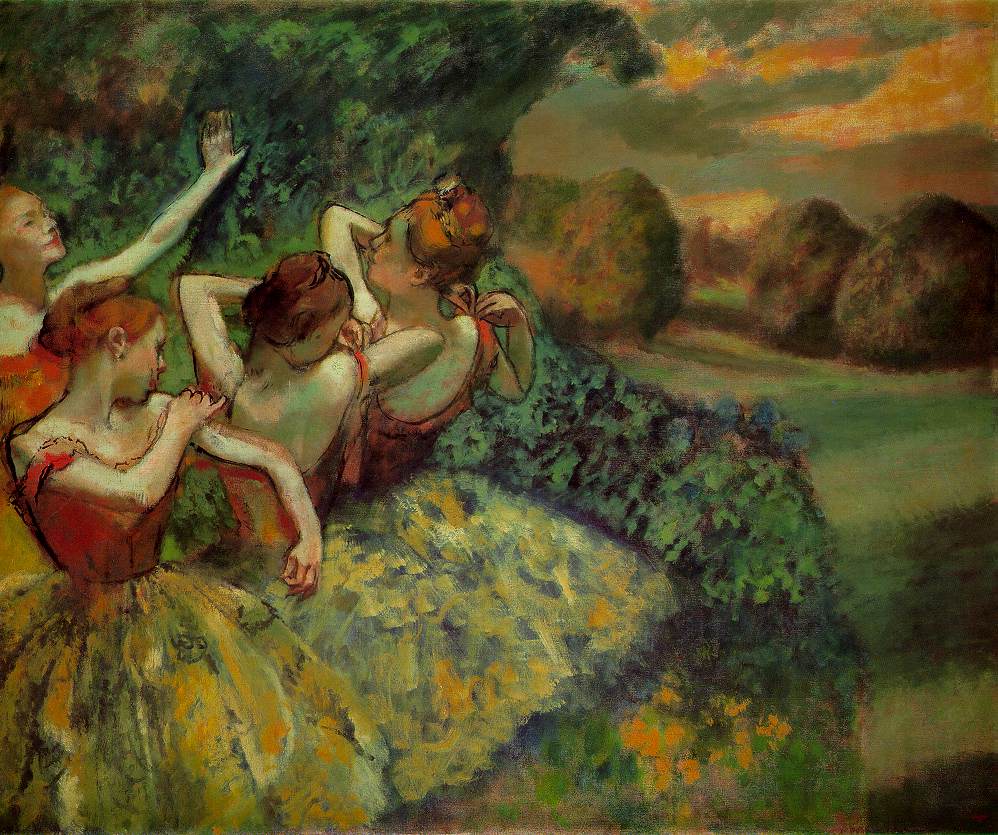
- Write a poem in response to "The Four Dancers" by Edgar Degas.
- Explore the photographs of dancers in the Alvin Ailey American Dance Theatre.
Student Assessment / Reflections
- Read students' journal reflections and discuss any ideas you feel would be helpful. Use your observations to guide further discussion on aesthetic elements of sports and movement.
- Observe students' group work in creating presentations for the Sports/Movement Center collection. Foster discussion to generate words and ideas on the lesson theme within the small groups.
- Use either the Sports Poetry Rubric or the rubric you create with the class to evaluate student poems. You might choose to use the rubric in the following ways as well:
- Have students use it as a self-evaluation.
- Work individually with students to revise their poems based on your feedback and their own.
- Lead a class discussion on the effectiveness of the rubric.
- Have students use it as a self-evaluation.