Let's Read It Again: Comprehension Strategies for English-Language Learners

- Preview |
- Standards |
- Resources & Preparation |
- Instructional Plan |
- Related Resources |
- Comments
Overview
One of the most effective ways to engage English-language learners (ELLs) and help them comprehend and read English is through repeated readings and retellings of appealing bilingual picture books. Using Con Mi Hermano/With My Brother by Eileen Roe, this lesson has second grade Spanish-speaking ELLs identify the main idea of the story, construct meaning from text and illustrations, and learn English words. They then demonstrate their knowledge and practice writing in English by writing a poem and a retelling of the story. This lesson (which can be adapted using bilingual books in other languages and for other ages) also has older struggling readers read with younger students. Finally, it encourages English-speaking students in mixed classrooms to learn Spanish words for familiar people and objects.
Featured Resources
- Flip Book: Have students use this interactive to create bilingual dictionaries with basic Spanish vocabulary.
- Concept Web Worksheet: Students can use this printout to record activities the boy likes to do with his brother. This web can be adapted to work for a variety of topics.
From Theory to Practice
- English-language learners (ELLs) have great cognitive demands put on them as they try to learn English and content quickly. They need practice using English in "purposeful, authentic contexts."
- Exposure to meaningful, age-appropriate texts is critical to helping ELLs become readers and writers in English.
- Numerous illustrations help ELLs with limited word knowledge figure out the meaning of what they are trying to read, helping them to read independently and improving their confidence.
- Content should be a consideration when choosing books for ELLs; the story should be accessible and the language direct. Books should include key vocabulary about day-to-day activities and topics that students new to their surroundings need to learn.
Common Core Standards
This resource has been aligned to the Common Core State Standards for states in which they have been adopted. If a state does not appear in the drop-down, CCSS alignments are forthcoming.
State Standards
This lesson has been aligned to standards in the following states. If a state does not appear in the drop-down, standard alignments are not currently available for that state.
NCTE/IRA National Standards for the English Language Arts
- 3. Students apply a wide range of strategies to comprehend, interpret, evaluate, and appreciate texts. They draw on their prior experience, their interactions with other readers and writers, their knowledge of word meaning and of other texts, their word identification strategies, and their understanding of textual features (e.g., sound-letter correspondence, sentence structure, context, graphics).
- 5. Students employ a wide range of strategies as they write and use different writing process elements appropriately to communicate with different audiences for a variety of purposes.
- 9. Students develop an understanding of and respect for diversity in language use, patterns, and dialects across cultures, ethnic groups, geographic regions, and social roles.
- 10. Students whose first language is not English make use of their first language to develop competency in the English language arts and to develop understanding of content across the curriculum.
- 12. Students use spoken, written, and visual language to accomplish their own purposes (e.g., for learning, enjoyment, persuasion, and the exchange of information).
Materials and Technology
- Con Mi Hermano/With My Brother by Eileen Roe (Aladdin Paperbacks, 1991)
- Computers with Internet access
- LCD projector
- Writing materials
- Overhead projector and transparencies
- Spanish-speaking volunteers (optional)
- Tape player and cassette (optional)
Printouts
Preparation
| 1. | Select a picture book that meets the requirements outlined in the From Theory to Practice section and also fits the needs of your students. This lesson uses Con Mi Hermano/With My Brother by Eileen Roe, which is topically appropriate for second-grade students, has text in both Spanish and English, and contains numerous illustrations to support the words. Ideally, you will have a copy of the book for every student in your class. Give English-language learners a chance to look at the book before the start of this lesson. |
| 2. | If you do not read or speak Spanish fluently, make arrangements to have a volunteer in your classroom during Session 1 to read the Spanish text. You might also ask someone to record the Spanish text for you to play back to students. |
| 3. | Print off the Pictures for Con Mi Hermano/With My Brother to post in your classroom during Session 2. The key on the first page indicates which words go with each picture. |
| 4. | Make a copy of the Concept Web Worksheet for each student in your class. Make a transparency of it as well. |
| 5. | Visit the Flip Book and follow the directions to label the pages. Starting with A, enter three letters to a page (e.g., A, B, C on Page 1; D, E, F on Page 2; and so on) until you have completed the alphabet. You should have nine pages total. Print the pages without entering anything else on them and then make enough copies of the pages so that each student will have his or her own book. Assemble the books for students to fill out during Session 3. Also make a sample Flip Book containing a few of the vocabulary words with pictures to illustrate the words. The words should be written on the correct letter page for the English spelling; write them in both English and Spanish with the English word listed first. |
| 6. | If you do not have classroom computers with Internet access, reserve Sessions 4 and 5 in your school's computer lab. If possible, arrange to use an LCD projector. |
| 7. | Visit and familiarize yourself with the Acrostic Poems and the Stapleless Book tools. Students will use the Acrostic Poems tool to write a poem about the types of things they do with a favorite person (see Session 4), and the Stapleless Book tool to retell what the main character of Con Mi Hermano/With My Brother does with his brother (see Session 5). Prepare your own acrostic poem and stapleless book to use when modeling the tools for students.
|
| 8. | Make arrangements with a teacher of older students to have struggling readers come and read with your class during Session 4. |
Student Objectives
Students will
- Improve English comprehension and fluency and learn new vocabulary words in their non-native language using repeated readings of a bilingual picture book
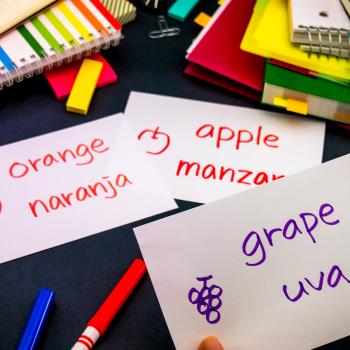
- Reinforce their knowledge of new vocabulary by creating their own English/Spanish dictionaries
- Apply what they have learned and practice the writing process by writing both an acrostic poem and a retelling of the story in English
- Work collaboratively to read and write
Session 1: Initial Reading of Con Mi Hermano/With My Brother
| 1. | Gather students together and ask them to talk about what they think kids the same age as them do in other parts of the world on a typical day. Write students' answers on the board. You want to reinforce the idea that although people in other countries may speak different languages, they do many of the same things that we do. |
| 2. | Show students Con Mi Hermano/With My Brother by Eileen Roe. Explain that the book is written in English and Spanish and that they will hear the story twice, once in each language. |
| 3. | Instruct students to pay attention to the everyday experiences of the little boy in the book because they will retell the story later. |
| 4. | Take students on a picture walk of the book and then read the book aloud, making sure to show the pictures as you read. You should read each page first in English, then in Spanish. Note: You can also have a Spanish-speaking volunteer read the book with you or play a recording of it in Spanish (see Preparation, Step 2). |
| 5. | After reading, answer any questions and then ask students what they think is the most important idea in the story (i.e., the reason it was written). What do they think the author wants them to understand? Answers might include "it's fun to be a younger brother" or "when you're little, it's hard to wait to do things the older kids get to do." Write students' responses on the board and have the class vote on the one that they think most explains the author's reason for writing the book. Tell them that this is called the main idea. |
| 6. | Congratulate students on a job well done identifying the main idea of the story, and explain that in a future session they will reread the story aloud with you and then retell the story as they remember it. |
Session 2: Choral Reading and Word Identification
For this session's activities, it is best to have multiple copies of the book. If you do not have enough books, make a transparency for each page and write the text from each page in English and Spanish on the transparency large enough so students can see it. Post all of the Pictures for Con Mi Hermano/With My Brother on the board in no particular order.
| 1. | Hand out copies of the book to students and explain that they will reread the story out loud with you. Remind them to point to each word as they read. (If you are using an overhead projector because you do not have enough copies of the book, be sure to point to each word as the transparencies are read.) |
| 2. | When you finish the story, project the Concept Web Worksheet transparency on the overhead projector and write in the middle circle: The little boy in the story likes to do many special things with his brother. |
| 3. | Ask students to turn to a classmate sitting next to them and quietly discuss some of the things that the little boy in the story likes to do with his older brother. |
| 4. | While they are talking, pass out copies of the Concept Web Worksheet. Then ask for volunteers to come up and choose a picture that shows one of the things that the little boy in the story likes to do with his brother. |
| 5. | Whether or not the student makes a correct choice, write the words that describe the picture in both Spanish and English next to the appropriate picture and then read them aloud. (The words are listed in the key on the first page of the Pictures for Con Mi Hermano/With My Brother.) Then have students say the words with you and ask them if they think the picture is one of the activities the boy likes to do. If it is, have them write both words in one of the bubbles on their Concept Web Worksheet while you write them on the transparency. Repeat these steps until students have chosen all of the things the little boy likes to do with his older brother. |
| 6. | Explain to students that in the next session they will be creating their own dictionaries. Tell them that besides the words they learned today, there will be a list of additional words from the story for them to learn in English and in Spanish. Collect students' Concept Web Worksheets for use in the next session. |
Session 3: Creation of Personal Dictionaries
| 1. | Hand back each student's Concept Web Worksheet, and give him or her a blank Flip Book (see Preparation, Step 5); the List of English/Spanish Vocabulary Words From Con Mi Hermano/With My Brother; and pencils, markers, or crayons. |
| 2. | Project the Concept Web transparency on the overhead projector. Tell students that they will write the words they have learned from the story in English and Spanish in their own personal Flip Book dictionaries. |
| 3. | Briefly show the sample Flip Book that you prepared in advance of the lesson. Emphasize to students that their personal dictionaries are English dictionaries and they should write the English word with the Spanish word next to it under the correct letter of the Flip Book page for the English spelling. They should also draw pictures to help them remember what the words mean. |
| 4. | Allow students time to write the six words shown on their Concept Web Worksheet and draw pictures in their dictionaries in the appropriate places. |
| 5. | Ask students to look at the List of English/Spanish Vocabulary Words From Con Mi Hermano/With My Brother. Review each word on the list by reading it aloud both in English and in Spanish with the students repeating each word in both languages. |
| 6. | Write each word from the list on the board in English and Spanish and ask students to tell you what they think the word means. If they have trouble coming up with an answer, have them look at the page in the book where the word appears to see if the pictures help them. They should draw a small picture next to each word on the sheet to help them remember. |
| 7. | Allow students to work independently or with a partner on their dictionaries while you circulate around the classroom to help where needed. |
Session 4: Repeated Reading With an Older Student
If you do not have classroom computers with Internet access, this session should take place in your school's computer lab.
| 1. | Pair older struggling students from another class with your students, and hand out copies of the book Con Mi Hermano/With My Brother to each pair. ELLs should be paired with native English speakers. Note: It does not matter whether it is the older or the younger student who is an ELL. It is also not necessary for each pair to have an ELL. |
| 2. | Explain to students that they will take turns reading the book with the older student reading first and the younger student second. Further instruct that those pairs with ELLs should alternate between reading the English and Spanish text on each page. The remaining pairs should read the English text in its entirety and look for and pronounce their Spanish vocabulary words from their dictionaries in the Spanish text. |
| 3. | Before students start reading, ask them if they know what an acrostic poem is. Explain that it is a poem about a person or thing and that every line of the poem relates to and starts with a letter in the word. Read them the acrostic poem you have written (see Preparation, Step 7), and then, using the LCD projector, show them how you used the Acrostic Poems tool to write your poem. |
| 4. | Explain that once they have read the story together, the older students can help the younger students write acrostic poems in English about the things they like to do with one of their favorite people. The person they choose should be the topic word for the poem. Tell them that they can use the dictionaries the younger students created during Session 3 and refer to Con Mi Hermano/With My Brother to help them write their poems. They should print their work when it is done, as they cannot save it online. |
| 5. | Students should read their stories together quietly. Once students are done reading, they can start working on their acrostic poems while you circulate and offer assistance as needed. Note: If access to computers is limited, instruct those students not at a computer to write a draft of their acrostic poem on a piece of paper and then use the online tool to publish their poem once a computer becomes available. Hand out paper and pencils to those students who need them. |
| 6. | If there is time, students can share their poems with the class. You can also display the completed poems in your classroom. |
| 7. | Allow students to work independently or with a partner on their dictionaries while you circulate around the classroom to help where needed. |
Session 5: Repeated Reading With a Classmate
If you do not have classroom computers with Internet access, this session should take place in your school's computer lab.
| 1. | Pair students and give each pair of students a copy of Con Mi Hermano/With My Brother. ELLs should be paired with native English speakers, but it is not necessary for every pair to have an ELL. Struggling readers should be paired with stronger readers. |
| 2. | Explain that students will take turns reading the story to each other. When they are done, they will work with their partners to retell the story in English. |
| 3. | Using the LCD projector, access the interactive Stapleless Book and demonstrate how the tool works. Explain that students should put a sentence on each page of the book retelling the events of the story in English. Once they are done, they should print out their book. Share a few pages from the book you created (see Preparation, Step 7). Explain that they can use the dictionaries they made during Session 3 and refer to Con Mi Hermano/With My Brother to help them with any text they may wish to put into their retellings. |
| 4. | Allow students time to reread the book and compose, type, print, assemble, and illustrate their stapleless books. Circulate around the room to help as needed. (If computers are limited, see the Note in Session 4, Step 5.) |
| 5. | If time permits, have students share their retellings with the class. |
Extensions
Student Assessment / Reflections
- Observe students’ participation during class discussions to see how well they grasp the main ideas of the story and how well they understand the vocabulary. Address any consistent misconceptions one-on-one or in small groups as necessary.
- Take notes during the Concept Web Worksheet activity to see how well students are able to correctly identify the pictures.
- Use the Checklist Sheet to assess each student’s dictionary, acrostic poem, and stapleless book retelling. The checklist can be used as a reference sheet to assist in grading students’ work, as documentation for students’ portfolios, or as a means of giving feedback to students. You may want to have students with real gaps reflected in their checklist to repeat the work with a different bilingual book.
- Observe students as they read with other students during Sessions 4 and 5. Check for improvements in fluency by listening for how smoothly students read, what words they stumble over or have difficulty with, what words they have mastered in pronouncing, and how confident they sound as they read.
Add new comment