Renaissance Humanism in Hamlet and The Birth of Venus

- Preview |
- Standards |
- Resources & Preparation |
- Instructional Plan |
- Related Resources |
- Comments
Overview
After reading Shakespeare's Hamlet, students use visual and literary tools to identify, analyze, and explain how elements in Botticelli's painting The Birth of Venus and examples from the play illustrate the philosophy of Renaissance Humanism. Students analyze Botticelli's painting by sketching it and then taking notes in relation to specific elements in the painting. Next, students explore how literary elements in Hamlet reflect Renaissance Humanism. Finally, students explain in writing how the elements in The Birth of Venus and Hamlet establish them as examples of Renaissance Humanism. While this lesson focuses on Hamlet in its examples, any Shakespearean play could be substituted for the analysis.
Featured Resources
Renaissance Humanism Interactive: This online tool provides students with background information about Renaissance Humanism.
From Theory to Practice
In the introduction of his Reading in the Dark, John Golden states, "Kids tend to be visually oriented, able to point out every significant image in a three-minute MTV music video, but when it comes to doing the same with a written text, they stare at it as if they are reading German." Golden goes on to state "the skills they use to decode the visual image are the same skills they use for a written text" (xiii). Golden's book outlines how to use film to help students practice their skills so they can then be transferred to written texts. The following lesson is based on the same principle but uses a work of art instead of a film to help students reinforce the same skills that are used to analyze a work of literature.
Further Reading
Common Core Standards
This resource has been aligned to the Common Core State Standards for states in which they have been adopted. If a state does not appear in the drop-down, CCSS alignments are forthcoming.
State Standards
This lesson has been aligned to standards in the following states. If a state does not appear in the drop-down, standard alignments are not currently available for that state.
NCTE/IRA National Standards for the English Language Arts
- 1. Students read a wide range of print and nonprint texts to build an understanding of texts, of themselves, and of the cultures of the United States and the world; to acquire new information; to respond to the needs and demands of society and the workplace; and for personal fulfillment. Among these texts are fiction and nonfiction, classic and contemporary works.
- 2. Students read a wide range of literature from many periods in many genres to build an understanding of the many dimensions (e.g., philosophical, ethical, aesthetic) of human experience.
- 3. Students apply a wide range of strategies to comprehend, interpret, evaluate, and appreciate texts. They draw on their prior experience, their interactions with other readers and writers, their knowledge of word meaning and of other texts, their word identification strategies, and their understanding of textual features (e.g., sound-letter correspondence, sentence structure, context, graphics).
- 5. Students employ a wide range of strategies as they write and use different writing process elements appropriately to communicate with different audiences for a variety of purposes.
- 6. Students apply knowledge of language structure, language conventions (e.g., spelling and punctuation), media techniques, figurative language, and genre to create, critique, and discuss print and nonprint texts.
- 7. Students conduct research on issues and interests by generating ideas and questions, and by posing problems. They gather, evaluate, and synthesize data from a variety of sources (e.g., print and nonprint texts, artifacts, people) to communicate their discoveries in ways that suit their purpose and audience.
- 8. Students use a variety of technological and information resources (e.g., libraries, databases, computer networks, video) to gather and synthesize information and to create and communicate knowledge.
Materials and Technology
- Text for The Tragedy of Hamlet by William Shakespeare (available online, though a printed copy is recommended)
- A Definition of Humanism, such as that from The Penguin Dictionary of Literary Terms and Literary Theory by J. A. Cuddon (Penguin, 2000), or the Lecture on Renaissance Humanism posted on The History Guide: Lectures on Modern European Intellectual History Website.
Printouts
Websites
Preparation
- Before this exploration, students should have read Shakespeare’s The Tragedy of Hamlet.
- Make arrangements to share a color version of Botticelli’s painting with students. You can project the Web image with an overhead projector, or make printouts of the image using a color printer.
- Review the Analysis of The Birth of Venus, Lecture on Renaissance Humanism, the resources in the Websites section, and any other available resources to choose those best for use with your class.
- Make copies of the Art Explication handout, the Renaissance Humanism in Hamlet handout, the Explication Essay Checklist, and the Explication Essay Rubric.
- Test the Renaissance Humanism student interactive on your computers to familiarize yourself with the tool and ensure that you have the Flash plug-in installed. You can download the plug-in from the technical support page.
Student Objectives
Students will
- identify and explain how the characteristics and concepts of a literary genre are reflected in a work of art and piece of literature.
- analyze the overall significance, meaning, and theme of a work of art and literature through an explication of its individual elements.
- examine the details in a work of art by sketching and labeling its major elements.
- synthesize knowledge of the ways that a painting uses subject, symbolism, color and light, composition, movement, and perspective to draw conclusions about the overall tone and theme of a work of art.
- use literary tools (diction, symbolism, characterization, tone, and elements of plot) to analyze and explain how specific elements establish the tone and theme of a work of art and a piece of literature.
- explain how the elements establish both a work of art and a piece of literature as examples of Renaissance Humanism.
Session One: Defining Renaissance Humanism
- Introduce the characteristics of Renaissance Humanism using the Renaissance Humanism student interactive. Students can explore the interactive individually if computer resources allow, or the interactive can be projected using an LCD projector.
- If desired, pause during the presentation to ask students to share examples from their readings that demonstrate the characteristics. These brainstormed ideas can be gathered on the board or on chart paper so that students can return to the list in later sessions.
- Additionally, students can read and take notes on the definition and major characteristics of Renaissance Humanism contained in their classroom literature anthology, in a book such as The Penguin Dictionary of Literary Terms and Literary Theory, or on the Lecture on Renaissance Humanism Web page. Additional Websites are available in the Resources section.
- By the end of this session, students should have identified and be able to explain the following characteristics of Renaissance Humanism:
- Marked by a revival of interest in Classical literature and thought (ancient Greek and Roman)
- Was a European phenomenon that was more worldly and secular than the preceding Medieval period
- Focused on anthropocentric ideas, seeking to dignify and ennoble humans
- Regarded humans as the crown of creation
- Sought to civilize humans and help them realize their potential powers and gifts as well as to reduce the discrepancy between human potential and achievement
- Concentrated on the perfection of a worldly life, rather than on the preparation for an eternal and spiritual life
- Increasingly regarded humans as creatures perfectible on earth
- Marked by a revival of interest in Classical literature and thought (ancient Greek and Roman)
Session Two: Identifying Renaissance Humanism in <em>The Tragedy of Hamlet</em>
- Review the characteristics of Renaissance Humanism, showing students where to find the resources used in the previous session such as the Renaissance Humanism student interactive or the Lecture on Renaissance Humanism Web page. If you created a list of characteristics and/or examples in the previous session, point students to this resource as well.
- Pass out the Renaissance Humanism in Hamlet handout.
- Explain that students will complete the chart by identifying an example from Hamlet, connecting the example to a characteristic of Renaissance Humanism, and explaining why the example reflects the characteristic. Explain that students will use the information that they gather to write an essay later in this unit.
- Encourage students to return to the resources on Renaissance Humanism as needed.
- Circulate among students, answering questions, providing supportive feedback, and noting progress. By the end of this session, students should have a working knowledge of the characteristics of Renaissance Humanism.
Session Three: Artwork Explication of <em>The Birth of Venus</em>
- Answer any questions about the characteristics of Renaissance Humanism that have arisen as students worked. Remind students where to locate the resources they can use as they work on this project.
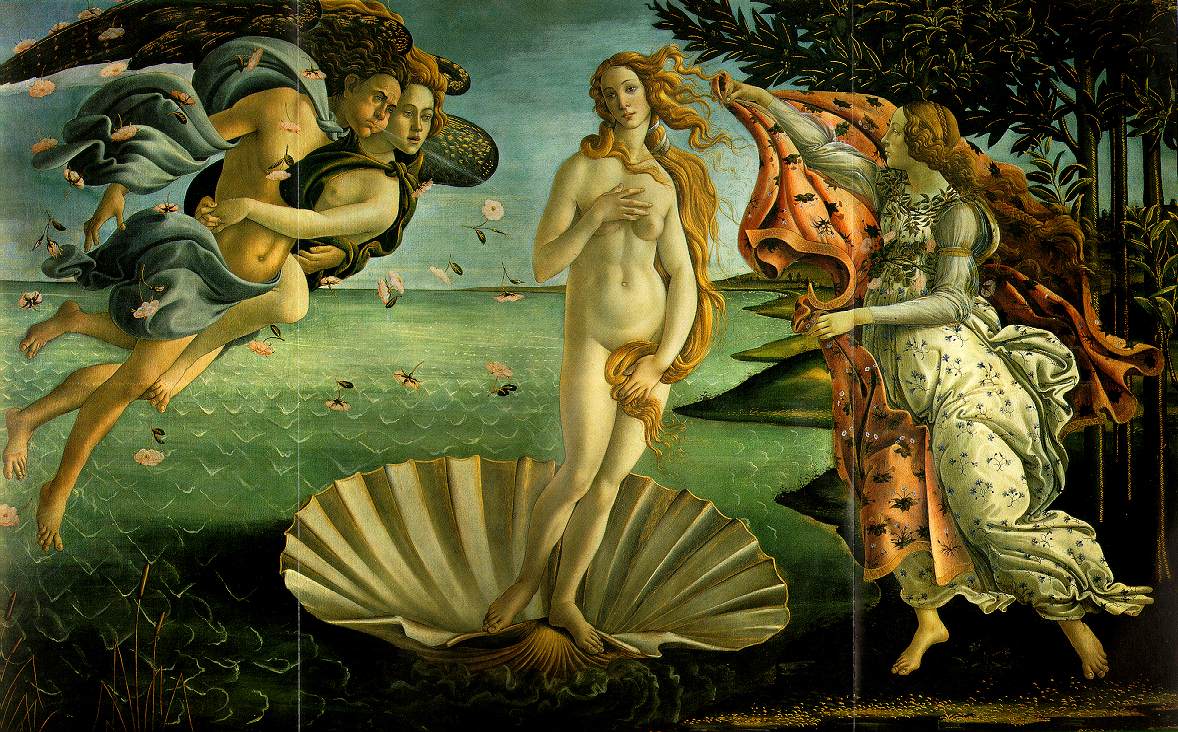
- Share Botticelli’s The Birth of Venus with students, providing basic background information about the painting and Botticelli. The painting was painted in approximately 1485-86 for the villa of Lorenzo di Pierfrancesco de Medici at Castello and measures 67.3 x 108.5 inches (172.5 x 278.5 cm).
- Invite students to identify Venus, or simply explain that she is the Roman goddess of Love and Beauty.
- Identify the other figures in the painting, so that students have a shared vocabulary for their discussion:
- Zephyr, the West Wind, is on the left front
- Chloris, a nymph, is on the left, beside Zephyr
- The Nymph of Spring is on the right
- Zephyr, the West Wind, is on the left front
- Alternatively, you might point students to the explanation of the figures on the WebMuseum site.
- Pass out the Art Explication: The Birth of Venus by Botticelli handout.
- Explain that students will work in small groups to sketch and label the painting’s major elements, in response to the questions on the handout. Remind students that they will use the information that they gather in class discussion as well as to write an essay later in this unit.
- Answer any questions about the activity, and divide students into groups of approximately four each.
- Encourage students to return to the resources on Renaissance Humanism as needed.
- Circulate among students, answering questions, providing supportive feedback, and noting progress.
Session Four: Conduct a class discussion of <em>The Birth of Venus</em>
- Invite students to reflect on their analysis of Botticelli’s painting, focusing the discussion on the question “How do individual elements in The Birth of Venus reflect the characteristics of Renaissance Humanism?” Encourage students to refer to specific elements in the painting to support their answers.
- Use the following list of features in the painting to help students identify the major elements in the painting:
- Venus’ sacred roses falling from the top left corner
- Zephyr the west wind blowing wind onto Venus
- Chloris the nymph, who later became Flora the goddess, is held by Zephyr
- Waves in stylized V shapes
- Venus imitating a pose of a famous antique Roman statue
- The faraway look in Venus’ eyes
- Orange grove on the right hand side
- A nymph representing spring moves in from the right and attempts to cover Venus
- A single blue anemone flower blooms at the feet of the nymph of Spring
- Venus’ sacred roses falling from the top left corner
- If desired, review the analysis of these elements on the World Art Treasures site.
Extensions
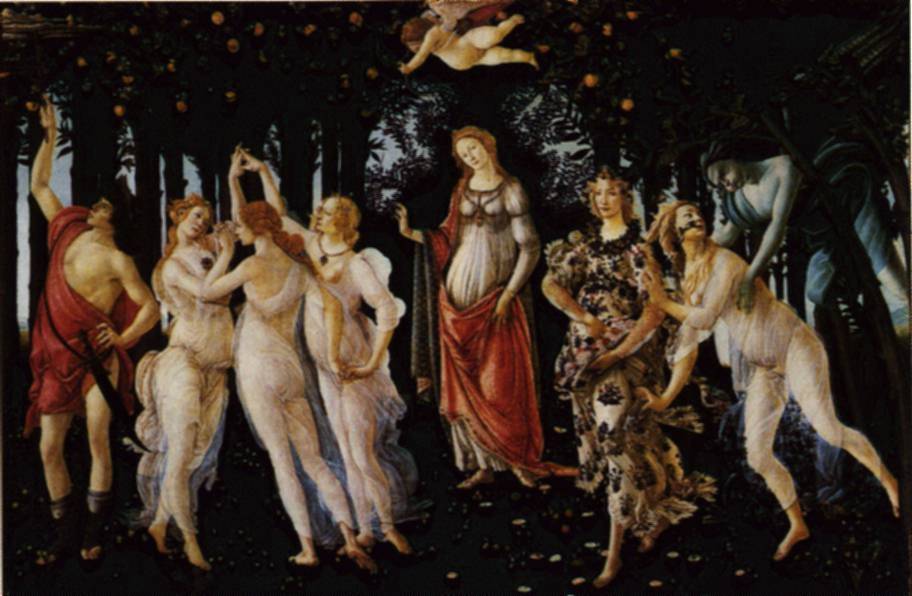
- Students can explore another of Botticelli’s paintings and identify characteristics of Renaissance art and humanism. Botticelli’s companion to The Birth of Venus, the painting La Primavera provides an interesting contrast to the analysis students complete in Sessions Three and Four. Share the Berger Foundations’ explanation of the relationship between the two paintings to encourage a more thorough analysis.
- Take the opportunity to explore Renaissance Humanism with a focus on race, gender, and class—begin by asking students just how human is defined in these works and extend the conversation to thinking about who is missing from the Renaissance's ideal. Can any human be “the crown of creation”?
Student Assessment / Reflections
Based on their investigation of Renaissance Humanism in Hamlet and The Birth of Venus, ask students to write an essay that identifies, analyzes, and explains how two elements from The Birth of Venus and two examples from The Tragedy of Hamlet reflect a characteristic of Renaissance Humanism. Share the Explication Essay Checklist and/or the Explication Essay Rubric before students begin so that they can monitor their own progress as they work. Students can write formal papers or complete this activity in their journals. You can use the Explication Essay Checklist as a grading sheet, if desired. For more formal assessment, use the Explication Essay Rubric.
As an alternate assessment, you can ask students to write a letter from Shakespeare to Botticelli (or vice versa) complimenting him on how their two works are similar.
Add new comment