Seeing Integration From Different Viewpoints

- Preview |
- Standards |
- Resources & Preparation |
- Instructional Plan |
- Related Resources |
- Comments
Overview
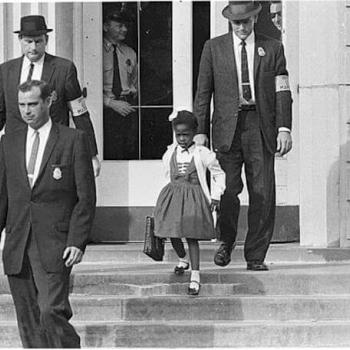
Is there more than one way to think about a work of nonfiction? Students will answer this question as they read and discuss Robert Coles' The Story of Ruby Bridges, a short story about court-ordered school desegregation in 1960s Louisiana. In this Directed Reading-Thinking Activity, students make predictions about the story before reading, focus on key ideas as they read aloud in groups, and enhance their comprehension of the story with a postreading class discussion. Finally, students participate in a postreading group activity in which they use colored glasses to view court-ordered desegregation from different perspectives.
Featured Resources
- Possible Sentences for The Story of Ruby Bridges: Use this printout to help students make and verify predictions about The Story of Ruby Bridges.
- Group Chart for Five Decision Lenses: Students can use this chart to record observations from positive, negative, emotional, factual, and limitless points of view.
From Theory to Practice
- Effective instruction in reading comprehension involves the explicit use of specific strategies as well as the chance to read, discuss, and write about texts.
- Students need to read texts beyond those specifically designed for reading instruction, especially those with a clear message or purpose.
- An important comprehension strategy is prediction; this can involve making predictions, activating prior knowledge, previewing, and overviewing.
- Predicting should have students use their prior knowledge to improve their understanding of new ideas they locate in a text.
- Improving communication and decision-making in groups is a matter of getting people to see things from different perspectives.
- One effective way to improve group discussion and practice seeing things from different points of view is to limit participants to expressing views that correspond to a specific posture, regardless of their true thoughts. This is particularly effective when discussing a controversial topic.
Common Core Standards
This resource has been aligned to the Common Core State Standards for states in which they have been adopted. If a state does not appear in the drop-down, CCSS alignments are forthcoming.
State Standards
This lesson has been aligned to standards in the following states. If a state does not appear in the drop-down, standard alignments are not currently available for that state.
NCTE/IRA National Standards for the English Language Arts
- 1. Students read a wide range of print and nonprint texts to build an understanding of texts, of themselves, and of the cultures of the United States and the world; to acquire new information; to respond to the needs and demands of society and the workplace; and for personal fulfillment. Among these texts are fiction and nonfiction, classic and contemporary works.
- 2. Students read a wide range of literature from many periods in many genres to build an understanding of the many dimensions (e.g., philosophical, ethical, aesthetic) of human experience.
- 3. Students apply a wide range of strategies to comprehend, interpret, evaluate, and appreciate texts. They draw on their prior experience, their interactions with other readers and writers, their knowledge of word meaning and of other texts, their word identification strategies, and their understanding of textual features (e.g., sound-letter correspondence, sentence structure, context, graphics).
- 4. Students adjust their use of spoken, written, and visual language (e.g., conventions, style, vocabulary) to communicate effectively with a variety of audiences and for different purposes.
- 6. Students apply knowledge of language structure, language conventions (e.g., spelling and punctuation), media techniques, figurative language, and genre to create, critique, and discuss print and nonprint texts.
- 11. Students participate as knowledgeable, reflective, creative, and critical members of a variety of literacy communities.
Materials and Technology
- The Story of Ruby Bridges by Robert Coles (Scholastic, 1995)
- Colored markers for use on overhead projector and charts
- Chartboard
- Sticky notes
- Colored construction paper
- Scissors
Printouts
Preparation
| 1. | Transfer the cover of The Story of Ruby Bridges and the Teacher's Model of Five Decision Lenses onto an overhead transparency or scan it onto a Smart Board. |
| 2. | Make a transparency of the Possible Sentences for The Story of Ruby Bridges handout and a paper copy for each student. |
| 3. | Make a paper copy of Description of Decision Lenses and Teacher's Model of Five Decision Lenses for each student in the class. |
| 4. | Make a transparency and five paper copies of each of the following handouts: |
| 5. | Divide the class into five groups, assigning a leader for each group. Using 8 x 11 inch pieces of construction paper, cut out gray, yellow, orange, green, and blue glasses. Cut out the circle inside of each lens and make enough of each color so that all the students in each group have one to wear. |
| 6. | Make a chart that describes the kind of information associated with each color of glasses. The different lenses can be categorized as follows:
|
Student Objectives
Students will
- Activate prior knowledge and analyze the topic of racial integration in the United States
- Focus on key ideas during reading by marking important passages in a text
- Improve their reading comprehension by participating in a postreading discussion
- Interpret facts or events critically by viewing them from different perspectives
Session 1
| 1. | Show students the cover of The Story of Ruby Bridges on an overhead transparency or a Smart Board. Ask students, "What do you think is happening in this picture? Why?" Using the overhead projector or the Smart Board, write down some of the students' answers so you can refer back to them later. |
| 2. | Distribute the Possible Sentences for The Story of Ruby Bridges handout so that each student has a copy. Read it chorally and then have students complete the four sentences in the "Before reading" section of the handout. Using a transparency on the overhead projector or the Smart Board, write some of the students' sentences so you can refer back to them later. |
During Reading (25 minutes)
| 3. | Have students read The Story of Ruby Bridges aloud in groups of three to five. They should then locate the answers that complete the four sentences in the Possible Sentences handout and mark their place in the text with sticky notes. |
Postreading (15 minutes)
| 4. | When students have finished reading the text about Ruby Bridges, have them complete the four sentences in the "After reading" section of the Possible Sentences handout. Have students read aloud sentences from the text to confirm each answer. Write some of the students' sentences on the "After reading" line using the overhead projector or the Smart Board and look for changes from the "Before Reading" responses. |
| 5. | Lead a discussion to promote students' comprehension of the story. Some questions you might ask include:
|
| 6. | Collect the Possible Sentences handout at the end of the session. |
Session 2
| 1. | Display the chart you created that describes the different types of glasses and distribute the Description of Decision Lenses handout to students. Review the characteristics of each pair of glasses, making sure that students understand them. |
| 2. | Tell students you will now look at an example of how these glasses might apply in a specific situation. Show students the Teacher's Model of Five Decision Lenses on an overhead transparency or a Smart Board while students review paper handouts. Read and discuss the different comments and how they relate to the type of glasses each person is wearing. You might leave this up for students to see while they are completing their group activity. |
| 3. | Divide the class into the five assigned groups and tell them which student is the leader. Distribute a copy of the Group Jobs for Five Decision Lenses and the Group Chart for Five Decision Lenses to each group leader. Using the transparencies you created or a Smart Board, review the jobs and give students a few minutes to divide the jobs in their groups. Then go over the Group Chart for Five Decision Lenses. You might ask students to help you fill in one of the boxes on the chart to demonstrate how they are expected to do so. |
| 4. | Using the transparency you created or a Smart Board, review the Group Assessment Rubric and tell students they will fill these out when they have completed the activity they are about to do. Explain that you will also use this rubric to assess their work as a group. |
| 5. | Tell students they will now use the Five Decision Lenses method while they think about what happened in The Story of Ruby Bridges. They should consider the US Supreme Court's decision that ordered school desegregation from different viewpoints and determine the effect of the decision on society in the 1960s and today. Each group will wear one pair of glasses at a time. While they are wearing a pair of glasses, they should react to the Supreme Court decision using the perspective of that pair of glasses. As they wear the glasses, they can speak from the point of view of students today or from the point of view of people whose opinions might be appropriate to that perspective. For example, while wearing the yellow glasses, they might speak as Ruby Bridges. Other characters and groups to consider include Ruby Bridges' parents, Miss Hurley, the white students who stayed home, the white children in the other wing of the building, the parents of the white children, the federal marshals, the Supreme Court judges, the New Orleans judge, and future generations of children of all ethnic groups. |
| 6. | About every eight minutes, ask students to rotate their glasses, until every group has considered the story from every point of view ("lens") and made written responses on the Group Chart for Five Decision Lenses. The chart should contain quotes from the group and should indicate whether the quote represents a specific character's point of view. It is very important that each student experience every perspective. All students in a group should wear the same kind of glasses at a time and each group should wear every color of glasses before the activity is complete. |
| 7. | Have members of each group assess their performance using the Group Assessment Rubric. |
| 8. | Bring the class back together to discuss their Group Charts. You might make a blank chart on chart paper or a transparency that you fill in using responses from the different groups to create a class chart. Students should be able explain why they responded the way they did when wearing a pair of glasses and should share why they thought certain characters would respond in certain ways. Ask students how it felt to react in ways that were different from their own perspectives. |
Extensions
- Explore additional information on this period in American history using the following books and websites:
- Bridges, R. (1999). Through my eyes. New York: Scholastic Press.
- Morrison, T. (2004). Remember: The journey to school integration. Boston: Houghton Mifflin.
- A Conversation with Ruby Bridges Hall: A Class of One
- Little Rock Central High 50th Anniversary
- Stand Up for Your Rights: On the Front Lines with the Little Rock 9
- Free at Last: The Civil Rights Movement in the United States
- Bridges, R. (1999). Through my eyes. New York: Scholastic Press.
- Modify the Possible Sentences for The Story of Ruby Bridges handout for any content or topic. As students read, have them use sticky notes as a during-reading strategy to mark the predictions from the modified handout.
- Consider various problems using the Five Decision Lenses method with groups of students. Use ideas from history, science, or literature, as well as those that relate to everyday classroom activities.
Student Assessment / Reflections
- Informally assess prior knowledge of racial integration in the 1960s by the predicted answers to the introductory question and the "Before reading" answers to the Possible Sentences for The Story of Ruby Bridges.
- As students are reading, informally assess active learning by seeing where students place sticky notes to find Possible Sentences responses.
- Compare the "Before reading" and "After reading" Possible Sentences responses to see how well students understood the story.
- Observe and assess student participation in their groups, how well they are able to complete their assigned jobs, and their responses and participation during the whole-class discussion of how they filled in their Group Chart for Five Decision Lenses.
- Use the Group Assessment Rubric to assign grades for the writing on the Group Chart for Five Decision Lenses. All students in the same group should receive the same grade.
Add new comment