Show-Me Sentences


- Preview |
- Standards |
- Resources & Preparation |
- Instructional Plan |
- Related Resources |
- Comments
Overview
When teaching a lesson on descriptive writing, students may write descriptively in the moment, but once the lesson is over, they tend to revert to their former ways. This lesson helps students learn to apply effective writing techniques on their own over time without constant reminders from the teacher.
Featured Resources
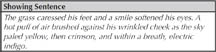 |
Show-Me Sentences Handout: This handout provides an example of a revised “show-me” sentence and six exercises for students to practice. |
From Theory to Practice
- While working with young children, Dyson finds that an attitude of playfulness and sense of fun helps students gain mastery over aspects of their writing. The same principle applies to adolescents and young adults.
- External stimuli prompt students to construct their own sentences and stories.
- When students have opportunities to revise, to observe, and to participate in peers’ revisions, they learn metacognitive strategies that transfer to their own writing.
Common Core Standards
This resource has been aligned to the Common Core State Standards for states in which they have been adopted. If a state does not appear in the drop-down, CCSS alignments are forthcoming.
State Standards
This lesson has been aligned to standards in the following states. If a state does not appear in the drop-down, standard alignments are not currently available for that state.
NCTE/IRA National Standards for the English Language Arts
- 4. Students adjust their use of spoken, written, and visual language (e.g., conventions, style, vocabulary) to communicate effectively with a variety of audiences and for different purposes.
- 5. Students employ a wide range of strategies as they write and use different writing process elements appropriately to communicate with different audiences for a variety of purposes.
- 6. Students apply knowledge of language structure, language conventions (e.g., spelling and punctuation), media techniques, figurative language, and genre to create, critique, and discuss print and nonprint texts.
Materials and Technology
Whiteboard or blackboard
Printouts
Preparation
This lesson is designated as a recurring lesson because it focuses on a writing skill that should be practiced throughout the year. Once students complete the examples provided in this lesson, be sure to compile additional practice exercises so students can continue to hone their skills over time. You may choose to use examples from students’ actual writing, with or without identification of the author.
In addition, consider having students visit Descriptive Writing With Virginia Hamilton to try some exercises outside of class.
- Provide each student with a Show-Me Sentences Handout.
- Write the following sentence on the board, “The car lands awkwardly, causing it to roll.”
Student Objectives
Students will
- Revise sentences to incorporate imagery and sensory detail
Instruction and Activities
- Discuss with the class the idea of “showing” rather than “telling” in writing. For example, in a casual conversation, a student might say, “I was in an automobile accident yesterday,” but such a statement gives little information. Was he or anyone else hurt? Did the accident involve another car or a tree? Was he alone in the car? Where did the accident happen?
- Read aloud the sentence on the board (see Preparation, Step 2), noting that it “tells” what happened rather than “shows” what happened.
- Ask the class to help rewrite the sentence so that the description comes alive.
“The car lands awkwardly, causing it to roll.”
- Ask, “What does lands awkwardly look like? Think of an image in your mind and let’s capture it in words.”
- Ask, “Is the car driving itself? Does the driver matter?”
- Ask, “Is enough detail provided to visualize what happened?”
- Ask, “What does lands awkwardly look like? Think of an image in your mind and let’s capture it in words.”
- In this manner, actively solicit sensory details (visual, auditory, tactile, olfactory descriptions) from students. Write the new “show” sentence next to the original “tell” sentence. Based upon this prompt, a ninth-grade student wrote:
“The car blasted through the guardrail, went into a free-fall, then spun around in the air and landed sideways, causing the weight to shift. Freddy felt the momentum pulling the car forward. The car kept rolling, and with each flip, Freddy felt more and more helpless.” - Refer students to the Show-Me Sentences Handout, and have them review the first example, first reading the “telling” sentence and then reading the “showing” sentence.
- Ask students if they could improve even more on the “showing” sentence. Allow students to provide suggestions and point out when their suggestions improve the descriptive quality of the sentence.
- Ask students to recreate the remaining “telling” sentences on the handout by incorporating visual and sensory details to more explicitly show the reader the scene.
- After students have worked through the sentences on the handout, ask for volunteers to read their revisions aloud. Point out effective uses of imagery and sensory details.
Extensions
Use this lesson early in the year so you can refer to it later when students are working on other writing assignments.
For example, after having students write a descriptive narrative and engage in a peer-review session, ask them to select three single, significant sentences from different parts of their narrative. Have students transform each sentence into a “showing” sentence as learned in this lesson. Each “showing” sentence can then be reinserted into the narrative as part of the revision process.
Student Assessment / Reflections
All students can demonstrate mastery of descriptive writing. However, it is not unusual to suggest that a student “add more description” to an initial reworking of a sentence. Witnessing how good peer writers reinvigorate sentences is especially helpful.