Storyboarding the Transformation from Dr. Jekyll into Mr. Hyde

- Preview |
- Standards |
- Resources & Preparation |
- Instructional Plan |
- Related Resources |
- Comments
Overview
While reading Dr. Jekyll and Mr. Hyde, students discuss a psychological (versus monster story) interpretation of the transformation of Dr. Jekyll into Mr. Hyde. Students then imagine how they would depict the transformation to illustrate their interpretation of the event and then storyboard those interpretations. After sharing their storyboards with the class, students view transformation scenes in a variety of film adaptations of the book, discuss the interpretations offered by the adaptations and argue for their preferred adaptation. The lesson can be adapted to use with other novels that have been turned into films.
Featured Resources
From Theory to Practice
In Reading in the Dark: Using Film as a Tool in the English Classroom, John Golden suggests:
…film and literature are not enemies; in fact, they should be used closely together because they share so many common elements and strategies to gain and keep the audience’s attention. We know that for many of our students, film is much more readily accessible than print because of the visual nature and immediacy of the medium, but the very things that films do for us, good and active readers of literature have to do for themselves. (36)
By having students imagine how they would film a scene and then asking them to analyze how professional filmmakers have produced the same scene, we can draw on students knowledge of the “visual nature and immediacy of the medium” as well as engage them as active readers of the printed and visual text.
Further Reading
Common Core Standards
This resource has been aligned to the Common Core State Standards for states in which they have been adopted. If a state does not appear in the drop-down, CCSS alignments are forthcoming.
State Standards
This lesson has been aligned to standards in the following states. If a state does not appear in the drop-down, standard alignments are not currently available for that state.
NCTE/IRA National Standards for the English Language Arts
- 1. Students read a wide range of print and nonprint texts to build an understanding of texts, of themselves, and of the cultures of the United States and the world; to acquire new information; to respond to the needs and demands of society and the workplace; and for personal fulfillment. Among these texts are fiction and nonfiction, classic and contemporary works.
- 2. Students read a wide range of literature from many periods in many genres to build an understanding of the many dimensions (e.g., philosophical, ethical, aesthetic) of human experience.
- 3. Students apply a wide range of strategies to comprehend, interpret, evaluate, and appreciate texts. They draw on their prior experience, their interactions with other readers and writers, their knowledge of word meaning and of other texts, their word identification strategies, and their understanding of textual features (e.g., sound-letter correspondence, sentence structure, context, graphics).
- 8. Students use a variety of technological and information resources (e.g., libraries, databases, computer networks, video) to gather and synthesize information and to create and communicate knowledge.
Materials and Technology
- TV with DVD or Computer connected to the internet (with projector)
Printouts
Websites
The internet movie database is an online database of movies and made for TV movies. It is a good place to start looking for adaptations of Dr. Jekyll and Mr. Hyde. While it is a good resources for finding and reading about adaptations, you cannot stream movies from IMDB.
You can stream several adaptations of Dr. Jekyll and Mr. Hyde on youtube.com. Additionally, several clips of transformation scenes are available. Try search terms “Dr. Jekyll and Mr. Hyde” and “Dr. Jekyll transformation.” Please preview all clips before showing in the classroom.
Netflix is a movie rental and streaming service that requires membership and costs a monthly fee. If you are already a customer, it is a good resource for streaming clips of transformation scenes without having to have the physical DVDs.
Preparation
- This activity works best after students have completed the novel Dr. Jekyll and Mr. Hyde. It is possible to begin the first session before students have read the final section of the novel, Henry Jekyll’s account of the affair, but they will lack some of his explanation of his motivation.
- Prepare copies of the Freud Civilization and its Discontents for each student.
- Prepare copies of the Small Group Discussion Guide (1 for every 4 students).
- Prepare copies of the Storyboard Printouts or arrange to access the Stapleless Book Interactive.
Student Objectives
Students will:
- summarize and evaluate Freud’s theory of repression.
- apply Freud’s theory to their reading of Dr. Jekyll and Mr. Hyde.
- develop their own interpretive perspective on the significance of the transformation of Dr. Jekyll into Mr. Hyde.
- visually represent their interpretation of the novel.
- evaluate movie interpretations of the novel.
Session One
- Session one is optional—rather than having students read the primary source material and puzzle out what Freud is arguing, it is an option to give a brief lecture on Freud’s theory of repression. Additionally, if this activity is being used with a novel other then Dr. Jekyll and Mr. Hyde, you can skip this session. All that is important for students to understand for the storyboarding activity is that Freud argues that all humans are basically selfish and aggressive by nature and it is only civilization (laws, marriage, religion) that keeps our natural aggression in check. A popular reading of Dr. Jekyll and Mr. Hyde sees the novel as a psychological morality tale—Dr. Jekyll has repressed his desires to engage in forbidden pursuits for so long that it results in the fragmentation of his personality into two. This interpretation pays less attention to monster aspect of the story and instead focuses attention on the part of Dr. Jekyll’s identity that he has repressed finally breaking to the surface.
- If you choose to give students the primary source material, distribute the excerpt from Freud’s Civilization and its Discontents (1930). Ask students to read through the excerpt individually, pausing after each paragraph to summarize in the margins what they think is the point of each paragraph.
- After they have read the excerpt, have students write any questions they have about what Freud is arguing or any places they agree or disagree with Freud. They will need their summaries and questions for the next activity.
- Break students into groups of 4 or 5 and give each group a copy of the Small Group Discussion Guide. The discussion guide has group roles and instructions.
- Give students 15-20 minutes to talk in their small groups, circulating and checking comprehension of the Freud excerpt at the beginning of the small group time and then giving assistance and asking additional probing questions during the remaining time. Some questions to consider asking the groups are below:
- What is your one sentence summary of the excerpt?
- Why did that seem like the most important part?
- What does Freud mean when he says, “. . . men are not gentle creatures, who want to be loved, who at the most can defend themselves if they are attacked; they are, on the contrary, creatures among whose instinctual endowments is to be reckoned a powerful share of aggressiveness.”
- What does Freud mean when he says, “In consequence of this primary mutual hostility of human beings, civilized society is perpetually threatened with disintegration.”
- (If students are struggling with these answers, you should restate Freud’s arguments in your own words. See #1 for a brief summary of Freud’s argument.)
- What is your one sentence summary of the excerpt?
- Towards the end of the session, ask students to come back to the full group and ask the reporter to summarize their groups’ discussion of the questions in section 2 of the Small Group Discussion Guide.
- Collect the reporters’ notes and use those to assess comprehension of a Freudian interpretation of the transformation of Dr. Jekyll into Mr. Hyde. If they were able to write a fairly accurate summary of the Freud excerpt and engaged in a discussion that pulled examples from the text, then they are beginning to understand this interpretation.
Session Two
- In this session, students will imagine how they would portray the transformation of Dr. Jekyll into Mr. Hyde if they were making a movie adaptation of the book. Before they begin sketching how they would do the transformation, they need to think about what interpretation of the transformation (Freudian, monster story, some other interpretation) will guide their visual choices. A Freudian interpretation was covered in the last session, a monster story interpretation would read the novel as a horror story and not read additional psychological implications into the text.
- Begin class with a five-minute free write. Free write prompt:
- If you were going to make a movie adaptation of Dr. Jekyll and Mr. Hyde
- What interpretation of the transformation (Freudian, monster story, or some other interpretation) would you choose to guide your adaptation? Explain your choice. If your interpretation is one other than Freudian or monster story, explain your interpretation as well.
- Towards the end of the free-write time, pass out the Storyboard Printouts or, if you are using the Stapleless Book interactive, allow students to open the interactive on their computers (if using the Stapleless Book interactive, students will need to type their description of the shots, print the book and then draw in their illustrations).
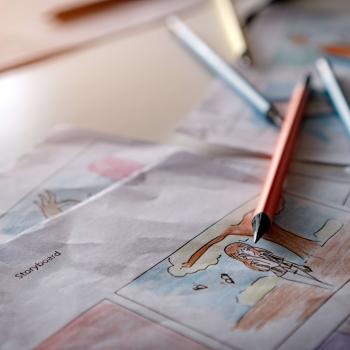
- Instruct students to imagine the moment when Dr. Jekyll transforms into Mr. Hyde and to draw a storyboard that illustrates that transformation. Encourage them to think about what the camera will focus on at the beginning, middle and end of the sequence and if they will use special effects or another way of distracting the audience’s attention when the transformation happens. Encourage them to also think about if they will use the same actor to portray both Jekyll and Hyde or if they will use different actors. If you wish, you may share with students the Sample Storyboard to show them what is expected.
- Give students 30 minutes to illustrate their storyboards. Stick figures are perfectly acceptable. The idea of the illustrations is to get the students thinking visually, so the quality of the drawings is not the focus. If they are concerned that their illustration doesn’t adequately communicate what they want to communicate, they should also describe what is happening on the lines below the picture box.
- In the last five minutes of the storyboard work time, have students turn their sheets over and write which interpretation they choose to represent in their adaptation and to write a couple sentences about how the visual choices they made illustrate that interpretation (i.e. “I had the camera focus on Dr. Jekyll’s eye while the transformation occurred in order to allow the special effects to take place off screen and to show that the change is mostly in Dr. Jekyll’s head”).
- In the last 10-15 minutes of class, ask a few students to talk through their adaptation. If they would like to show their storyboard to the class, they may, but they don’t have to. In particular, ask them to focus on what interpretation they choose and how they tried to incorporate that into their storyboard. Ask follow up questions about specific choices (i.e. What effect does having a different actor play Jekyll and Hyde have on the interpretation of the scene? Why did you choose to focus on Dr. Jekyll’s hand when the transformation is taking place?)
- Collect storyboards at end of class and use them to assess student understanding of the relationship between visual/adaptation choices and interpretation. If students drew or described several (4-8) shots depicting the transformation and were able to write about both the visual choices they made and related those choices to their interpretation of the text, then they are starting to connect the visual portrayal to interpretation of the text.
Session Three
- For this session, gatehr DVD clips from several adaptations of Dr. Jekyll and Mr. Hyde. A simple search of the Internet Movie Database (imdb.com) yields more than 70 results. See Suggested Adaptations document for annotated guidance. Choose 3-4 scenes that offer widely varying interpretations and know where in the DVD the transformation scene occurs so that you can easily access it when you switch films. Make sure that there is one copy per student available of the Note Taking Guide.
- Revisit the summary conversation from the last session by asking a student to remind the class of some ways the class came up with to show the Freudian and monster story interpretation of Jekyll’s transformation.
- Before showing DVD clips, ask students as they are viewing the scenes to try to discern what interpretive lens the film director is bringing to the story. They should take brief notes on the Note Taking Guide so that they can reference specific choices from the clips.
- After each clip, ask students for their immediate reaction to the clip and for what choices they liked and did not like. Spend no more than 5 minutes discussing their immediate reactions. You will want to leave at least 15 minutes for discussion after you have shown all the clips, so make decisions about how many clips to show and how much immediate reaction you want to allow based on the length of your class period.
- After all clips have been shown, ask students to write for five minutes answering the following prompt: If the novel is read as a commentary on the darkness that resides in all souls that is reigned in by civilization, do any of these portrayals reinforce that interpretation or offer a different interpretation?
- Once students have written, ask the question to the full class and continue the discussion asking them to further explain their answers. If they answered that the portrayals offered a different interpretation, ask them to elaborate on what interpretation they thought was offered. Ask them to elaborate on how the actors and directors (or lighting or music or special effects) communicated the directors’ interpretations.
- Finally, ask students which interpretation they preferred and why.
- If time allows, have students share their writing and offer their preferences on interpretations to their classmates.
- If students have been able to engage in a discussion of the interpretive choices various directors have made and are able to argue for which interpretation they prefer, then they have successfully engaged in evaluation of the film clips.
Extensions
- This lesson could work with Mary Shelley’s novel Frankenstein and the multiple movie versions made from that novel. If you wanted to offer students an interpretive lens, you can give a brief explanation of the concept of tabula rasa (the Romantic notion that people are born as a blank slate that civilization corrupts) and have students apply that to the portrayal of Frankenstein’s creature in the novel and movie adaptations.
- This lesson could be adapted for use with Shakespeare’s The Tempest and movie portrayals of the character of Caliban.
- Students who are inspired can make live action or stop motion animation clips of their storyboards, including the use of the interactive Comic Creator, if desired.
- Students who enjoyed drawing their storyboards can add color or storyboard additional scenes.
- The NCTE publication Reading in the Dark by John Golden has an entire chapter devoted to using film as a tool for literary analysis.
Student Assessment / Reflections
Assessment ideas for each session are suggested in the last step of each session. They are:
- Session One: Collect the reporters’ notes and use those to assess comprehension of a Freudian interpretation of the transformation of Dr. Jekyll into Mr. Hyde. If they were able to write a fairly accurate summary of the Freud excerpt and engaged in a discussion that pulled examples from the text then they are beginning to understand this interpretation.
- Session Two: Collect storyboards at end of class and use them to assess student understanding of the relationship between visual/adaptation choices and interpretation. If students engaged in the activity and were able to write about both the visual choices they made and related those choices to their interpretation of the text, then they are starting to connect the visual portrayal to interpretation of the text.
- Session Three: If students have been able to engage in a discussion of the interpretive choices various directors have made and are able to argue for which interpretation they prefer, then they have successfully engaged in evaluation of the film clips.