Word Recognition Strategies Using Nursery Rhymes

- Preview |
- Standards |
- Resources & Preparation |
- Instructional Plan |
- Related Resources |
- Comments
Overview
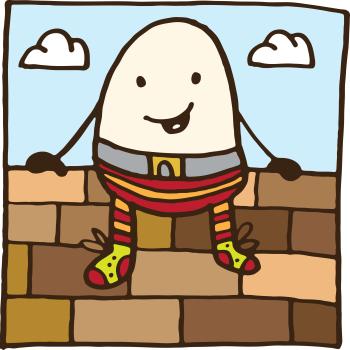
Nursery rhymes are the perfect vehicle for teaching word families because they are rich with examples of rhyming words. In this lesson, students learn to identify written words with similar endings by singing and reciting nursery rhymes. Students begin by reciting Humpty Dumpty, identifying two words with similar ending sounds, and creating their own lists of words with the same ending sound. Students repeat this procedure with words from Peter, Peter, Pumpkin Eater and Jack and Jill. Finally, students access a website to identify the word families featured in other nursery rhymes and then create an illustration and text based on their favorite nursery rhyme.
From Theory to Practice
- Children benefit from both direct phonics instruction and the reading and discussion of texts.
- Children entering first grade with minimal reading skill seem to have the greatest success with the following practices: modeling of chunking, sounding, and blending, comparing and contrasting words sounds and spelling patterns, and small group lessons.
Common Core Standards
This resource has been aligned to the Common Core State Standards for states in which they have been adopted. If a state does not appear in the drop-down, CCSS alignments are forthcoming.
State Standards
This lesson has been aligned to standards in the following states. If a state does not appear in the drop-down, standard alignments are not currently available for that state.
NCTE/IRA National Standards for the English Language Arts
- 2. Students read a wide range of literature from many periods in many genres to build an understanding of the many dimensions (e.g., philosophical, ethical, aesthetic) of human experience.
- 3. Students apply a wide range of strategies to comprehend, interpret, evaluate, and appreciate texts. They draw on their prior experience, their interactions with other readers and writers, their knowledge of word meaning and of other texts, their word identification strategies, and their understanding of textual features (e.g., sound-letter correspondence, sentence structure, context, graphics).
- 6. Students apply knowledge of language structure, language conventions (e.g., spelling and punctuation), media techniques, figurative language, and genre to create, critique, and discuss print and nonprint texts.
- 11. Students participate as knowledgeable, reflective, creative, and critical members of a variety of literacy communities.
Materials and Technology
- Black marker
- Chart paper
- Pocket chart
- Unlined index cards
- Computers with Internet access
- KidPix software
Printouts
Word families activity sheet
Websites
Preparation
Before beginning this lesson, write the words of a familiar children's song or nursery rhyme on chart paper. Featured nursery rhymes in this lesson include Humpty Dumpty; Peter, Peter Pumpkin Eater; and Jack and Jill.
Student Objectives
Students will
- Recite nursery rhymes or familiar children's songs
- Identify words with identical endings
- Brainstorm words that rhyme
- Categorize words according to word families
- Access the Internet to read nursery rhymes and identify word families
- Use KidPix software to create an illustration to accompany a favorite nursery rhyme
Session 1
| 1. | In a small group, display the chart paper featuring the words of Humpty Dumpty. |
| 2. | Recite the words as a group and allow for discussion. |
| 3. | Draw students' attention to the first two lines of the nursery rhyme and read them aloud. |
| 4. | Ask students if they can identify two words (other than Humpty and Dumpty) that have similar ending sounds. Lead them to identify the words wall and fall and underline those words on the chart paper. |
| 5. | Ask students to repeat the words as you point to them. Demonstrate how to sound out the words by blending the letter sounds together. Invite them to brainstorm how the two words are similar. |
| 6. | Point out that the two words end with the same three letters -all. |
| 7. | Ask students if they can think of other words that end with the letters -all. Write each of the words on a separate index cards. Words might include ball, call, fall, hall, mall, tall, and wall. |
| 8. | Display the word cards, and invite students to read the cards as a group. Be sure to draw attention to the fact that each word sounds the same except for the beginning letter. |
| 9. | Place the index cards in a pocket chart and encourage students to read and interact with the words on the cards in future lessons or during free time. |
Sessions 2 and 3
| 1. | Repeat this lesson using Peter, Peter Pumpkin Eater. For this rhyme, feature the words shell and well. In the same manner as the first activity, invite students to brainstorm words ending in the letters -ell. |
| 2. | Using Jack and Jill, feature the words Jill and hill and words ending in -ill. |
Session 4
| 1. | Allow students access to the website Word Families in Nursery Rhymes. |
| 2. | Students may scroll down the page to see lists of word families. Scrolling further down the page they will find a list of nursery rhymes that include these word families. |
| 3. | Instruct students to click on the title of a nursery rhyme, which will reveal a new page showing the complete text for the nursery rhyme. |
| 4. | Encourage students to identify the word families in a few of the nursery rhymes. |
| 5. | Finally, allow students to select their favorite nursery rhyme. Using KidPix software (or another graphics program), help them create an illustration for the nursery rhyme they selected. Have students type the nursery rhyme, underline the rhyming words, and include the illustration. |
Extensions
- Display the word cards created for the three nursery rhymes featured in the lesson, and encourage students to read the words on the cards and sort them into word family groups. Have students place the cards in groups using a pocket chart.
- Invite students to use words featured on the pocket chart in their story writing and journal writing activities.
- Access the following website to find more activities relating to word families: Activities to Practice Word Families.
- Have students access the online interactive Construct-a-Word to gain more practice with word families. Similar to a magnetic board, students manipulate letters on the screen to make rhyming words.
- Have students access the interactive Picture Match or the Word Family Sort for additional practice with short-vowel words and word families. The lesson "Word Sorts for Beginning and Struggling Readers" can also be used for follow-up lesson planning.
Student Assessment / Reflections
- Teacher observation: Take note of each student's level of participation during the activities. Reflect on the student's ability to identify, read, and categorize words in particular word families.
- Student evaluation: Distribute copies of the word families activity sheet. After completion of the handout, evaluate each student's ability to create new words.
- Student interviews: Ask students to read and interact with the word cards, and then ask individual students to share his or her understanding of words with similar endings.
- Journal writing: Take note of the students' use of featured words in their personal writing.
Add new comment