http://www.readwritethink.org/classroom-resources/printouts/common-content-area-roots-30842.html
Contribute to ReadWriteThink / RSS / FAQs / Site Demonstrations / Contact Us
![]()
![]()
To view our printable materials, you must download the latest version of the free Adobe Acrobat software.
![]()
Our lesson plans are written and reviewed by educators using current research and the best instructional practices and are aligned to state and national standards. Choose from hundreds of topics and strategies.
![]()
ReadWriteThink has a variety of resources for out-of-school use. Visit our Parent & Afterschool Resources section to learn more.
![]()
Home › Classroom Resources › Printouts
Printout
Common Content Area Roots and Affixes
![]()
| ABOUT THIS PRINTOUT |
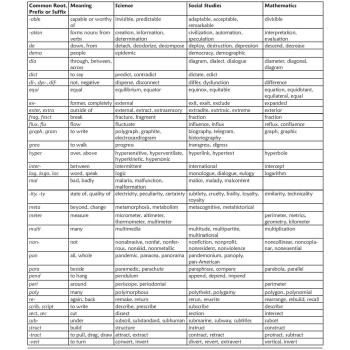
This printout offers 50 or so common roots, prefixes, and affixes that give students access to hundreds of key concepts across the content areas.
This printout has been reproduced from the following book: Ellery, V., & Rosenboom, J.L. (2011). Sustaining strategic readers: Techniques for supporting content literacy in grades 6-12. Newark, DE: International Reading Asssociation.
If your students are unfamiliar with the process of analyzing a word for its roots and affixes, you may need to begin by defining prefix, root, and suffix (using examples from the science, social studies, and mathematics section of the Common Content Area Roots and Affixes). Point out to students that once they are familiar with a root or affix, they can use that knowledge in multiple situations, increasing their vocabulary exponentially.
Use the chart as an inquiry tool by covering the “Meaning” column and asking students to determine the meaning of the common root, prefix, or affix based on the content of the other columns. Students may be surprised at how much they already know and encouraged by the number of words their background knowledge gives them access to.
- When students have a handle on the function and structure of these word parts, model the process of dissecting words into prefixes, roots, and affixes and using knowledge of word parts to make meaning of unfamiliar words based on prior knowledge.
- Have students explore the systematic effect certain suffixes have on roots. The suffix “-ism” for example, can turn an adjective into a noun, while “-ful” transforms nouns into adjective. Have students generate a list of such modifying suffixes and look for examples of them in their reading.
- Ask students create a blank version of the Common Content Area Roots and Affixes chart to keep in a notebook they take with them throughout the day. Challenge them to look for roots and affixes across content areas. Keep a chart in the classroom that students are invited to add to throughout the school year, demonstrating their expanding word knowledge and know-how.
| Lesson Plans | Student Interactives | Calendar Activities | Professional Development | Parent & Afterschool Resources |
Grades 6 – 8 | Lesson Plan | Recurring Lesson
Flip-a-Chip: Examining Affixes and Roots to Build Vocabulary
Do your students detest having to define vocabulary words? Don"t confine them to worksheetsturn the study of affixes and roots into a hands-on contest to create context-rich vocabulary puzzles.
Grades 3 – 5 | Lesson Plan | Standard Lesson
Rooting Out Meaning: Morpheme Match-Ups in the Primary Grades
In this lesson, students use morphemesEnglish words that have been formed by combining common word partsto explore word meanings.
Grades 6 – 8 | Lesson Plan | Standard Lesson
You Can't Spell the Word Prefix Without a Prefix
Students explore the role of prefixes, as well as their origins and meanings, and examine how the understanding of prefixes can improve comprehension, decoding, and spelling.
Grades 6 – 8 | Lesson Plan | Recurring Lesson
Using a Word Journal to Create a Personal Dictionary
Students will be the definition of vocabulary experts as they use the skills they learn in this lesson to track, define, and ultimately master unfamiliar words.
Grades 6 – 8 | Lesson Plan | Standard Lesson
ABC Bookmaking Builds Vocabulary in the Content Areas
V is for vocabulary. A content area unit provides the theme for a specialized ABC book, as students select, research, define, and illustrate a word for each alphabet letter.
Grades 9 – 12 | Lesson Plan | Standard Lesson
Brave New Words: Novice Lexicography and the Oxford English Dictionary
Students become novice lexicographers as they explore recent new entries to the dictionary, learn the process of writing entries for the Oxford English Dictionary, and write a new entry themselves.
Grades 6 – 8 | Lesson Plan | Standard Lesson
Improve Comprehension: A Word Game Using Root Words and Affixes
Students study common root words and affixes, improve their comprehension and spelling, and make a card game in which they form words with a prefix, root word, and suffix.
![]()


