Readers Theatre Rubric
About this printout
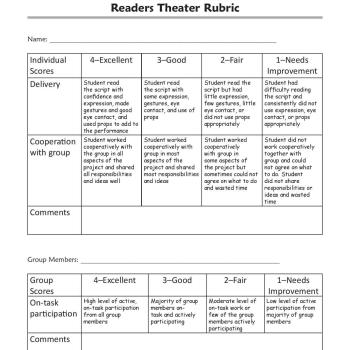
This rubric is designed to be used for any Readers Theatre performance. Students are scored both individually in the areas of delivery and cooperation and as a group in the area of active, on-task participation.
Teaching with this printout
Readers Theatre is a fun, interactive way to help students improve their reading fluency and oral speaking skills. Readers Theatre also gives students a chance to work cooperatively in groups and helps build their confidence, especially for reluctant readers. This rubric assesses students both individually in two major areas, delivery and cooperation, and as a group in the area of on-task participation. Delivery includes eye contact, expression, gestures, and use of props. Cooperation assesses students on how well they worked individually in a group and how well the group worked together overall. Give students the rubric ahead of time so they know and understand what they will be scored on. Discuss each of the major areas and how they relate to the Readers Theatre presentation. This rubric is flexible and can be used individually, for the whole group, or both.
More ideas to try
- After students have completed their Readers Theatre presentations, ask them to do a self-assessment with the same rubric and conference with them to compare their self-assessment with your own assessment.
- Provide students with several examples of Readers Theatre presentations before they plan and execute their own Readers Theatre. Ask students to evaluate and assess the exemplar presentations using the same rubric.
- Students can do peer evaluations of the Readers Theatre using this rubric. Students can meet with a partner or in small groups to give each other feedback and explain their scoring.