http://www.readwritethink.org/classroom-resources/printouts/search-process-reflection-chart-30786.html
Contribute to ReadWriteThink / RSS / FAQs / Site Demonstrations / Contact Us
![]()
![]()
To view our printable materials, you must download the latest version of the free Adobe Acrobat software.
![]()
Our lesson plans are written and reviewed by educators using current research and the best instructional practices and are aligned to state and national standards. Choose from hundreds of topics and strategies.
![]()
ReadWriteThink has a variety of resources for out-of-school use. Visit our Parent & Afterschool Resources section to learn more.
![]()
Home › Classroom Resources › Printouts
Printout
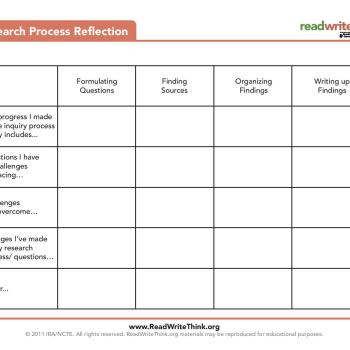
I-Search Process Reflection Chart
![]()
| ABOUT THIS PRINTOUT |
Because the written I-Search paper addresses the research process as much as the product or results of the research, students need time and space to reflect on and record their day-to-day progress. This chart asks students to consider their challenges and successes across the span of the research process, from question formulation to the final write-up.
- At the beginning of the I-Search process, model some possible responses in the area of “Formulating Questions.” After doing so, invite students to share some of their responses verbally before asking students to being recording some of their thinking in writing.
- Offer additional modeling as students move to each new step in the research process. Doing so not only reinforces the kinds of reflective thinking they will need for their papers, but it also gives you a chance to discuss how the process is actually not linear. A challenge in finding sources, for example, naturally takes the researcher back into the question formulation stage.
- Check students’ reflections frequently, both to offer feedback on how thorough and thoughtful they are being and to respond to some of the challenges they are facing.
- At certain points in the process, encourage students to being translating the daily notes into paragraphs of connected reflective writing.
- This chart merely represents a model for recording daily reflections, and might be used early on in the process to demonstrate for students. After students understand the goals of the chart, they may wish to record reflections in a notebook, on a folder containing some of their printed research, on sticky notes, or on a research process blog.
Grades 9 – 12 | Lesson Plan | Standard Lesson
Hoax or No Hoax? Strategies for Online Comprehension and Evaluation
Are your students easily fooled? You’ll find out in this lesson in which students carefully and critically examine hoax websites to determine their validity.
Grades 6 – 8 | Lesson Plan | Standard Lesson
Exploring Careers Using the Internet
Doctors, astrophysicists, and daycare providers are only some of the careers that will be explored in this lesson in which students research careers and publish occupational summaries about them.
Grades 6 – 8 | Lesson Plan
Keywords: Learning to Focus Internet Research
Surf’s up! Students will make a splash in this lesson when they learn how to effectively surf the Internet for specific information.
Grades 6 – 8 | Lesson Plan | Standard Lesson
Wading Through the Web: Teaching Internet Research Strategies
The Internet is often the first stop for student researchers, but few know how to vet sources effectively. In this lesson, students learn about Internet research through an interactive PowerPoint presentation.
Grades 6 – 8 | Lesson Plan | Unit
Scaffolding Methods for Research Paper Writing
In this lesson, students use a scaffold to help them compile information to write a solid research paper.
![]()