http://www.readwritethink.org/classroom-resources/student-interactives/alphabet-organizer-30035.html
Contribute to ReadWriteThink / RSS / FAQs / Site Demonstrations / Contact Us
![]()
![]()
Download the plug-in tools you need to use our games and tools, or check to see if you've got the latest version.
![]()
Looking for ways to engage your students in online literacy learning? Find more interactive tools that help them accomplish a variety of goals-from organizing their thoughts to learning about language.
![]()
Check out our collection of strategy guides to find effective literacy teaching and learning strategies to use in your classroom.
![]()
Home › Classroom Resources › Student Interactives
Student Interactive
Alphabet Organizer
![]()
| Grades | K – 12 |
| Interactive Type | Organizing & Summarizing |
| Tech Requirement | |
| URL | http://www.readwritethink.org /files/resources/interactives /alphabet_organizer/ |
| ABOUT THIS INTERACTIVE |
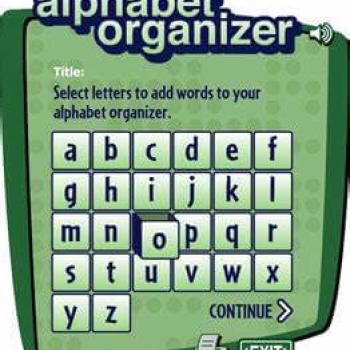
Alphabet Organizer has numerous applications for classroom instruction. Students have the option to enter one word, more than one word, or a word and related notes for each letter of the alphabet. Elementary students can use the tool to create an alphabet book with words for each letter of the alphabet. The tool can also be used to have students brainstorm and discuss background knowledge on a topic they are beginning to study. At the end of the unit, the chart can be revisited to add new information or to correct erroneous information. Alternatively, the tool can be used for a vocabulary study by having students enter vocabulary words and related notes or definitions. This interactive tool enables students to print an alphabet chart or pages for an alphabet book.
Lesson plans on ReadWriteThink illustrate various examples of how the tool can be used in the classroom; for ideas of how to use it outside the classroom, see Alphabet Organizer in the Parent & Afterschool Resources section.
Grades 9 – 12 | Lesson Plan | Minilesson
Students examine a letter of the alphabet from all angles, creating image pools of original metaphors that they then turn into poems.
Grades 6 – 8 | Lesson Plan | Standard Lesson
A Prereading Strategy: Using the Vocabulary, Language, Prediction (VLP) Approach
Students learn content area vocabulary and increase reading comprehension using the Vocabulary, Language, Prediction (VLP) approach.
Grades 2 – 12 | Calendar Activity |  April 14
Noah Webster published his American Dictionary of the English Language in 1828.
After dividing students into small groups, students play a variation of the game Balderdash to celebrate the publication of Webster's dictionary.
Grades K – 1 | Printout | Graphic Organizer
This alphabet chart has many possibilities for helping your students learn and review their letters, sounds, phonemes, and word formations.
Grades K – 2 | Activity & Project
Show children a fun way to practice their ABCs using summer words in an alphabet book.
Grades K – 5 | Game & Tool
The Alphabet Organizer lets children create a calendar-style ABC chart or letter pages for an alphabet book.
Grades K – 1 | Printout | Word Play
This activity helps children learn to recognize letters and their sounds, and to associate sounds and letters with words.
Grades K – 5 | Podcast Episode
Find alphabet books to inspire and educate the entire family in this Chatting About Books podcast episode.
![]()

