http://www.readwritethink.org/classroom-resources/student-interactives/circle-plot-diagram-30026.html
Contribute to ReadWriteThink / RSS / FAQs / Site Demonstrations / Contact Us
![]()
![]()
Download the plug-in tools you need to use our games and tools, or check to see if you've got the latest version.
![]()
Looking for ways to engage your students in online literacy learning? Find more interactive tools that help them accomplish a variety of goals-from organizing their thoughts to learning about language.
![]()
Check out our collection of strategy guides to find effective literacy teaching and learning strategies to use in your classroom.
![]()
Home › Classroom Resources › Student Interactives
Student Interactive
Circle Plot Diagram
![]()
| Grades | 3 – 12 |
| Interactive Type | Organizing & Summarizing |
| Tech Requirement | |
| URL | http://www.readwritethink.org /files/resources/interactives /circle-plot/ |
| ABOUT THIS INTERACTIVE |
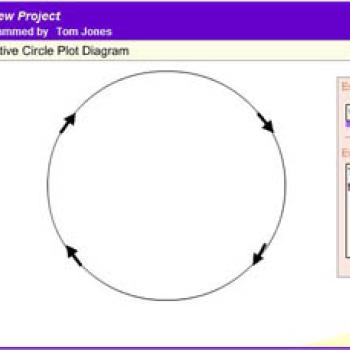
Introducing the concept of text structure to elementary students is made easy-and fun!-through the use of the Circle Plot Diagram. The tool can be used as a prewriting graphic organizer for students writing original stories with a circular plot structure (e.g., If You Take a Mouse to School), as well as a postreading organizer used to explore the text structures in a book. By students inserting main examples of a story's plot directly onto the circular interactive (shown at left), the concepts of structure and plot are reinforced each time the tool is used. When used as a prewriting exercise, the diagram can be printed out and shared with peers and teacher for feedback and revision in this phase of the writing process.
Grades 9 – 12 | Lesson Plan | Standard Lesson
Spend a Day in My Shoes: Exploring the Role of Perspective in Narrative
In this lesson, students imagine spending a day in someone else's shoes. After reviewing the characteristics of narrative writing, they then write narratives from that person's point of view.
Grades 3 – 8 | Printout | Graphic Organizer
This concept map can be used in a variety of ways to show relationships between words and phrases. Students can add arrows as needed and group certain ideas together.
![]()