http://www.readwritethink.org/classroom-resources/student-interactives/comic-creator-30021.html
Contribute to ReadWriteThink / RSS / FAQs / Site Demonstrations / Contact Us
![]()
![]()
Download the plug-in tools you need to use our games and tools, or check to see if you've got the latest version.
![]()
Looking for ways to engage your students in online literacy learning? Find more interactive tools that help them accomplish a variety of goals-from organizing their thoughts to learning about language.
![]()
Check out our collection of strategy guides to find effective literacy teaching and learning strategies to use in your classroom.
![]()
Home › Classroom Resources › Student Interactives
Student Interactive
Comic Creator
![]()
| Grades | K – 12 |
| Interactive Type | Writing & Publishing Prose |
| Tech Requirement | |
| URL | http://www.readwritethink.org /files/resources/interactives /comic/ |
| ABOUT THIS INTERACTIVE |
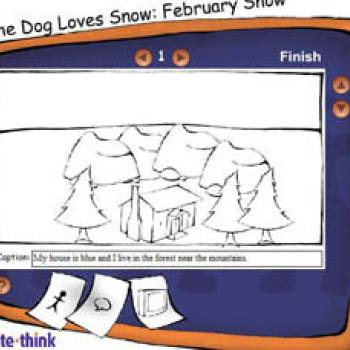
The Comic Creator invites students to compose their own comic strips for a variety of contexts (prewriting, pre- and postreading activities, response to literature, and so on). The organizers focus on the key elements of comic strips by allowing students to choose backgrounds, characters, and props, as well as to compose related dialogue (shown at left). This versatile tool can be used by students from kindergarten through high school, for purposes ranging from learning to write dialogue to an in-depth study of a formerly neglected genre. The tool is easy to use, made even easier with the Comic Strip Planning Sheet, a printable PDF that comic creators can use to draft and revise their work before creating and printing their final comics. After completing their comic, students have the ability to print out and illustrate their final versions for feedback and assessment.
Grades 3 – 5 | Lesson Plan | Standard Lesson
Comics in the Classroom as an Introduction to Genre Study
Multidimensional, challenging, and popular with students, comics provide an excellent way to introduce the concept of genres.
Grades 3 – 5 | Lesson Plan | Standard Lesson
Comics in the Classroom as an Introduction to Narrative Structure
This lesson uses comic strip frames to define plot and reinforce the structure that underlies a narrative. Students finish by writing their own original narratives.
Grades 3 – 5 | Lesson Plan | Standard Lesson
Book Report Alternative: Examining Story Elements Using Story Map Comic Strips
Comic frames are traditionally used to illustrate a story in a short, concise format. In this lesson, students use a six-paneled comic strip frame to create a story map, summarizing a book or story that they've read. Each panel retells a particular detail or explains a literary element (such as setting or character) from the story.
Grades 3 – 5 | Lesson Plan | Standard Lesson
Blending Fiction and Nonfiction to Improve Comprehension and Writing Skills
Students use a text set to increase understanding of content area material and demonstrate what they have learned by writing an original piece that blends together narrative and expository elements.
Grades 3 – 5 | Lesson Plan | Minilesson
To, Too, or Two: Developing an Understanding of Homophones
The classroom becomes a stage in this interactive lesson in which students sing, act, and design comic strips to learn the meanings and spellings of common homophones.
Grades 3 – 5 | Lesson Plan | Standard Lesson
Weather Detectives: Questioning the Fact and Folklore of Weather Sayings
Students adopt a skeptical stance and become weather detectives who ask “Why?” and “Why not?” as they investigate the history and validity of some common weather sayings.
Grades K – 3 | Lesson Plan | Standard Lesson
Word Study with Henry and Mudge
Henry and Mudge is used in this lesson to build students' word recognition through rereading, high-frequency word banks, word studies, and writing.
Grades 3 – 5 | Lesson Plan | Standard Lesson
What If We Changed the Book? Problem-Posing with Sixteen Cows
After reading a piece of math-related children’s literature aloud, students pose and solve new problems by asking what-if questions about the events in the story.
Grades 3 – 6 | Lesson Plan | Standard Lesson
Opening the Door for Reading: Sharing Favorite Texts to Build Community
In this lesson, students build classroom community by exploring environmental print and a teacher-created display that focuses on a favorite book. They then create and share their own presentations.
Grades 3 – 5 | Lesson Plan | Standard Lesson
Once Upon a Time Rethought: Writing Fractured Fairy Tales
Students read and analyze fairy tales, identifying their common elements. They then write their own “fractured” fairy tales by changing one of the literary elements found in the original.
Grades 3 – 5 | Lesson Plan | Standard Lesson
Our Classroom: Writing an Owner’s Manual
Students write an owner’s manual that helps them get to know their classroom, provides them with a sense of ownership, and lets others know about their classroom.
Grades 3 – 5 | Lesson Plan | Standard Lesson
Buzz! Whiz! Bang! Using Comic Books to Teach Onomatopoeia
This lesson is sure to sizzle, not fizzle, as students use comic strips to find onomatopoetic words, develop a vocabulary list from the words, and discuss why writers use onomatopoeia.
Grades 3 – 5 | Lesson Plan | Recurring Lesson
Using Word Storms to Explore Vocabulary and Encourage Critical Thinking
Students learn that dogs are more than just pets in this lesson, which teaches them to use research and vocabulary-acquisition strategies to learn and write about working dogs.
Grades 3 – 5 | Lesson Plan | Unit
Searching for Gold: A Collaborative Inquiry Project
Each small group of students researches one aspect of the same big topic, such as the Gold Rush, and teaches what they have learned to the rest of the class.
Grades 3 – 5 | Lesson Plan | Unit
Zines for Kids: Multigenre Texts About Media Icons
Special edition! Students use ReadWriteThink tools to create magazines about prominent figures using a variety of writing genres and styles.
Grades 3 – 5 | Lesson Plan | Standard Lesson
Gabbing About Garfield: Conversing About Texts With Comic Creator
Students will definitely get animated as they discuss comics’ features and designs, and they’re sure to enjoy the lesson’s punch line assignment: creating a comic strip of their own.
Grades 3 – 5 | Lesson Plan | Standard Lesson
Reading Idol! Bringing Readers Theatre Center Stage in Your Classroom
Students produce a Readers Theatre performance to compete to be named the Reading Idol. Students vote on the final performances and record them as podcasts.
Grades 2 – 4 | Lesson Plan
Engaging With Cause-and-Effect Relationships Through Creating Comic Strips
Students demonstrate their knowledge of cause-and-effect relationships by creating original comic strips and sharing their completed work in an oral presentation format.
Grades 9 – 12 | Lesson Plan | Standard Lesson
Seuss and Silverstein: Posing Questions, Presenting Points
Students will enjoy this blast from the past as they read the works of Dr. Seuss and Shel Silverstein to analyze the way social issues are addressed in selected works.
Grades 9 – 12 | Lesson Plan | Standard Lesson
Dialect Detectives: Exploring Dialect in Great Expectations
Great Expectations is rich in dialogue and in the dialect of the working class and the poor of Victorian England. What does Dickens reveal about his characters using dialect?
Grades 6 – 12 | Strategy Guide
Supporting Vocabulary Acquisition for English Language Learners
This Strategy Guide introduces strategies teachers can use for ELL vocabulary instruction in their English and content area classrooms.
Grades 8 – 12 | Professional Library | Book
Literacy Remix: Bridging Adolescents’ In and Out of School Literacies
This resources promotes the use new literacies to help students connect to school texts.
Grades K – 8 | Professional Library | Book
Trading Cards to Comic Strips: Popular Culture Texts and Literacy Learning in Grades K-8
This resource shows how to use television, movies, video games, music, magazines, and other media to motivate students and enhance literacy learning.
![]()

