http://www.readwritethink.org/classroom-resources/student-interactives/comic-creator-30021.html
Contribute to ReadWriteThink / RSS / FAQs / Site Demonstrations / Contact Us
![]()
![]()
Download the plug-in tools you need to use our games and tools, or check to see if you've got the latest version.
![]()
Looking for ways to engage your students in online literacy learning? Find more interactive tools that help them accomplish a variety of goals-from organizing their thoughts to learning about language.
![]()
Check out our collection of strategy guides to find effective literacy teaching and learning strategies to use in your classroom.
![]()
Home › Classroom Resources › Student Interactives
Student Interactive
Comic Creator
![]()
| Grades | K – 12 |
| Interactive Type | Writing & Publishing Prose |
| Tech Requirement | |
| URL | http://www.readwritethink.org /files/resources/interactives /comic/ |
| ABOUT THIS INTERACTIVE |
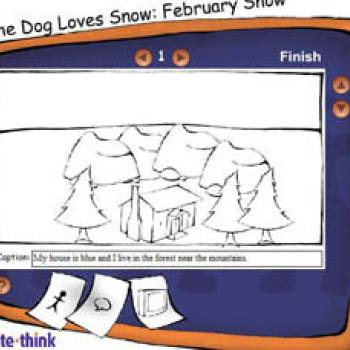
The Comic Creator invites students to compose their own comic strips for a variety of contexts (prewriting, pre- and postreading activities, response to literature, and so on). The organizers focus on the key elements of comic strips by allowing students to choose backgrounds, characters, and props, as well as to compose related dialogue (shown at left). This versatile tool can be used by students from kindergarten through high school, for purposes ranging from learning to write dialogue to an in-depth study of a formerly neglected genre. The tool is easy to use, made even easier with the Comic Strip Planning Sheet, a printable PDF that comic creators can use to draft and revise their work before creating and printing their final comics. After completing their comic, students have the ability to print out and illustrate their final versions for feedback and assessment.
Grades 9 – 12 | Lesson Plan | Standard Lesson
Comic Makeovers: Examining Race, Class, Ethnicity, and Gender in the Media
Students explore stereotypes in the media and representations of race, class, ethnicity, and gender by analyzing comics over a two-week period and then re-envisioning them with a "comic character makeover."
Grades 9 – 12 | Lesson Plan | Unit
Examining Transcendentalism through Popular Culture
Using excerpts from the works of Ralph Waldo Emerson and Henry David Thoreau, comics, and songs from different musical genres, students examine the characteristics of transcendentalism.
Grades 9 – 12 | Lesson Plan | Standard Lesson
Happily Ever After? Exploring Character, Conflict, and Plot in Dramatic Tragedy
By exploring the decisions points in a tragedy, students consider how the plot of the story can change if the key characters make a different choice at the turning point.
Grades 9 – 12 | Lesson Plan | Standard Lesson
Analyzing Symbolism, Plot, and Theme in Death and the Miser
Students apply the analytical skills that they use when reading literature to an exploration of the underlying meaning and symbolism in Hieronymous Bosch’s early Renaissance painting Death and the Miser.
Grades 9 – 12 | Lesson Plan | Standard Lesson
Analyzing and Comparing Medieval and Modern Ballads
Students explore the ballads genre by reading medieval ballads to deduce their characteristics, acting out the ballads, comparing medieval and modern ballads using Venn diagrams, and composing their own ballads.
Grades 9 – 12 | Lesson Plan
Persuasive Techniques in Advertising ![]()
Students will be introduced to persuasive techniques used in advertising, analyze advertising, and explore the concepts of demographics, marketing for a specific audience, and dynamic advertising.
Grades 9 – 12 | Lesson Plan | Standard Lesson
Seuss and Silverstein: Posing Questions, Presenting Points
Students will enjoy this blast from the past as they read the works of Dr. Seuss and Shel Silverstein to analyze the way social issues are addressed in selected works.
Grades 9 – 12 | Lesson Plan | Standard Lesson
Dialect Detectives: Exploring Dialect in Great Expectations
Great Expectations is rich in dialogue and in the dialect of the working class and the poor of Victorian England. What does Dickens reveal about his characters using dialect?
Grades 6 – 12 | Strategy Guide
Supporting Vocabulary Acquisition for English Language Learners
This Strategy Guide introduces strategies teachers can use for ELL vocabulary instruction in their English and content area classrooms.
Grades 8 – 12 | Professional Library | Book
Literacy Remix: Bridging Adolescents’ In and Out of School Literacies
This resources promotes the use new literacies to help students connect to school texts.
Grades K – 8 | Professional Library | Book
Trading Cards to Comic Strips: Popular Culture Texts and Literacy Learning in Grades K-8
This resource shows how to use television, movies, video games, music, magazines, and other media to motivate students and enhance literacy learning.
![]()

