http://www.readwritethink.org/classroom-resources/student-interactives/comparison-contrast-guide-30033.html
Contribute to ReadWriteThink / RSS / FAQs / Site Demonstrations / Contact Us
![]()
![]()
Download the plug-in tools you need to use our games and tools, or check to see if you've got the latest version.
![]()
Looking for ways to engage your students in online literacy learning? Find more interactive tools that help them accomplish a variety of goals-from organizing their thoughts to learning about language.
![]()
Check out our collection of strategy guides to find effective literacy teaching and learning strategies to use in your classroom.
![]()
Home › Classroom Resources › Student Interactives
Student Interactive
Comparison and Contrast Guide
![]()
| Grades | 3 – 12 |
| Interactive Type | Organizing & Summarizing |
| Tech Requirement | |
| URL | http://www.readwritethink.org /files/resources/interactives /compcontrast/ |
| ABOUT THIS INTERACTIVE |
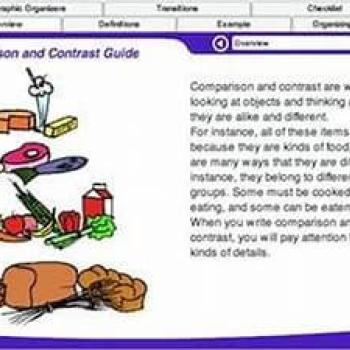
This interactive guide provides an introduction to the basic characteristics and resources that are typically used when students compose comparison and contrast essays. The Comparison and Contrast Guide includes an overview, definitions and examples. The Organizing a Paper section includes details on whole-to-whole (block), point-by-point, and similarities-to-differences structures. In addition, the Guide explains how graphic organizers are used for comparison and contrast, provides tips for using transitions between ideas in comparison and contrast essays, and includes a checklist, which matches an accompanying rubric.
Grades 9 – 12 | Lesson Plan | Standard Lesson
Critical Literacy: Women in 19th-Century Literature
Reading historical selections will give students the perspective they need to compare the author’s purpose and voice of two separate writers.
Grades 6 – 12 | Lesson Plan | Standard Lesson
Comparing Portrayals of Slavery in Nineteenth-Century Photography and Literature
In this lesson, students analyze similarities and differences among depictions of slavery in The Adventures of Huckleberry Finn, Frederick Douglass’ Narrative, and nineteenth century photographs of slaves. Students formulate their analysis of the role of art and fiction, as they attempt to reliably reflect social ills, in a final essay.
Grades 3 – 6 | Lesson Plan | Standard Lesson
The Tale of Despereaux: Fact or Fiction?
Using the book The Tale of Despereaux, students look a closer look at medieval times to see if the novel accurately portrays this time in history. Looking at key sections of the book, students will use the Compare and Contrast Guide and Map to help them decipher between fact and fiction.
Grades 3 – 12 | Student Interactive | Organizing & Summarizing
The Compare & Contrast Map is an interactive graphic organizer that enables students to organize and outline their ideas for different kinds of comparison essays.
Grades K – 12 | Student Interactive | Organizing & Summarizing
This interactive tool allows students to create Venn diagrams that contain two or three overlapping circles, enabling them to organize their information logically.
![]()