Cube Creator
About this Interactive
Overview
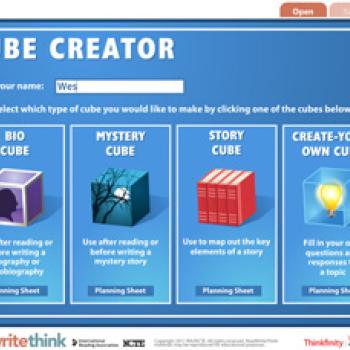
Summarizing information is an important postreading and prewriting activity that helps students synthesize what they have learned. The interactive Cube Creator offers four options:
 Bio Cube: This option allows students to develop an outline of a person whose biography or autobiography they have just read; it can also be used before students write their own autobiography. Specific prompts ask students to describe a person's significance, background, and personality.
 Mystery Cube: Use this option to help your students sort out the clues in their favorite mysteries or develop outlines for their own stories. Among its multiple applications, the Mystery Cube helps students identify mystery elements, practice using vocabulary from this popular genre, and sort and summarize information. Specific prompts ask students to describe the setting, clues, crime or mystery, victim, detective, and solution.
 Story Cube: In this cube option, students can summarize the key elements in a story, including character, setting, conflict, resolution, and theme. Students can even identify their favorite part of the story. This can be used as an alternative to the Story Map interactive.
 Create-Your-Own Cube: Working on a science unit? Doing some research on volcanoes? The Create-Your-Own Cube is your answer. This version allows teachers and students to generate their own questions or topics. Teachers can type in the questions, lock them from editing using the padlock icon, and save the file using the Save tab at the top of the screen. The saved file can then be shared with students to enter in their responses. Students can also customize cubes on topics of their choosing.
Students can save their draft cubes to revise later. See the five-minute video tutorial Saving Work With the Student Interactives for more information on have to save, e-mail, and open a file in any of the ReadWriteThink Student Interactives. The finished cube can also be saved, printed, and folded into a fun cube shape that can be used for future reference.