http://www.readwritethink.org/classroom-resources/student-interactives/diamante-poems-30053.html
Contribute to ReadWriteThink / RSS / FAQs / Site Demonstrations / Contact Us
![]()
![]()
Download the plug-in tools you need to use our games and tools, or check to see if you've got the latest version.
![]()
Looking for ways to engage your students in online literacy learning? Find more interactive tools that help them accomplish a variety of goals-from organizing their thoughts to learning about language.
![]()
Check out our collection of strategy guides to find effective literacy teaching and learning strategies to use in your classroom.
![]()
Home › Classroom Resources › Student Interactives
Student Interactive
Diamante Poems
![]()
| Grades | K – 12 |
| Interactive Type | Writing Poetry |
| Tech Requirement | |
| URL | http://www.readwritethink.org /files/resources/interactives /diamante/ |
| ABOUT THIS INTERACTIVE |
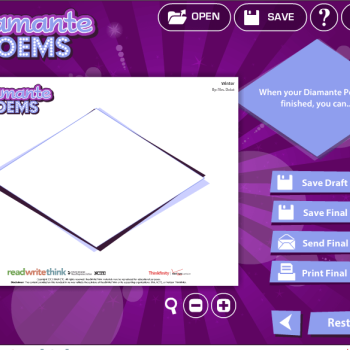
In this online tool, students can learn about and write diamante poems, which are diamond-shaped poems that use nouns, adjectives, and gerunds to describe either one central topic or two opposing topics (for example, night/day or winter/spring). Examples of both kinds of diamante poems can be viewed online or printed out.
Because diamante poems follow a specific format that uses nouns on the first and last lines, adjectives on the second and fourth lines, and gerunds in the third and fifth lines, this tool has numerous word-study applications. The tool provides definitions of the different parts of speech students use in composing the poems, reinforcing the connection between word study and writing. It also includes prompts to write and revise poems, thus reinforcing elements of the writing process. Students can save their draft diamante poems to revise later, and save and print their finished diamante poems.
For additional ideas on how to use this tool out of school, see Diamante Poems in the Parent & Afterschool Resources section.
Grades 3 – 5 | Lesson Plan | Unit
Peace Poems and Picasso Doves: Literature, Art, Technology, and Poetry
Students apply think-aloud strategies to reading and to composition of artwork and poetry. They research symbols of peace as they prewrite, compose, and publish their poetry.
Grades 3 – 5 | Lesson Plan | Unit
Creating Classroom Community by Crafting Themed Poetry Collections
Students create poetry collections with the theme of "getting to know each other." They study and then write a variety of forms of poetry to include in their collections.
Grades 3 – 5 | Lesson Plan | Standard Lesson
Building Classroom Community Through the Exploration of Acrostic Poetry
What do your students think about each other? Find out as you teach them the concepts of acrostic poems and challenge them to write an uplifting acrostic about a classmate.
Grades 3 – 5 | Lesson Plan | Standard Lesson
Introduce gerunds and review nouns, adjectives, and verbs through engaging read-alouds; then apply these concepts through collaborative word-sorting and poetry-writing activities.
Grades 3 – 5 | Lesson Plan | Standard Lesson
All About Alliteration: Responding to Literature Through a Poetry Link
Studied students stupefy! Students learn about alliteration by listening to an alliterative read-aloud and apply the knowledge they gain to the creation of their own poem and illustration.
Grades 3 – 5 | Lesson Plan | Standard Lesson
Earth Verse: Using Science in Poetry
Students shape up their reading, writing, and listening skills in this lesson by creating original diamante, acrostic, and shape poems about science.
Grades 4 – 8 | Lesson Plan | Standard Lesson
Talking Poetry with Blabberize
Students will be motivated to share their poetry through an online tool the features recording and animation.
Grades 7 – 10 | Lesson Plan | Standard Lesson
Engineering the Perfect Poem by Using the Vocabulary of STEM
Students research engineering careers and create poetry to understand the vocabulary of STEM (science, technology, engineering, and mathematics).
Grades 6 – 12 | Lesson Plan | Standard Lesson
Making History Come Alive Through Poetry and Song
Students compare the sinking of the Edmund Fitzgerald with the song, “The Wreck of the Edmund Fitzgerald,” then create their own poetry about a historical event.
Grades K – 5 | Student Interactive | Writing Poetry
Formerly known as Shape Poems, this online tool allows elementary students to write poems in various shapes.
Grades K – 12 | Student Interactive | Writing Poetry
This online tool enables students to learn about and write acrostic poems. Elements of the writing process are also included.
Grades K – 12 | Calendar Activity |  April 1
April is National Poetry Month!
Students are assigned to be "poets of the day" and are provided several models to create, illustrate, and present their different poems to the class.
Grades 3 – 8 | Printout | Writing Starter
This tool will allow your students to create a diamante poem by reflecting on their knowledge of a topic and by using nouns, verbs, and adjectives in a creative manner.
Grades 2 – 6 | Printout | Writing Starter
This graphic organizer provides students the opportunity to brainstorm words about a given topic, count and record the syllables, and draft a haiku.
Grades 3 – 8 | Professional Library | Journal
This article discusses the need to engage students and teachers in active poetry writing.
Grades 5 – 8 | Activity & Project
Learn about diamante poems, and then consider the idea of cause and effect before working it into the diamante poem format.
Grades 4 – 6 | Activity & Project
Kids will love Hink Pinks—word puzzles that use two-word clues to lead to a rhyming solution. Try one and get hooked yourself: Obese feline? Fat cat!
Grades 3 – 12 | Game & Tool
Diamante poems are poems where the longest line comes in the middle, creating a diamond-like shape. The Diamante Poems tool helps children write these patterned poems.
![]()

