http://www.readwritethink.org/classroom-resources/student-interactives/flip-book-30054.html
Contribute to ReadWriteThink / RSS / FAQs / Site Demonstrations / Contact Us
![]()
![]()
Download the plug-in tools you need to use our games and tools, or check to see if you've got the latest version.
![]()
Looking for ways to engage your students in online literacy learning? Find more interactive tools that help them accomplish a variety of goals-from organizing their thoughts to learning about language.
![]()
Check out our collection of strategy guides to find effective literacy teaching and learning strategies to use in your classroom.
![]()
Home › Classroom Resources › Student Interactives
Student Interactive
Flip Book
![]()
| Grades | 3 – 12 |
| Interactive Type | Writing & Publishing Prose |
| Tech Requirement | |
| URL | http://www.readwritethink.org /files/resources/interactives /flipbook/ |
| ABOUT THIS INTERACTIVE |
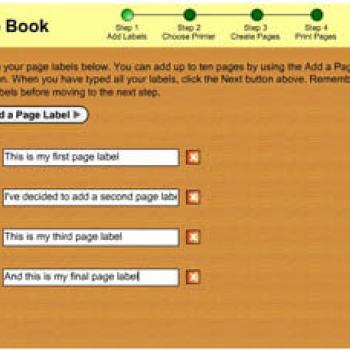
The Flip Book is designed to allow users to type and illustrate tabbed flip books up to ten pages long. Students and teachers can use the flip book for taking notes while reading, making picture books, collecting facts, or creating question and answer booklets. Students can choose from nine different layouts for the pages of their books (shown left). A blank flip book is available for demonstration and planning.
Grades 6 – 8 | Lesson Plan | Standard Lesson
Cooking Up Descriptive Language: Designing Restaurant Menus
Students explore the menu genre by analyzing existing menus from local restaurants. They review adjectives and descriptive writing and then work in groups to create their own custom menus.
Grades 6 – 8 | Lesson Plan | Standard Lesson
You Know the Movie is ComingNow What?
In this lesson, students read a literary text with the eye of a director, selecting scenes from the text and putting a cinematic spin on them.
Grades 6 – 8 | Lesson Plan | Unit
When I Was Young In...A Literature to Language Experience
Past meets present in this lesson in which students practice verb tense when they write personal short stories that they then publish in a flip book.
Grades 6 – 8 | Lesson Plan | Unit
Students as Creators: Exploring Multimedia
Students are introduced to the genre of multimedia presentations through a review and analysis of online presentations. They then apply what they have learned to create their own multimedia presentations.
Grades 6 – 8 | Lesson Plan | Standard Lesson
Polishing Preposition Skills through Poetry and Publication
Students deepen and refine their understanding of prepositions by reading Ruth Heller's Behind the Mask. They write preposition poetry and create a study guide using an online tool.
Grades 6 – 8 | Lesson Plan | Standard Lesson
Swish! Pow! Whack! Teaching Onomatopoeia Through Sports Poetry
Students explore poetry about sports, looking closely at the use of onomatopoeia. After viewing a segment of a sporting event, students create their own onomatopoeic sports poems.
Grades 4 – 8 | Lesson Plan | Minilesson
Creative Writing in the Natural World: A Framing
Students practice writing detailed, sensory-rich descriptions by framing a small piece of nature and freewriting about it. From this minilesson, students can develop a variety of types of writing.
Grades 4 – 7 | Lesson Plan | Standard Lesson
As a pre-reading activity for The Cay, groups of students choose and study a Caribbean island, create a final product in the format of their choice, and finally, do an oral presentation to share information learned.
Grades K – 12 | Student Interactive | Writing & Publishing Prose
The interactive Printing Press is designed to assist students in creating newspapers, brochures, and flyers.
Grades K – 12 | Student Interactive | Writing & Publishing Prose
The Stapleless Book can be used for taking notes while reading, making picture books, collecting facts, or creating vocabulary booklets . . . the possibilities are endless!
Grades 3 – 8 | Calendar Activity |  August 13
The first English printer, William Caxton, was born on this day in 1422.
Students consider how the printing press affects their world by completing a printing inventory, comparing lists, and developing a "super" list of all printed materials that they interact with.
Grades K – 5 | Strategy Guide
Implementing the Writing Process
This strategy guide explains the writing process and offers practical methods for applying it in your classroom to help students become proficient writers.
![]()

