http://www.readwritethink.org/classroom-resources/student-interactives/graphic-30039.html
Contribute to ReadWriteThink / RSS / FAQs / Site Demonstrations / Contact Us
![]()
![]()
Download the plug-in tools you need to use our games and tools, or check to see if you've got the latest version.
![]()
Looking for ways to engage your students in online literacy learning? Find more interactive tools that help them accomplish a variety of goals-from organizing their thoughts to learning about language.
![]()
Check out our collection of strategy guides to find effective literacy teaching and learning strategies to use in your classroom.
![]()
Home › Classroom Resources › Student Interactives
Student Interactive
Graphic Map
![]()
| Grades | 3 – 12 |
| Interactive Type | Organizing & Summarizing |
| Tech Requirement | |
| URL | http://www.readwritethink.org /files/resources/interactives /graphicmap/ |
| ABOUT THIS INTERACTIVE |
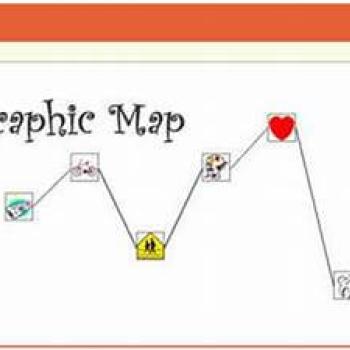
The Graphic Map is designed to assist teachers and students in reading and writing activities. The organizer focuses on charting the high and low points related to a particular item or group of items, such as chapters in a book, amounts of money spent, events during a day, month, year, or life, or scenes in a play. The Graphic Map creates a graphic representation of these high and low points that displays related images and descriptions. The interactive can be used as a prewriting activity, as students map ideas for an autobiography; as a postreading activity, as students map the significance of events in a story; and as a reflection and assessment activity, as students map the high and low points of their inquiry process.
Grades 3 – 5 | Lesson Plan | Unit
Writing and Assessing an Autobiographical Incident
Students build upon their knowledge of biographies to write their own autobiographical incident. After going through a process of revision, they use a rubric to assess their work.
Grades 6 – 8 | Lesson Plan | Unit
Reading and Writing Workshop: Freak the Mighty
Students use a variety of reading and writing strategies as they read Rodman Philbrick’s Freak the Mighty.
Grades 3 – 5 | Lesson Plan | Recurring Lesson
This lesson describes how small groups of students can plan meetings to discuss what they've read in a "just for fun" book club they've organizedand that they control.
Grades 6 – 8 | Lesson Plan | Standard Lesson
In this autobiographical prewriting activity, students brainstorm important memories, choose graphics to represent these memories, and then rank the events as low or high points in their lives.
Grades 3 – 5 | Lesson Plan | Standard Lesson
Mapping Characters Across Book Series
Students work on a guided characterization project, using a graphic map to illustrate the ways a character from a book series grows and evolves over the course of the story.
Grades 3 – 5 | Lesson Plan | Standard Lesson
Talking, Writing, and Reasoning: Making Thinking Visible with Math Journals
Students explore how their problem-solving strategies work by writing in math journals as they work in small groups to solve a math puzzle with multiple solutions.
Grades 6 – 8 | Lesson Plan | Standard Lesson
Developing Reading Plans to Support Independent Reading
Students analyze their past readings and use that knowledge to create reading plans for the future.
Grades 3 – 5 | Lesson Plan | Standard Lesson
Graphing Plot and Character in a Novel
In this graphical mapping project, students assign a value to the events, characters, and themes in a novel and think about how the elements of the story are all interconnected.
Grades 3 – 5 | Lesson Plan | Standard Lesson
Creating Family Timelines: Graphing Family Memories and Significant Events
Students interview family members, and then create graphic family timelines based on important and memorable family events.
Grades 6 – 8 | Lesson Plan | Unit
Boys Read: Considering Courage in Novels
In this lesson designed especially for boys, students read a work of realistic fiction and get to know courageous male characters through writing, Internet activities, and discussion.
Grades 6 – 8 | Lesson Plan | Standard Lesson
Texting a Response to Lord of the Flies
Students use Lord of the Flies to explore communication styles and techniques by writing text messages from one of the novel’s characters to an imagined audience off the island.
Grades 5 – 10 | Lesson Plan | Standard Lesson
Songs of Our Lives: Using Lyrics to Write Stories
Students learn about the life and music of John Lennon, write a short story from their lives integrating lyrics from some of their favorite songs, and create a class book of stories.
Grades 4 – 7 | Lesson Plan | Standard Lesson
Boars and Baseball: Making Connections
In this lesson, students will make text-to-self, text-to-text, and text-to-world connections after reading In the Year of the Boar and Jackie Robinson. After sharing and discussing connections, students choose and plan a project that makes a personal connection to the text.
Grades K – 12 | Student Interactive | Organizing & Summarizing
The Story Map interactive is designed to assist students in prewriting and postreading activities by focusing on the key elements of character, setting, conflict, and resolution.
Grades K – 12 | Student Interactive | Organizing & Summarizing
Students can generate descriptive timelines that can be plotted with their choice of units of measure (date, time, event, entry, or other).
Grades 3 – 6 | Calendar Activity |  August 2
Get ready to go back to school!
Students share details about their lives with one another using the interactive Graphic Map and share their memories in small groups or with the whole class.
Grades 3 – 12 | Game & Tool
The Graphic Map allows children and teens to chart the significant points related to a particular item or group of items, such as chapters in a book, amounts of money spent, events during a day,
month, year, or life, or scenes in a play.
![]()