http://www.readwritethink.org/classroom-resources/student-interactives/letter-generator-30005.html
Contribute to ReadWriteThink / RSS / FAQs / Site Demonstrations / Contact Us
![]()
![]()
Download the plug-in tools you need to use our games and tools, or check to see if you've got the latest version.
![]()
Looking for ways to engage your students in online literacy learning? Find more interactive tools that help them accomplish a variety of goals-from organizing their thoughts to learning about language.
![]()
Check out our collection of strategy guides to find effective literacy teaching and learning strategies to use in your classroom.
![]()
Home › Classroom Resources › Student Interactives
Student Interactive
Letter Generator
![]()
| Grades | K – 12 |
| Interactive Type | Writing & Publishing Prose |
| Tech Requirement | |
| URL | http://www.readwritethink.org /files/resources/interactives /letter_generator/ |
| ABOUT THIS INTERACTIVE |
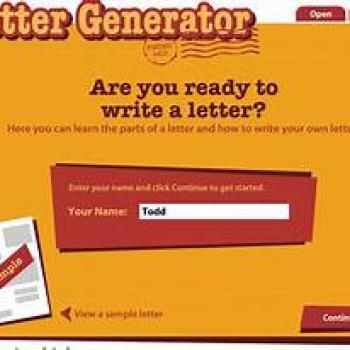
The Letter Generator tool is designed to help students learn to identify all the essential parts of a business or friendly letter, and then generate letters by typing information into letter templates. A sample letter is included, and students can learn about the parts of a letter by reading descriptions of each part.
Once students have become familiar with letter formats, they are prompted to write their own letter. Students follow the steps and fill in specific fields in the template (for example, heading, salutation, closing, signature, and so on). They may even add a decorative border and postscript to the friendly letter. The finished letter can be saved, e-mailed, or printed.
This useful tool provides step-by-step instructions for familiarizing users with the necessary elements of written correspondence, and can serve as an excellent practice method for composing and proofreading both formal and informal letters.
For ideas of how to use this tool outside the classroom, see Letter Generator in the Parent & Afterschool Resources section.
Grades 3 – 5 | Lesson Plan | Standard Lesson
Who’s Got Mail? Using Literature to Promote Authentic Letter Writing
Students discuss and chart letter elements and write their own letters to adults at school, reinforcing letter-writing skills beyond the classroom lesson.
Grades 3 – 5 | Lesson Plan | Standard Lesson
Using Writing and Role-Play to Engage the Reluctant Writer
What does the world look like through a javelina’s eyes? Students become javelinas in this lesson when they analyze a character and write from his or her perspective.
Grades 3 – 6 | Lesson Plan | Standard Lesson
Guided Comprehension: Self-Questioning Using Question-Answer Relationships
Guided comprehension moves your students beyond decoding to become independent readers. Generating questions to guide reading helps readers make connections with the text and supports independent comprehension of new texts.
Grades 4 – 6 | Lesson Plan | Standard Lesson
Guided Comprehension: Making Connections Using a Double-Entry Journal
Based on the Guided Comprehension Model by Maureen McLaughlin and Mary Beth Allen, this lesson helps students learn three types of connections (text-to-text, text-to-self, and text-to-world) using a double-entry journal.
Grades 3 – 5 | Lesson Plan | Standard Lesson
Blending Fiction and Nonfiction to Improve Comprehension and Writing Skills
Students use a text set to increase understanding of content area material and demonstrate what they have learned by writing an original piece that blends together narrative and expository elements.
Grades 3 – 5 | Lesson Plan | Standard Lesson
Investigating Junk Mail: Negotiating Critical Literacy at the Mailbox
Students increase their media literacy skills by critically examining and revising junk mail.
Grades 3 – 5 | Lesson Plan | Standard Lesson
A Genre Study of Letters With The Jolly Postman
Students read The Jolly Postman, in which a postman delivers letters to storybook characters. They explore different types of mail and categorize letters from the book and their own mail.
Grades 3 – 5 | Lesson Plan | Standard Lesson
Our Classroom: Writing an Owner’s Manual
Students write an owner’s manual that helps them get to know their classroom, provides them with a sense of ownership, and lets others know about their classroom.
Grades 3 – 5 | Lesson Plan | Standard Lesson
Dear Librarian: Writing a Persuasive Letter
Students write persuasive letters to their librarian requesting that specific texts be added to the school library. As they work, students plan their arguments and outline their reasons and examples.
Grades 3 – 5 | Lesson Plan | Unit
Zines for Kids: Multigenre Texts About Media Icons
Special edition! Students use ReadWriteThink tools to create magazines about prominent figures using a variety of writing genres and styles.
Grades 3 – 5 | Lesson Plan | Standard Lesson
Critical Perspectives: Reading and Writing About Slavery
Students critically explore the moral issue of slavery through reading fiction and nonfiction children's literature about the Underground Railroad, and they extend their understanding through creative writing projects.
Grades 3 – 5 | Lesson Plan | Standard Lesson
Cultural Connections and Writing for Change
A little understanding can go a long way. After learning about difficulties that Palestinian youths face, students will write a letter to an official discussing these issues.
Grades 9 – 12 | Lesson Plan | Unit
Using published writers’ texts and students’ own writing, this unit explores emotions that are associated with the artful and deliberate use of commas, semicolons, colons, and exclamation points (end-stop marks of punctuation).
Grades K – 8 | Student Interactive | Writing & Publishing Prose
The Postcard Creator helps students learn to identify all the typical parts of a postcard, and then generate their own postcard messages by typing information into letter templates. After printing their texts, students can illustrate the front of their postcards in a variety of ways, including drawing, collage, and stickers.
Grades 1 – 12 | Calendar Activity |  July 7
Write letters that make things happen!
In a small group or as individuals, students write letters related to a unit of study or particular topic they have studied.
Grades 9 – 12 | Calendar Activity |  December 10
Poet Emily Dickinson was born in 1830.
Students discuss Dickinson's poem "This Is My Letter To The World" and use it to focus on how audience affects voice.
Grades K – 12 | Strategy Guide
This strategy guide explains how to use shared writing to teach students effective strategies that will improve their own independent writing ability.
Grades 6 – 8 | Activity & Project
Write Letters to Friends and Family
Invite young adults to write letters to classmates, postcards from travels, and e-mails to family and friends.
Grades 3 – 5 | Activity & Project
Children learn how to make a convincing argument—an important skill in school and in life.
Grades 3 – 8 | Game & Tool
The Letter Generator shows children the key parts of a letter and lets them practice writing either a friendly or business letter.
![]()

