Skip to contentContribute to ReadWriteThink / RSS / FAQs / Technical Help / Contact Us


Technical Help

Download the plug-in tools you need to use our games and tools, or check to see if you've got the latest version.

Learn more


More Student Interactives

Looking for ways to engage your students in online literacy learning? Find more interactive tools that help them accomplish a variety of goals-from organizing their thoughts to learning about language.

More


Strategy Guides

Check out our collection of strategy guides to find effective literacy teaching and learning strategies to use in your classroom.

More


HomeClassroom ResourcesStudent Interactives

Student Interactive

Literary Elements Map
E-mail / Share / Print This Page / Print All Materials (Note: Handouts must be printed separately)


Literary Elements Map

Grades 6 – 12
Interactive Type Inquiry & Analysis
Tech Requirement
URL http://www.readwritethink.org
/files/resources/interactives
/lit-elements/

Get Started


ABOUT THIS INTERACTIVE  

Overview


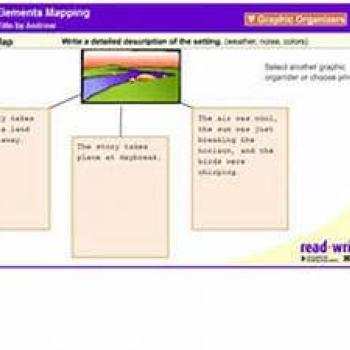
An updated version of the Story Map, this interactive best suits secondary students in literary study. The tool includes a set of graphic organizers designed to assist teachers and students in prewriting and postreading activities, focusing on the key elements of character, setting, conflict, and resolution development (shown at left). As with the Story Map, this interactive can be used in multiple contexts, whether they be author studies, genre studies, or thematic units, among others. Students can map out the key literary elements for a variety purposes, including response to literature or as a prewriting activity when composing their own fiction. After completing individual sections or the entire organizer, students have the ability to print out their final versions for feedback and assessment.

Lessons That Use This Interactive

back to top


Grades   6 – 8  |  Lesson Plan  |  Unit

Fairy Tale Autobiographies

Students read and analyze fairy tales from several cultures, identifying common elements. Choosing common situations, students write original fairy tales, using picture books as models and a peer review process.


Grades   6 – 8  |  Lesson Plan  |  Unit

Story Character Homepage

Students analyze personal homepages, as well as a character in a book they have read, and then create a homepage for the character.


Grades   6 – 8  |  Lesson Plan  |  Unit

Book Reviews, Annotation, and Web Technology

Students work in groups to create annotated book reviews with links to topics of interest related to their book.


Grades   6 – 8  |  Lesson Plan  |  Standard Lesson

Media Literacy: Examining the World of Television Teens

Pop culture and the classroom collide in this lesson when students go behind the scenes to analyze a television series for characterization to use in an original television show proposal.


Grades   6 – 8  |  Lesson Plan  |  Standard Lesson

Exploring Change through Allegory and Poetry

Students read an example of allegory, review literary concepts, complete literary elements maps and plot diagrams, create a pictorial allegory, and write diamante poems related to the theme of change.


Related Classroom & Professional Development Resources

back to top


Grades   9 – 12  |  Lesson Plan  |  Standard Lesson

Seuss and Silverstein: Posing Questions, Presenting Points

Students will enjoy this blast from the past as they read the works of Dr. Seuss and Shel Silverstein to analyze the way social issues are addressed in selected works.