http://www.readwritethink.org/classroom-resources/student-interactives/literary-elements-30011.html
Contribute to ReadWriteThink / RSS / FAQs / Site Demonstrations / Contact Us
![]()
![]()
Download the plug-in tools you need to use our games and tools, or check to see if you've got the latest version.
![]()
Looking for ways to engage your students in online literacy learning? Find more interactive tools that help them accomplish a variety of goals-from organizing their thoughts to learning about language.
![]()
Check out our collection of strategy guides to find effective literacy teaching and learning strategies to use in your classroom.
![]()
Home › Classroom Resources › Student Interactives
Student Interactive
Literary Elements Map
![]()
| Grades | 6 – 12 |
| Interactive Type | Inquiry & Analysis |
| Tech Requirement | |
| URL | http://www.readwritethink.org /files/resources/interactives /lit-elements/ |
| ABOUT THIS INTERACTIVE |
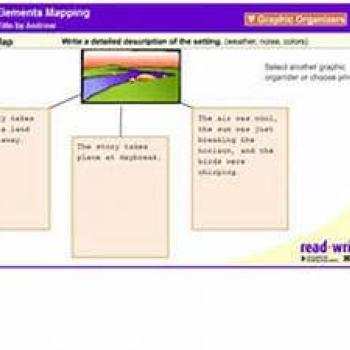
An updated version of the Story Map, this interactive best suits secondary students in literary study. The tool includes a set of graphic organizers designed to assist teachers and students in prewriting and postreading activities, focusing on the key elements of character, setting, conflict, and resolution development (shown at left). As with the Story Map, this interactive can be used in multiple contexts, whether they be author studies, genre studies, or thematic units, among others. Students can map out the key literary elements for a variety purposes, including response to literature or as a prewriting activity when composing their own fiction. After completing individual sections or the entire organizer, students have the ability to print out their final versions for feedback and assessment.
Grades 5 – 9 | Lesson Plan | Standard Lesson
Students read and analyze fairy tales from several cultures, identifying common elements. Choosing common situations, students write original fairy tales, using picture books as models and a peer review process.
Grades 9 – 12 | Lesson Plan | Standard Lesson
Novel News: Broadcast Coverage of Character, Conflict, Resolution, and Setting
This twist on readers theater has students prepare original news programs based on incidents in a recent reading, as they explore standard literary elements of character, conflict, resolution, and setting.
Grades 9 – 12 | Lesson Plan | Standard Lesson
Critical Reading: Two Stories, Two Authors, Same Plot?
Students make predictions about the stories and analyze story elements, compare and contrast the different stories, distinguish between fact and opinion, and draw conclusions supported by evidence from their readings.
Grades 9 – 12 | Lesson Plan | Standard Lesson
Teaching the Epic through Ghost Stories
In this lesson, students connect to the oral tradition of epic storytellers by sharing their own oral tales of ghosts and goblins and monsters.
Grades 9 – 12 | Lesson Plan | Unit
Students analyze the elements of a novel in many different genres and then hyperlink these pieces together on student-constructed Websites.
Grades 9 – 12 | Lesson Plan | Standard Lesson
Seuss and Silverstein: Posing Questions, Presenting Points
Students will enjoy this blast from the past as they read the works of Dr. Seuss and Shel Silverstein to analyze the way social issues are addressed in selected works.
Grades 9 – 12 | Lesson Plan | Standard Lesson
Paying Attention to Technology: Exploring a Fictional Technology
Students complete a short survey to establish their beliefs about technology. They compare their opinions to the ideas in a novel that depicts technology (such as 1984 or Fahrenheit 451).
Grades 9 – 12 | Lesson Plan | Unit
Short Story Fair: Responding to Short Stories in Multiple Media and Genres
In this activity, students read short stories and create presentations in multiple media to share in a Short Story Fair. At the fair, students explore and respond to the displays.
Grades 9 – 12 | Lesson Plan | Standard Lesson
Word Maps: Developing Critical and Analytical Thinking About Literary Characters
Students read "After Twenty Years" by O. Henry, use a word map to identify characters' qualities or traits, discuss the characters' feelings and actions, and reflect upon these in journals.
Grades 9 – 12 | Lesson Plan | Unit
Heroes Are Made of This: Studying the Character of Heroes
Designed to explore the hero and the heroic in literature, this unit asks students to discuss their ideas of heroism and analyze heroes in literature.
Grades 9 – 12 | Lesson Plan
The movie Shrek introduces the satirical techniques of exaggeration, incongruity, reversal, and parody. Students brainstorm fairy tale characteristics, identify satirical techniques, then create their own satirical versions of fairy tales.
Grades 9 – 12 | Lesson Plan | Standard Lesson
The Pros and Cons of Discussion
Students use a Discussion Web to engage in meaningful discussion of the question, "Are people equal?"
Grades 9 – 12 | Lesson Plan | Standard Lesson
Developing Characterization in Raymond Carver’s “A Small, Good Thing”
Students read Raymond Carver's story "A Small, Good Thing," focusing on characterization in order to develop one of the static charactersthe hit-and-run driver who causes Scotty’s deathmore fully.
Grades 9 – 12 | Lesson Plan | Standard Lesson
Rummaging for Fiction: Using Found Photographs and Notes to Spark Story Ideas
In this lesson, students use found notes and found photographs as inspiration to help them identify subjects, settings, characters, and conflicts for pieces of creative writing.
Grades 9 – 12 | Lesson Plan | Standard Lesson
Looking for the Byronic Hero Using Twilight's Edward Cullen
Using the character of Edward Cullen from the Twilight series, this lesson introduces the Byronic hero and asks students to compare the Byronic hero to the traditional hero and villain.
Grades 9 – 12 | Lesson Plan | Standard Lesson
I Have a Dream: Exploring Nonviolence in Young Adult Texts
Students will identify how Martin Luther King Jr.'s dream of nonviolent conflict-resolution is reinterpreted in modern texts. Homework is differentiated to prompt discussion on how nonviolence is portrayed through characterization and conflict. Students will be formally assessed on a thesis essay that addresses the Six Kingian Principles of Nonviolence.
Grades 6 – 12 | Lesson Plan | Standard Lesson
Book Report Alternative: Getting Acquainted with Farcebook
In this alternative to the traditional book report, students report on their novel choices using Facebook-like pages.
Grades 5 – 12 | Calendar Activity |  December 23
After reading Nothing But the Truth, students explore a current event topic and write their own short work of fiction in a similar multigenre format.
Grades 3 – 8 | Calendar Activity |  October 4
Edward Stratemeyer, creator of book series such as Nancy Drew, was born on this day in 1862.
Students select several books from one of Stratemeyer's series to read, discuss shared elements in the books, and use the 3-Circle Venn Diagram to compare story elements.
![]()

