http://www.readwritethink.org/classroom-resources/student-interactives/literary-graffiti-30023.html
Contribute to ReadWriteThink / RSS / FAQs / Site Demonstrations / Contact Us
![]()
![]()
Download the plug-in tools you need to use our games and tools, or check to see if you've got the latest version.
![]()
Looking for ways to engage your students in online literacy learning? Find more interactive tools that help them accomplish a variety of goals-from organizing their thoughts to learning about language.
![]()
Check out our collection of strategy guides to find effective literacy teaching and learning strategies to use in your classroom.
![]()
Home › Classroom Resources › Student Interactives
Student Interactive
Literary Graffiti
![]()
| Grades | 9 – 12 |
| Interactive Type | Organizing & Summarizing |
| Tech Requirement | |
| URL | http://www.readwritethink.org /files/resources/interactives /graffiti/ |
| ABOUT THIS INTERACTIVE |
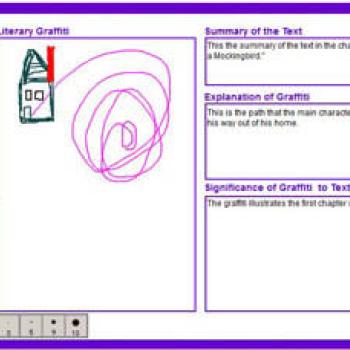
Teaching high school students to visualize what they are reading and to create graphic symbols helps them develop as readers. The Literary Graffiti interactive combines the process of drawing with analytical thinking about a text by pairing an online drawing space with writing prompts (shown at left) that encourage students to make connections between their visual designs and the text. The tool can be used for whole-class discussion of a text, small-group work, or individually, where students use "graffiti," symbols, drawings, shapes, and colors to construct a graphic of the text they are reading. After completing their individual or group images, students have the ability to print out their final versions for feedback and assessment.
Grades 9 – 12 | Lesson Plan | Standard Lesson
Graffiti Wall: Discussing and Responding to Literature Using Graphics
Tap students' desires to doodle and draw by having them create a Graffiti Wall, using graphics to discuss a piece of literature that has been read by the whole class.
Grades 9 – 12 | Lesson Plan | Standard Lesson
Discovering a Passion for Poetry With Langston Hughes
Through a study of Langston Hughes’ poetry, students connect his writing to his place in history.
Grades 9 – 12 | Lesson Plan | Standard Lesson
The Pros and Cons of Discussion
Students use a Discussion Web to engage in meaningful discussion of the question, "Are people equal?"
Grades 9 – 12 | Lesson Plan | Standard Lesson
Stairway to Heaven: Examining Metaphor in Popular Music
Students explore figurative language by examining the lyrics of popular songs.
Grades 9 – 12 | Lesson Plan | Standard Lesson
Thinking Inductively: A Close Reading of Seamus Heaney’s “Blackberry Picking”
This lesson eases students’ fear of interpreting complex poetry by teaching them a strategy with which they determine patterns of imagery, diction, and figurative language in order to unlock meaning.
Grades 9 – 12 | Lesson Plan | Standard Lesson
Teaching Student Annotation: Constructing Meaning Through Connections
Students examine text closely and create annotations to make personal and meaningful connections with the work.
Grades 9 – 12 | Lesson Plan | Standard Lesson
Creating Psychological Profiles of Characters in To Kill a Mockingbird
Students explore the motivation behind characters’ actions in To Kill A Mockingbird by creating psychological profiles for characters from the novel.
![]()