http://www.readwritethink.org/classroom-resources/student-interactives/multigenre-mapper-30047.html
Contribute to ReadWriteThink / RSS / FAQs / Site Demonstrations / Contact Us
![]()
![]()
Download the plug-in tools you need to use our games and tools, or check to see if you've got the latest version.
![]()
Looking for ways to engage your students in online literacy learning? Find more interactive tools that help them accomplish a variety of goals-from organizing their thoughts to learning about language.
![]()
Check out our collection of strategy guides to find effective literacy teaching and learning strategies to use in your classroom.
![]()
Home › Classroom Resources › Student Interactives
Student Interactive
Multigenre Mapper
![]()
| Grades | 3 – 10 |
| Interactive Type | Writing & Publishing Prose |
| Tech Requirement | |
| URL | http://www.readwritethink.org /files/resources/interactives /multigenre-mapper/ |
| ABOUT THIS INTERACTIVE |
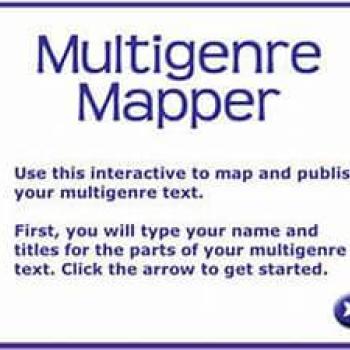
These days, when students read and write, often it is not only in one genre. Instead, the types and kinds of reading and writing intertwine and blend together. Their work becomes multigenre. In Blending Genre, Altering Style (Heinemann, 2000), Tom Romano describes how multigenre texts work: "Multigenre allows us to "meld fact, interpretation, and imagination,' into a series of self-contained pieces called crots that appear in forms that include poetry, prose, drama, and exposition" (109). This interactive invites students to create original multigenre, multimodal works-one drawing and three written texts. The tool asks students to name the genres for each section, making the tool flexible for multiple writing activities. The Multigenre Mapper Planning Sheet, a printable PDF, allows writers to draft and revise their work before going online to use the interactive.
Grades 3 – 5 | Lesson Plan | Standard Lesson
Playing with Prepositions through Poetry
Students play with and explore prepositions during a whole group reading of Ruth Heller’s Behind the Mask, and then by composing and publishing prepositional poems based on the book’s style.
Grades 3 – 5 | Lesson Plan | Standard Lesson
Using Snowflake Bentley as a Framing Text for Multigenre Writing
Using Snowflake Bentley as a model, students create a working definition of multigenre text and then use that definition to create their own multigenre piece about winter or another theme.
Grades 3 – 5 | Lesson Plan | Standard Lesson
What If We Changed the Book? Problem-Posing with Sixteen Cows
After reading a piece of math-related children’s literature aloud, students pose and solve new problems by asking what-if questions about the events in the story.
Grades 3 – 5 | Lesson Plan | Standard Lesson
Bridging Literature and Mathematics by Visualizing Mathematical Concepts
During interactive read-aloud sessions, students identify how an author conveys mathematical information about animals’ sizes and abilities. They then conduct research projects focusing on the same mathematical concepts.
Grades 3 – 5 | Lesson Plan | Unit
Literature as a Jumping Off Point for Nonfiction Inquiry
Students use text sets to research a topic inspired by a fiction book they have read. A text set is a collection of multiple text genres with a single focus.
Grades 3 – 6 | Lesson Plan | Standard Lesson
Opening the Door for Reading: Sharing Favorite Texts to Build Community
In this lesson, students build classroom community by exploring environmental print and a teacher-created display that focuses on a favorite book. They then create and share their own presentations.
Grades 3 – 5 | Lesson Plan | Standard Lesson
Our Classroom: Writing an Owner’s Manual
Students write an owner’s manual that helps them get to know their classroom, provides them with a sense of ownership, and lets others know about their classroom.
Grades 3 – 5 | Lesson Plan | Standard Lesson
Engaging Students in a Collaborative Exploration of the Gettysburg Address
In small groups, students closely examine one sentence from the Gettysburg Address and create a multigenre project communicating what they have discovered about the meaning and significance of the text.
Grades 3 – 5 | Lesson Plan | Unit
Zines for Kids: Multigenre Texts About Media Icons
Special edition! Students use ReadWriteThink tools to create magazines about prominent figures using a variety of writing genres and styles.
Grades 3 – 5 | Lesson Plan | Standard Lesson
Reading, Writing, Haiku Hiking! A Class Book of Picturesque Poems
Students learn haiku
write descriptive poems
and share with the class.
Grades 6 – 8 | Lesson Plan | Standard Lesson
Polishing Preposition Skills through Poetry and Publication
Students deepen and refine their understanding of prepositions by reading Ruth Heller's Behind the Mask. They write preposition poetry and create a study guide using an online tool.
Grades 6 – 8 | Lesson Plan | Standard Lesson
Building Vocabulary: Making Multigenre Glossaries Based on Student Inquiry
Students choose unfamiliar words from their reading and create a multigenre, multimodal glossary of terms.
Grades 6 – 8 | Lesson Plan | Standard Lesson
Blurring Genre: Exploring Fiction and Nonfiction with Diary of a Worm
After reading several examples of how a published author incorporates facts in fiction writing, students research a topic of their choice and write fictional diary entries that incorporate factual information.
Grades 6 – 12 | Lesson Plan | Recurring Lesson
Active Reading through Self-Assessment: The Student-Made Quiz
This recurring lesson encourages students to comprehend their reading through inquiry and collaboration. They choose important quotations from the text and work in groups to formulate “quiz” questions that their peers will answer.
Grades 5 – 12 | Calendar Activity |  December 23
After reading Nothing But the Truth, students explore a current event topic and write their own short work of fiction in a similar multigenre format.
Grades 9 – 12 | Calendar Activity |  December 2
David Macaulay was born in 1946.
Students use the Multigenre Mapper interactive to explore Macaulay's use of multiple genres by composing original multigenre texts.
![]()

