http://www.readwritethink.org/classroom-resources/student-interactives/persuasion-30034.html
Contribute to ReadWriteThink / RSS / FAQs / Site Demonstrations / Contact Us
![]()
![]()
Download the plug-in tools you need to use our games and tools, or check to see if you've got the latest version.
![]()
Looking for ways to engage your students in online literacy learning? Find more interactive tools that help them accomplish a variety of goals-from organizing their thoughts to learning about language.
![]()
Check out our collection of strategy guides to find effective literacy teaching and learning strategies to use in your classroom.
![]()
Home › Classroom Resources › Student Interactives
Student Interactive
Persuasion Map
![]()
| Grades | 3 – 12 |
| Interactive Type | Organizing & Summarizing |
| Tech Requirement | |
| URL | http://www.readwritethink.org /files/resources/interactives /persuasion_map/ |
| ABOUT THIS INTERACTIVE |
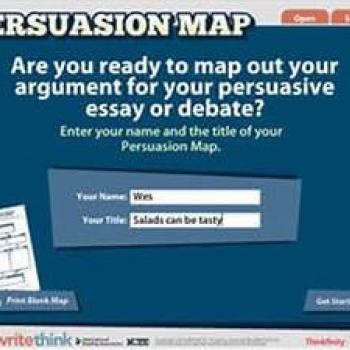
The Persuasion Map is an interactive graphic organizer that enables students to map out their arguments for a persuasive essay or debate. Students begin by determining their goal or thesis. They then identify three reasons to support their argument, and three facts or examples to validate each reason. The map graphic in the upper right-hand corner allows students to move around the map, instead of having to work in a linear fashion. The finished map can be saved, e-mailed, or printed.
Grades 6 – 8 | Lesson Plan | Unit
Expository EscapadeDetective’s Handbook
Students create a Detective's Handbook based on a detective mystery they have read. The handbooks include expository and descriptive writing, as well as a letter.
Grades 6 – 8 | Lesson Plan | Standard Lesson
Persuasive Essay: Environmental Issues
How can we convince others to agree with us on important issues? In this lesson, students explore relevant environmental issues and gather information to write persuasive essays.
Grades 6 – 8 | Lesson Plan | Standard Lesson
Exploring Free Speech and Persuasion with Nothing But the Truth
Students read Avi’s Nothing But the Truth and examine the First Amendment and student rights, and then decide whether the rights of the novel's protagonist, Philip, are violated.
Grades 3 – 10 | Lesson Plan | Standard Lesson
A Case for Reading - Examining Challenged and Banned Books
Students examine books, selected from the American Library Association Challenged/Banned Books list, and write persuasive pieces expressing their views about what should be done with the books at their school.
Grades 6 – 8 | Lesson Plan | Unit
Literary Characters on Trial: Combining Persuasion and Literary Analysis
Students stage a mock trial for a literary character, with groups of students acting as the prosecution, defense, and jury.
Grades 6 – 8 | Lesson Plan | Standard Lesson
Book Report Alternative: A Character’s Letter to the Editor
Students write a persuasive letter to the editor of a newspaper from a selected fictional character’s perspective, focusing on a specific issue or situation explored in the novel.
Grades 6 – 8 | Lesson Plan | Unit
Campaigning for Fair Use: Public Service Announcements on Copyright Awareness
Students explore a range of resources on fair use and copyright then design their own audio public service announcements (PSAs), to be broadcast over the school’s public address system.
Grades 6 – 8 | Lesson Plan | Unit
Boys Read: Considering Courage in Novels
In this lesson designed especially for boys, students read a work of realistic fiction and get to know courageous male characters through writing, Internet activities, and discussion.
Grades 6 – 8 | Lesson Plan | Unit
Crit Lit for Kids: From Critical Consciousness to Service Learning
Students take their ideas from the classroom page to the community pavement when they participate in a service-learning project based on their multimedia presentations.
Grades 6 – 8 | Lesson Plan | Standard Lesson
Copyright Law: From Digital Reprints to Downloads
Students investigate how and why copyright law has changed over time, and apply this information to recent copyright issues, creating persuasive arguments based on the perspective of a particular group.
Grades 6 – 8 | Lesson Plan | Standard Lesson
Persuading the Principal: Writing Persuasive Letters About School Issues
Students learn that you don’t have to raise your voice to raise a point. Writing a persuasive letter to your principal is a great way to get your opinions heard.
Grades 6 – 10 | Lesson Plan | Standard Lesson
Students learn how to get their voice out on the web when they research issues important to them and compose a persuasive podcast to post online.
Grades 7 – 9 | Lesson Plan | Unit
Finding Solutions to Food Waste: Persuasion in a Digital World
Using various reading strategies and resources, students explore the issue of food waste. They also create persuasive arguments and blog posts examining this topic.
Grades 9 – 12 | Lesson Plan | Standard Lesson
Demonstrating Understanding of Richard Wright's Rite of Passage
Students use the elements of persuasion for a specific audience to demonstrate their understanding of Richard Wright’s accessible and engaging coming-of-age novel, Rite of Passage.
Grades 3 – 12 | Student Interactive | Organizing & Summarizing
The Compare & Contrast Map is an interactive graphic organizer that enables students to organize and outline their ideas for different kinds of comparison essays.
Grades 3 – 12 | Student Interactive | Organizing & Summarizing
The Essay Map is an interactive graphic organizer that enables students to organize and outline their ideas for an informational, definitional, or descriptive essay.
Grades 1 – 6 | Calendar Activity |  October 13
The Beverly Cleary Sculpture Garden was dedicated on October 13, 1995.
Students select characters that they believe are the most memorable from Cleary's books and write short persuasive essays to explain their choices.
Grades 6 – 12 | Printout | Assessment Tool
Use this rubric to assess the effectiveness of a student’s essay, speech, poster, or any type of assignment that incorporates persuasion.
Grades 3 – 12 | Printout | Graphic Organizer
Use this graphic organizer to develop a persuasive stance for an essay, speech, poster, or any type of assignment that incorporates persuasion.
Grades K – 5 | Strategy Guide
This strategy guide focuses on persuasive writing and offers specific methods on how you can help your students use it to improve their critical writing and thinking skills.
Grades K – 5 | Strategy Guide
Implementing the Writing Process
This strategy guide explains the writing process and offers practical methods for applying it in your classroom to help students become proficient writers.
Grades 6 – 12 | Strategy Guide
Developing Persuasive Writing Strategies
This strategy guide describes the techniques used in effective persuasive writing and shares activities you can use to help students understand and use persuasion in their writing and critical thinking.
Grades 6 – 12 | Strategy Guide
This Strategy Guide describes the processes involved in composing and producing audio files that are published online as podcasts.
![]()

