http://www.readwritethink.org/classroom-resources/student-interactives/persuasion-30034.html
Contribute to ReadWriteThink / RSS / FAQs / Site Demonstrations / Contact Us
![]()
![]()
Download the plug-in tools you need to use our games and tools, or check to see if you've got the latest version.
![]()
Looking for ways to engage your students in online literacy learning? Find more interactive tools that help them accomplish a variety of goals-from organizing their thoughts to learning about language.
![]()
Check out our collection of strategy guides to find effective literacy teaching and learning strategies to use in your classroom.
![]()
Home › Classroom Resources › Student Interactives
Student Interactive
Persuasion Map
![]()
| Grades | 3 – 12 |
| Interactive Type | Organizing & Summarizing |
| Tech Requirement | |
| URL | http://www.readwritethink.org /files/resources/interactives /persuasion_map/ |
| ABOUT THIS INTERACTIVE |
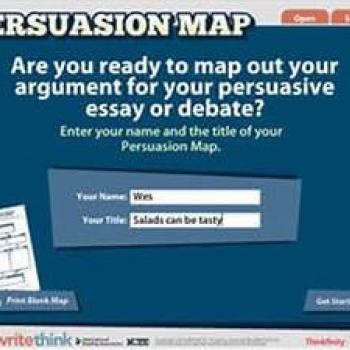
The Persuasion Map is an interactive graphic organizer that enables students to map out their arguments for a persuasive essay or debate. Students begin by determining their goal or thesis. They then identify three reasons to support their argument, and three facts or examples to validate each reason. The map graphic in the upper right-hand corner allows students to move around the map, instead of having to work in a linear fashion. The finished map can be saved, e-mailed, or printed.
Grades 9 – 12 | Lesson Plan | Standard Lesson
Propaganda Techniques in Literature and Online Political Ads
Students analyze propaganda techniques used in pieces of literature and political advertisements. They then look for propaganda in other media, such as print ads and commercials.
Grades 3 – 10 | Lesson Plan | Standard Lesson
A Case for Reading - Examining Challenged and Banned Books
Students examine books, selected from the American Library Association Challenged/Banned Books list, and write persuasive pieces expressing their views about what should be done with the books at their school.
Grades 9 – 12 | Lesson Plan | Standard Lesson
Reader Response in Hypertext: Making Personal Connections to Literature
Students write a narrative of place, a character sketch, an extended metaphor poem and a persuasive essay then link all four texts to quotations they have selected from a novel.
Grades 9 – 12 | Lesson Plan | Unit
Copyright Infringement or Not? The Debate over Downloading Music
This lesson takes advantage of students’ interest in music and audio sharing. Students investigate multiple perspectives in the music downloading debate and develop a persuasive argument for a classroom debate.
Grades 9 – 12 | Lesson Plan | Standard Lesson
Star-Crossed Lovers Online: Romeo and Juliet for a Digital Age
Explore the modern significance of an older text, such as Shakespeare’s Romeo and Juliet, by asking students to create their own modern interpretation of specific events from the drama.
Grades 9 – 12 | Lesson Plan | Standard Lesson
Persuading an Audience: Writing Effective Letters to the Editor
Students use persuasive writing and an understanding of the characteristics of letters to the editor to compose effective letters to the editor on topics of interest to them.
Grades 9 – 12 | Lesson Plan | Minilesson
Finding Common Ground: Using Logical, Audience-Specific Arguments
Using a hypothetical situation, students generate arguments from opposing points of view, discover areas of commonality using Venn diagrams, and construct logical, audience-specific arguments to persuade their opponents.
Grades 9 – 12 | Lesson Plan | Standard Lesson
Blogtopia: Blogging about Your Own Utopia
Students work together to create their own utopias, using blogs as the primary source of publication.
Grades 9 – 12 | Lesson Plan | Standard Lesson
Communicating on Local Issues: Exploring Audience in Persuasive Letter Writing
Students will research a local issue, and then write letters to two different audiences, asking readers to take a related action or adopt a specific position on the issue.
Grades 9 – 12 | Lesson Plan | Unit
Love of War in Tim O’Brien’s “How to Tell a True War Story”
Students explore the theme of love of war through texts on camaraderie among soldiers. They then compose a visual collage depicting their beliefs about the relationship between love and war.
Grades 9 – 12 | Lesson Plan | Standard Lesson
Comparing a Literary Work to Its Film Interpretation
Students will really get into the swing of things as they analyze the text and film versions of Edgar Allan Poe’s story, “The Pit and the Pendulum.”
Grades 9 – 12 | Lesson Plan | Unit
MyTube: Changing the World With Video Public Service Announcements
This assignment will go viral with students as they think about the meanings of words and images in public service announcements from YouTube before creating a PSA of their own.
Grades 9 – 12 | Lesson Plan | Unit
Designing Effective Poster Presentations
Students explore the genre of posters, review informational writing and visual design, and then design poster presentations to share in class or at a school-wide fair.
Grades 9 – 12 | Lesson Plan | Standard Lesson
Persuading Readers with Endorsement Letters
Students explore the genre of commercial endorsements, establishing characteristics and requirements for the genre. Each student then composes an endorsement of a product, service, company, or industry.
Grades 9 – 12 | Lesson Plan | Unit
Tracking the Ways Writers Develop Heroes and Villains
Everyone knows that Star Wars character Darth Vader is a villain. This lesson asks students to explore how they know such things about heroes and villains they encounter in texts.
Grades 9 – 12 | Lesson Plan | Standard Lesson
Joining the Conversation about Young Adult Literature
Students create a persuasive case calling for the adoption of a particular young adult literature title into their school’s language arts curriculum by writing letters or speeches.
Grades 6 – 10 | Lesson Plan | Standard Lesson
Students learn how to get their voice out on the web when they research issues important to them and compose a persuasive podcast to post online.
Grades 9 – 12 | Lesson Plan | Standard Lesson
Brave New Words: Novice Lexicography and the Oxford English Dictionary
Students become novice lexicographers as they explore recent new entries to the dictionary, learn the process of writing entries for the Oxford English Dictionary, and write a new entry themselves.
Grades 9 – 12 | Lesson Plan | Standard Lesson
The Great Service-Learning Debate & Research Project
Students debate about incorporating service-learning into their school’s curriculum.
Grades 9 – 12 | Lesson Plan | Standard Lesson
Developing Persuasive Arguments through Ethical Inquiry: Two Prewriting Strategies
In this lesson, students use focused prewriting strategies to explore content and ethical issues related to a persuasive assignment.
Grades 7 – 9 | Lesson Plan | Unit
Finding Solutions to Food Waste: Persuasion in a Digital World
Using various reading strategies and resources, students explore the issue of food waste. They also create persuasive arguments and blog posts examining this topic.
Grades 9 – 12 | Lesson Plan | Standard Lesson
Demonstrating Understanding of Richard Wright's Rite of Passage
Students use the elements of persuasion for a specific audience to demonstrate their understanding of Richard Wright’s accessible and engaging coming-of-age novel, Rite of Passage.
Grades 3 – 12 | Student Interactive | Organizing & Summarizing
The Compare & Contrast Map is an interactive graphic organizer that enables students to organize and outline their ideas for different kinds of comparison essays.
Grades 3 – 12 | Student Interactive | Organizing & Summarizing
The Essay Map is an interactive graphic organizer that enables students to organize and outline their ideas for an informational, definitional, or descriptive essay.
Grades 1 – 6 | Calendar Activity |  October 13
The Beverly Cleary Sculpture Garden was dedicated on October 13, 1995.
Students select characters that they believe are the most memorable from Cleary's books and write short persuasive essays to explain their choices.
Grades 6 – 12 | Printout | Assessment Tool
Use this rubric to assess the effectiveness of a student’s essay, speech, poster, or any type of assignment that incorporates persuasion.
Grades 3 – 12 | Printout | Graphic Organizer
Use this graphic organizer to develop a persuasive stance for an essay, speech, poster, or any type of assignment that incorporates persuasion.
Grades 6 – 12 | Strategy Guide
Developing Persuasive Writing Strategies
This strategy guide describes the techniques used in effective persuasive writing and shares activities you can use to help students understand and use persuasion in their writing and critical thinking.
Grades 6 – 12 | Strategy Guide
This Strategy Guide describes the processes involved in composing and producing audio files that are published online as podcasts.
Grades K – 5 | Strategy Guide
This strategy guide focuses on persuasive writing and offers specific methods on how you can help your students use it to improve their critical writing and thinking skills.
Grades K – 5 | Strategy Guide
Implementing the Writing Process
This strategy guide explains the writing process and offers practical methods for applying it in your classroom to help students become proficient writers.
![]()

