http://www.readwritethink.org/classroom-resources/student-interactives/plot-diagram-30040.html
Contribute to ReadWriteThink / RSS / FAQs / Site Demonstrations / Contact Us
![]()
![]()
Download the plug-in tools you need to use our games and tools, or check to see if you've got the latest version.
![]()
Looking for ways to engage your students in online literacy learning? Find more interactive tools that help them accomplish a variety of goals-from organizing their thoughts to learning about language.
![]()
Check out our collection of strategy guides to find effective literacy teaching and learning strategies to use in your classroom.
![]()
Home › Classroom Resources › Student Interactives
Student Interactive
Plot Diagram
![]()
| Grades | 1 – 12 |
| Interactive Type | Organizing & Summarizing |
| Tech Requirement | |
| URL | http://www.readwritethink.org /files/resources/interactives /plot-diagram/ |
| ABOUT THIS INTERACTIVE |
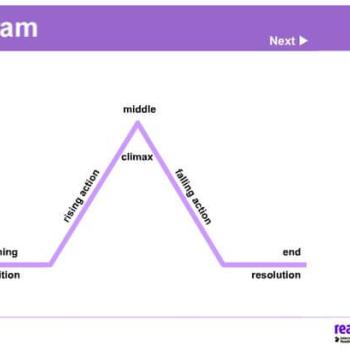
The Plot Diagram is an organizational tool focusing on a pyramid or triangular shape, which is used to map the events in a story. This mapping of plot structure allows readers and writers to visualize the key features of stories.
The basic triangle-shaped plot structure, representing the beginning, middle, and end of a story, was described by Aristotle. Gustav Freytag modified Aristotle's system by adding a rising action and a falling action to the structure. This interactive version of the graphic organizer supports both Aristotle's and Freytag's conceptualizations of plot structures.
Grades 5 – 9 | Lesson Plan | Standard Lesson
Students read and analyze fairy tales from several cultures, identifying common elements. Choosing common situations, students write original fairy tales, using picture books as models and a peer review process.
Grades 3 – 5 | Lesson Plan | Unit
Picture books provide the basis for an analysis of fairy tale elements before students write their own original tales.
Grades 3 – 5 | Lesson Plan | Standard Lesson
Looking for the History in Historical Fiction: An Epidemic for Reading
This lesson pairs the reading of historical fiction with nonfiction to introduce students to the large themes of history.
Grades 6 – 8 | Lesson Plan | Unit
Modeling Reading and Analysis Processes with the Works of Edgar Allan Poe
Explore reading strategies using Edgar Allan Poe’s “The Raven” and other works. Students read Poe’s works in both large- and small-group readings then conclude with a variety of projects.
Grades 3 – 5 | Lesson Plan | Standard Lesson
Using Picture Books to Teach Plot Development and Conflict Resolution
Students read picture books to explore the concepts of plot development and conflict resolution. They first learn about the connections between reading and writing, and then revise their own writing.
Grades 3 – 5 | Lesson Plan | Standard Lesson
Graphing Plot and Character in a Novel
In this graphical mapping project, students assign a value to the events, characters, and themes in a novel and think about how the elements of the story are all interconnected.
Grades 3 – 5 | Lesson Plan | Standard Lesson
Alter Egos and More with Avi’s "Who Was That Masked Man, Anyway?"
After reading Avi’s novel "Who Was That Masked Man, Anyway?", students create an alter ego for themselves and use it to write their own radio show, modeled after the book.
Grades 6 – 8 | Lesson Plan | Standard Lesson
Plot Structure: A Literary Elements Mini-Lesson
Students learn that the plot structure described by Freytag's Pyramid is actually quite familiar as they diagram the plots of a familiar story, a television show, and a narrative poem.
Grades 6 – 8 | Lesson Plan | Standard Lesson
Book Report Alternative: Creating a Childhood for a Character
Students explore familiar literary characters, usually first encountered as adults, but whose childhood stories are only told later. Students then create childhoods for adult characters from books of their choice.
Grades 6 – 8 | Lesson Plan | Unit
Developing Story Structure With Paper-Bag Skits
Lights, camera, action, and a bit of mystery! In this lesson, students use mystery props in a skit bag to create and perform in short, impromptu skits.
Grades 6 – 8 | Lesson Plan | Standard Lesson
Exploring Change through Allegory and Poetry
Students read an example of allegory, review literary concepts, complete literary elements maps and plot diagrams, create a pictorial allegory, and write diamante poems related to the theme of change.
Grades 6 – 8 | Lesson Plan | Unit
3-2-1 Vocabulary: Learning Filmmaking Vocabulary by Making Films
Bring the vocabulary of film to life through the processes of filmmaking. Students learn terminology and techniques simultaneously as they plan, film, and edit a short video.
Grades 5 – 8 | Lesson Plan | Standard Lesson
Audience & Purpose: Evaluating Disney's Changes to the Hercules Myth
What drives changes to classic myths and fables? In this lesson students evaluate the changes Disney made to the myth of "Hercules" in order to achieve their audience and purpose.
Grades 6 – 12 | Lesson Plan | Standard Lesson
Book Report Alternative: Rewind the Plot!
In this alternative to the traditional book report, students report on their novel choices by rewinding the plot.
Grades K – 12 | Student Interactive | Organizing & Summarizing
Students can generate descriptive timelines that can be plotted with their choice of units of measure (date, time, event, entry, or other).
Grades K – 12 | Student Interactive | Organizing & Summarizing
The Story Map interactive is designed to assist students in prewriting and postreading activities by focusing on the key elements of character, setting, conflict, and resolution.
Grades 3 – 8 | Printout | Graphic Organizer
After students read a short story or chapter of a novel, they can use the Narrative Pyramid to reflect on key ideas and details.
![]()