http://www.readwritethink.org/classroom-resources/student-interactives/printing-press-30036.html
Contribute to ReadWriteThink / RSS / FAQs / Site Demonstrations / Contact Us
![]()
![]()
Download the plug-in tools you need to use our games and tools, or check to see if you've got the latest version.
![]()
Looking for ways to engage your students in online literacy learning? Find more interactive tools that help them accomplish a variety of goals-from organizing their thoughts to learning about language.
![]()
Check out our collection of strategy guides to find effective literacy teaching and learning strategies to use in your classroom.
![]()
Home › Classroom Resources › Student Interactives
Student Interactive
Printing Press
![]()
| Grades | K – 12 |
| Interactive Type | Writing & Publishing Prose |
| Tech Requirement | |
| URL | http://www.readwritethink.org /files/resources/interactives /Printing_Press |
| ABOUT THIS INTERACTIVE |
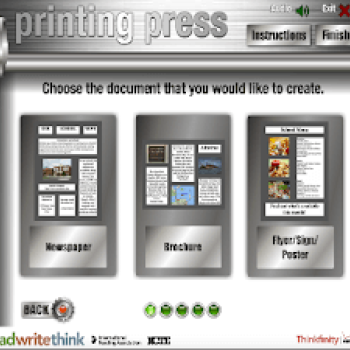
The interactive Printing Press is designed to assist students in creating newspapers, brochures, and flyers. Teachers and students can choose from several templates to publish class newspapers, informational brochures, and flyers announcing class events. Text added to the templates can be modified using a simple WYSIWYG editor, which allows students to choose text features, such as font size and color. Documentation for the Printing Press includes instructions for using the tool. Customized versions of the tool, which include additional instructions and more focused choices, are included with some lessons. A basic planning sheet is available to help students gather ideas before working on this interactive tool.
Grades 9 – 12 | Lesson Plan | Standard Lesson
Discovering Poetic Form and Structure Using Concrete Poems
This lesson uses concrete poems to explore the connection between a poem's layout and its meaning. While appropriate any time of year, the lesson is especially topical near Columbus Day.
Grades 9 – 12 | Lesson Plan | Standard Lesson
Authentic Persuasive Writing to Promote Summer Reading
Turn summer reading lists from a teacher-centered requirement to a student-driven exploration by asking students to create brochures and flyers that suggest books to explore during the summer months.
Grades 9 – 12 | Lesson Plan | Standard Lesson
The Year I Was Born: An Autobiographical Research Project
Students explore the year they were born through interviews and research, and then weave the details into a newspaper or booklet, written from another person’s point of view.
Grades 9 – 12 | Lesson Plan | Standard Lesson
A Significant Influence: Describing an Important Teacher in Your Life
In this project, students write tributes to teachers who have made a profound difference in their lives then publish their work in a class collection.
Grades 9 – 12 | Lesson Plan | Standard Lesson
Star-Crossed Lovers Online: Romeo and Juliet for a Digital Age
Explore the modern significance of an older text, such as Shakespeare’s Romeo and Juliet, by asking students to create their own modern interpretation of specific events from the drama.
Grades 9 – 12 | Lesson Plan | Standard Lesson
So What Do You Think? Writing a Review
Writing a review of an author’s work challenges students to develop their critical thinking skills. It provides an opportunity for students to speak their mindsand to enjoy being heard.
Grades 9 – 12 | Lesson Plan | Standard Lesson
Myth and Truth: The Gettysburg Address
By exploring myths and truths surrounding Abraham Lincoln’s Gettysburg Address, students think critically about commonly believed stories regarding this famous speech from the Civil War era.
Grades 9 – 12 | Lesson Plan | Standard Lesson
Put That on the List: Collaboratively Writing a Catalog Poem
Using the structure of a list poem, students combine creative expression with poetic techniques and language exploration in order to write group poems about what really matters in their lives.
Grades 9 – 12 | Lesson Plan | Standard Lesson
Put That on the List: Independently Writing a Catalog Poem
In this follow-up to writing collaborative catalog poems, students write individual catalog poems about what really matters in their lives, based on Carver’s poem “The Car.”
Grades 11 – 12 | Lesson Plan | Standard Lesson
A Poem of Possibilities: Thinking about the Future
After reading John Updike's “Ex-Basketball Player,” students write poems describing themselves five years in the future. The teacher takes the poems and mails them to students in five years.
Grades 9 – 12 | Lesson Plan | Standard Lesson
The Feature StoryFifteen Minutes (and 500 Words) of Fame!
Students learn how to differentiate between a news story and a feature story by writing a profile of a classmate.
Grades 9 – 12 | Lesson Plan | Unit
Brochures: Writing for Audience and Purpose
Students create brochures on the same topic as another piece of writing they have done, highlighting how shifting purposes and audiences creates changes in their strategies as writers.
Grades 9 – 12 | Lesson Plan | Unit
Connecting Past and Present: A Local Research Project
In this unit, students become active archivists, gathering photos, artifacts, and stories for a museum exhibit that highlights one decade in their school’s history.
Grades 9 – 12 | Lesson Plan | Unit
Ekphrasis: Using Art to Inspire Poetry
In this lesson, students explore ekphrasiswriting inspired by art. Students find pieces of art that inspire them and compose a booklet of poems about the pieces they have chosen.
Grades 9 – 12 | Lesson Plan
Persuasive Techniques in Advertising ![]()
Students will be introduced to persuasive techniques used in advertising, analyze advertising, and explore the concepts of demographics, marketing for a specific audience, and dynamic advertising.
Grades 9 – 12 | Lesson Plan | Standard Lesson
Creating Psychological Profiles of Characters in To Kill a Mockingbird
Students explore the motivation behind characters’ actions in To Kill A Mockingbird by creating psychological profiles for characters from the novel.
Grades 9 – 12 | Lesson Plan | Standard Lesson
Breaking the Rules with Sentence Fragments
Though teachers usually caution students against using sentence fragments, Edgar Schuster’s work demonstrates that professional writers often use fragments effectively. This lesson helps students understand that there are reasons that they can and should use sentence fragments to become effective writers.
Grades 6 – 12 | Lesson Plan | Standard Lesson
Book Report Alternative: Rewind the Plot!
In this alternative to the traditional book report, students report on their novel choices by rewinding the plot.
Grades K – 12 | Student Interactive | Writing & Publishing Prose
The Stapleless Book can be used for taking notes while reading, making picture books, collecting facts, or creating vocabulary booklets . . . the possibilities are endless!
Grades 3 – 12 | Student Interactive | Writing & Publishing Prose
The Flip Book is designed to allow users to type and illustrate tabbed flip books up to ten pages long. Students and teachers can use the flip book for taking notes while reading, making picture books, collecting facts, or creating question and answer booklets.
Grades 7 – 12 | Calendar Activity |  February 10
The New York Times used the slogan "All the News That's Fit to Print."
After discussing newspapers and their different points of view, students choose a current event, read editorials on the event, and share them with the class to identify the editor's point of view.
Grades 5 – 10 | Calendar Activity |  June 15
Brian Jacques, author of the Redwall series, was born in 1939.
After students have read one of Brian Jacques' Redwall stories, a class newspaper is created based on the story.
Grades 3 – 8 | Calendar Activity |  August 13
The first English printer, William Caxton, was born on this day in 1422.
Students consider how the printing press affects their world by completing a printing inventory, comparing lists, and developing a "super" list of all printed materials that they interact with.
Grades 1 – 12 | Calendar Activity |  October 1
Get ready for National Bullying Prevention Month!
Students create a poster to enter into a poster contest that educates others about issues surrounding bullying.
Grades K – 12 | Strategy Guide
This strategy guide explains how to use shared writing to teach students effective strategies that will improve their own independent writing ability.
Grades K – 3 | Strategy Guide
This strategy guide explains how to use small-group, guided writing instruction to teach students effective strategies and improve their ability to produce text independently.
![]()

