http://www.readwritethink.org/classroom-resources/student-interactives/readwritethink-notetaker-30055.html
Contribute to ReadWriteThink / RSS / FAQs / Site Demonstrations / Contact Us
![]()
![]()
Download the plug-in tools you need to use our games and tools, or check to see if you've got the latest version.
![]()
Looking for ways to engage your students in online literacy learning? Find more interactive tools that help them accomplish a variety of goals-from organizing their thoughts to learning about language.
![]()
Check out our collection of strategy guides to find effective literacy teaching and learning strategies to use in your classroom.
![]()
Home › Classroom Resources › Student Interactives
Student Interactive
ReadWriteThink Notetaker
![]()
| Grades | 3 – 12 |
| Interactive Type | Organizing & Summarizing |
| Tech Requirement | |
| URL | http://interactives.mped.org /notetaker722.aspx |
| ABOUT THIS INTERACTIVE |
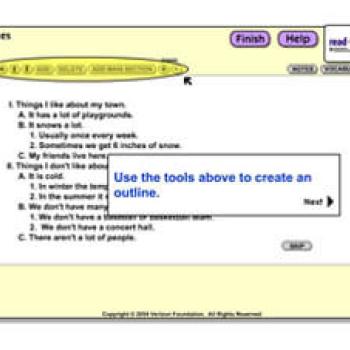
This hierarchical outlining tool allows students to organize up to five levels of information for reading and writing activities. During or after reading, the Notetaker can be used to compile and organize reading notes, research, and related ideas. During the writing process, students can use the tool to organize their information and plan texts in the prewriting stage and to review and structure their ideas during writing and revision. Students can choose the format that the outline will use (e.g., bullets, Roman numerals, letters) as well as enter up to five levels of information. The Notetaker includes a tutorial, which demonstrates how to use the tool, as well as a Notes area where students can track information that does not fit into the outline. The Notetaker creates an HTML file of students' outlines, which can be printed or saved and edited later in any HTML editor.
Grades 3 – 5 | Lesson Plan | Unit
Searching for Gold: A Collaborative Inquiry Project
Each small group of students researches one aspect of the same big topic, such as the Gold Rush, and teaches what they have learned to the rest of the class.
Grades 6 – 8 | Lesson Plan | Standard Lesson
Becoming History Detectives Using Shakespeare’s Secret
Is the case closed on the authorship of Shakespeare’s plays? Student history detectives explore the evidence for and against one of the possible alternatives, Edward deVere, using the novel Shakespeare’s Secret plus a variety of online sources.
Grades 6 – 8 | Lesson Plan | Standard Lesson
Exploring Plagiarism, Copyright, and Paraphrasing
Students investigate issues of plagiarism, fair use, and paraphrasing using KWL charts, discussion, and practice.
Grades 6 – 8 | Lesson Plan | Standard Lesson
Copyright Law: From Digital Reprints to Downloads
Students investigate how and why copyright law has changed over time, and apply this information to recent copyright issues, creating persuasive arguments based on the perspective of a particular group.
Grades 6 – 8 | Lesson Plan | Standard Lesson
Blurring Genre: Exploring Fiction and Nonfiction with Diary of a Worm
After reading several examples of how a published author incorporates facts in fiction writing, students research a topic of their choice and write fictional diary entries that incorporate factual information.
Grades 6 – 8 | Lesson Plan
Reading Through Different Lenses: Making Text Connections Across the Curriculum
Students learn to comprehend the linguistic text styles of different content areas and use the interactive ReadWriteThink Notetaker tool as the teacher models the exercise.
Grades 4 – 8 | Lesson Plan
Beyond History Books: Researching With Twin Texts and Technology
Students in grades 4–8 activate prior knowledge and research information about a historic event through fiction and nonfiction literature and exploration of relevant websites.
Grades 3 – 12 | Printout | Assessment Tool
This rubric is designed to be used for any oral presentation. Students are scored in three categories—delivery, content, and audience awareness.
Grades 6 – 12 | Strategy Guide
This Strategy Guide describes the processes involved in composing and producing audio files that are published online as podcasts.
Grades K – 12 | Strategy Guide
This strategy guide explains how to use write-aloud (also known as modeled writing) to teach effective writing strategies and improve students’ independent writing ability.
Grades 6 – 12 | Strategy Guide
The strategy examined in this Strategy Guide teaches students an outlining technique to help them differentiate between main ideas and details in their reading and writing.
Grades 6 – 12 | Strategy Guide
This Strategy Guide describes the processes involved in composing blogs in the classroom, the process of writing regular posts, or entries, that are published online.
![]()

