http://www.readwritethink.org/classroom-resources/student-interactives/readwritethink-notetaker-30055.html
Contribute to ReadWriteThink / RSS / FAQs / Site Demonstrations / Contact Us
![]()
![]()
Download the plug-in tools you need to use our games and tools, or check to see if you've got the latest version.
![]()
Looking for ways to engage your students in online literacy learning? Find more interactive tools that help them accomplish a variety of goals-from organizing their thoughts to learning about language.
![]()
Check out our collection of strategy guides to find effective literacy teaching and learning strategies to use in your classroom.
![]()
Home › Classroom Resources › Student Interactives
Student Interactive
ReadWriteThink Notetaker
![]()
| Grades | 3 – 12 |
| Interactive Type | Organizing & Summarizing |
| Tech Requirement | |
| URL | http://interactives.mped.org /notetaker722.aspx |
| ABOUT THIS INTERACTIVE |
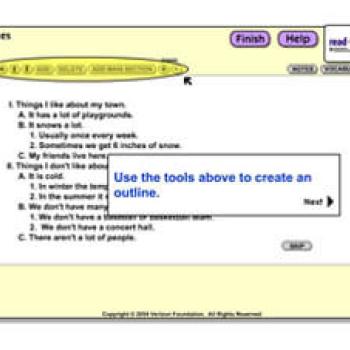
This hierarchical outlining tool allows students to organize up to five levels of information for reading and writing activities. During or after reading, the Notetaker can be used to compile and organize reading notes, research, and related ideas. During the writing process, students can use the tool to organize their information and plan texts in the prewriting stage and to review and structure their ideas during writing and revision. Students can choose the format that the outline will use (e.g., bullets, Roman numerals, letters) as well as enter up to five levels of information. The Notetaker includes a tutorial, which demonstrates how to use the tool, as well as a Notes area where students can track information that does not fit into the outline. The Notetaker creates an HTML file of students' outlines, which can be printed or saved and edited later in any HTML editor.
Grades 9 – 12 | Lesson Plan | Standard Lesson
Audio Listening Practices: Exploring Personal Experiences with Audio Texts
Students keep a daily diary that records how and when they listen to audio texts, then analyze the details and compare their results to published reports on American radio listeners.
Grades 9 – 12 | Lesson Plan | Standard Lesson
Writing about Writing: An Extended Metaphor Assignment
After discussing the poem “The Writer” by Richard Wilbur, students analyze their own writing habits and create an extended metaphor describing themselves as writers.
Grades 9 – 12 | Lesson Plan | Standard Lesson
Blogtopia: Blogging about Your Own Utopia
Students work together to create their own utopias, using blogs as the primary source of publication.
Grades 9 – 12 | Lesson Plan | Unit
Family Memoir: Getting Acquainted With Generations Before Us
Creating a memoir of an older family member allows students both to learn more about their own backgrounds and to learn the power of storytellers.
Grades 9 – 12 | Lesson Plan | Unit
Connecting Past and Present: A Local Research Project
In this unit, students become active archivists, gathering photos, artifacts, and stories for a museum exhibit that highlights one decade in their school’s history.
Grades 9 – 12 | Lesson Plan | Standard Lesson
Gaining Background for the Graphic Novel Persepolis: A WebQuest on Iran
To prepare students for reading the graphic novel Persepolis, this lesson uses a WebQuest to focus students' research on finding reliable information about Iran before and during the Islamic Revolution.
Grades 9 – 12 | Lesson Plan | Standard Lesson
Creative Outlining-From Freewriting to Formalizing
After reading a short story, students use freewriting as a catalyst for a literary analysis essay.
Grades 9 – 12 | Lesson Plan | Unit
Designing Effective Poster Presentations
Students explore the genre of posters, review informational writing and visual design, and then design poster presentations to share in class or at a school-wide fair.
Grades 9 – 12 | Lesson Plan | Standard Lesson
By analyzing Dear Abby’s “rant” about bad grammar usage, students become aware that attitudes about race, social class, moral and ethical character, and “proper” language use are intertwined.
Grades 9 – 12 | Lesson Plan | Standard Lesson
Analyzing and Comparing Medieval and Modern Ballads
Students explore the ballads genre by reading medieval ballads to deduce their characteristics, acting out the ballads, comparing medieval and modern ballads using Venn diagrams, and composing their own ballads.
Grades 9 – 12 | Lesson Plan | Standard Lesson
Writing Technical Instructions
Students walk through the process of creating technical instructions by analyzing existing instructions, choosing an audience, writing their own instructions, receiving user feedback, and then revising and publishing their instructions.
Grades 9 – 12 | Lesson Plan | Unit
Help Wanted: Writing Professional Resumes
Students will create a beginning resume that represents their current work experience and demonstrates their knowledge of rhetorical situations for professional writing.
Grades 9 – 12 | Lesson Plan | Standard Lesson
All’s Well that Sells Well: A Creative Introduction to Shakespeare
Students compare attending a performance at The Globe Theater with attending a modern theater production or movie. They then create a commercial for an Elizabethan audience promoting a modern product.
Grades 9 – 12 | Lesson Plan | Standard Lesson
Constructing New Understanding Through Choral Readings of Shakespeare ![]()
After reading The Tempest or any other play by William Shakespeare, students work in small groups to plan, compose, and perform a choral reading based on a character or theme.
Grades 9 – 12 | Lesson Plan | Standard Lesson
Speaking Poetry: Exploring Sonic Patterns Through Performance
Using their voices as interpretive instruments, students gain a deeper appreciation of the art of poetry as they prepare a recitation of the frequently anthologized poem “Those Winter Sundays.”
Grades 9 – 12 | Lesson Plan | Standard Lesson
Analyzing Famous Speeches as Arguments
Students are often asked to perform speeches, but rarely do we require students to analyze speeches as carefully as we study works of literature. In this unit, students are required to identify the rhetorical strategies in a famous speech and the specific purpose for each chosen device. They will write an essay about its effectiveness and why it is still famous after all these years.
Grades 11 – 12 | Lesson Plan | Standard Lesson
Professional Writing in Action! Publishing Student Reviews Online
Writing professional reviews teaches students to understand audience, content, and publication guidelines. In this lesson, students put these into practice as professional writers critiquing, designing, and publishing reviews on Amazon.com.
Grades 10 – 12 | Lesson Plan | Unit
Seeking Social Justice Through Satire: Jonathan Swift’s “A Modest Proposal”
This lesson assists advanced students in grades 10–12 in comprehending Jonathan Swift’s “A Modest Proposal” and developing a presentation to satirize a contemporary social issue.
Grades 3 – 12 | Printout | Assessment Tool
This rubric is designed to be used for any oral presentation. Students are scored in three categories—delivery, content, and audience awareness.
Grades 6 – 12 | Strategy Guide
This Strategy Guide describes the processes involved in composing blogs in the classroom, the process of writing regular posts, or entries, that are published online.
Grades 6 – 12 | Strategy Guide
This Strategy Guide describes the processes involved in composing and producing audio files that are published online as podcasts.
Grades K – 12 | Strategy Guide
This strategy guide explains how to use write-aloud (also known as modeled writing) to teach effective writing strategies and improve students’ independent writing ability.
Grades 6 – 12 | Strategy Guide
The strategy examined in this Strategy Guide teaches students an outlining technique to help them differentiate between main ideas and details in their reading and writing.
![]()

