http://www.readwritethink.org/classroom-resources/student-interactives/readwritethink-webbing-tool-30038.html
Contribute to ReadWriteThink / RSS / FAQs / Site Demonstrations / Contact Us
![]()
![]()
Download the plug-in tools you need to use our games and tools, or check to see if you've got the latest version.
![]()
Looking for ways to engage your students in online literacy learning? Find more interactive tools that help them accomplish a variety of goals-from organizing their thoughts to learning about language.
![]()
Check out our collection of strategy guides to find effective literacy teaching and learning strategies to use in your classroom.
![]()
Home › Classroom Resources › Student Interactives
Student Interactive
ReadWriteThink Webbing Tool
![]()
| Grades | 3 – 12 |
| Interactive Type | Organizing & Summarizing |
| Tech Requirement | |
| URL | http://interactives.mped.org /webbing127.aspx |
| ABOUT THIS INTERACTIVE |
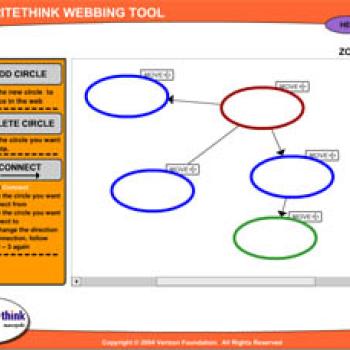
The Webbing Tool provides a free-form graphic organizer for activities that ask students to pursue hypertextual thinking and writing. The tool provides a quick way for students to trace out options and rearrange connections. Students can use the Webbing Tool to analyze readings as well as a prewriting activity and flowcharting tool. Students can drag the circle or box shapes representing their ideas to arrange any layout and relationship that they want. Each layer on the chart will have a different color border for the shapes that you choose. Customized versions of the tool, which include additional instructions and more focused choices, are included with some lessons.
Grades 6 – 8 | Lesson Plan | Standard Lesson
Weaving the Threads: Integrating Poetry Annotation and Web Technology
Students read a poem by a Native American, explore Native American culture and then create a Website that explains words and phrases from the poem.
Grades 6 – 8 | Lesson Plan | Unit
Choose Your Own Adventure: A Hypertext Writing Experience
Students analyze "choose your own adventure" stories and brainstorm to develop setting, characters, and plots for their own adventures stories and related Websites.
Grades 6 – 8 | Lesson Plan | Unit
Investigating the Holocaust: A Collaborative Inquiry Project
Students explore a variety of resources as they learn about the Holocaust. Working collaboratively, they investigate the materials, prepare oral responses, and produce a topic-based newspaper to complete their research.
Grades 6 – 8 | Lesson Plan | Standard Lesson
Focusing Reader Response Through Vocabulary Analysis
Students suggest and categorize words that they associate with a novel they have recently read, ranging from details about the plot to feelings about a character.
Grades 3 – 5 | Lesson Plan | Standard Lesson
Delicious, Tasty, Yummy: Enriching Writing with Adjectives and Synonyms
Students thoroughly explore identifying synonyms and adjectives before using them to add variety and interest to their own writing.
Grades 3 – 5 | Lesson Plan | Standard Lesson
Exploring Cause and Effect Using Expository Texts About Natural Disasters
Students explore the nature and structure of expository texts that focusing on cause and effect and apply what they learned using graphic organizers and writing paragraphs to outline cause-and-effect relationships.
Grades 6 – 8 | Lesson Plan | Standard Lesson
Exploring Change through Allegory and Poetry
Students read an example of allegory, review literary concepts, complete literary elements maps and plot diagrams, create a pictorial allegory, and write diamante poems related to the theme of change.
Grades 6 – 8 | Lesson Plan | Standard Lesson
Textmasters: Shaking Up Textbook Reading in Science Classrooms
Engage students in content area reading with the Textmasters strategy, which allows students to collaborate with their peers in different roles that enable better understanding of the content.
Grades 4 – 8 | Lesson Plan
Beyond History Books: Researching With Twin Texts and Technology
Students in grades 4–8 activate prior knowledge and research information about a historic event through fiction and nonfiction literature and exploration of relevant websites.
![]()